

Intrinsically Safe vs Flameproof Lighting: Ex i vs Ex d Compared
The two most-cited protection concepts solve the ignition problem in opposite ways: one limits the energy to an extremely low level — so low that even an open-circuit or short-circuit fault cannot become an ignition source — and the other contains the blast. Choosing between them — or knowing when you don't have a choice — is a basic hazardous area engineering skill.
How Intrinsically Safety (Ex i) Works
Intrinsic safety caps the available energy in a circuit — voltage, current and stored charge — below the minimum ignition energy of the surrounding gas, under normal operation and defined fault conditions. Barriers or certified designs limit sparks and surface temperatures.
The consequence is fundamental: Ex i is a low-power game. It dominates in instrumentation (4–20 mA loops, sensors, gas detectors) and small portable lights. A 150 W area luminaire simply cannot be made intrinsically safe with practical electronics.
How Flameproofing (Ex d) Works
Flameproof enclosures take the opposite bet: an internal explosion is allowed to happen. The enclosure withstands the pressure and its machined flame paths (joints between housing parts, threaded entries) cool escaping gases below ignition temperature. The explosion never leaves the box.
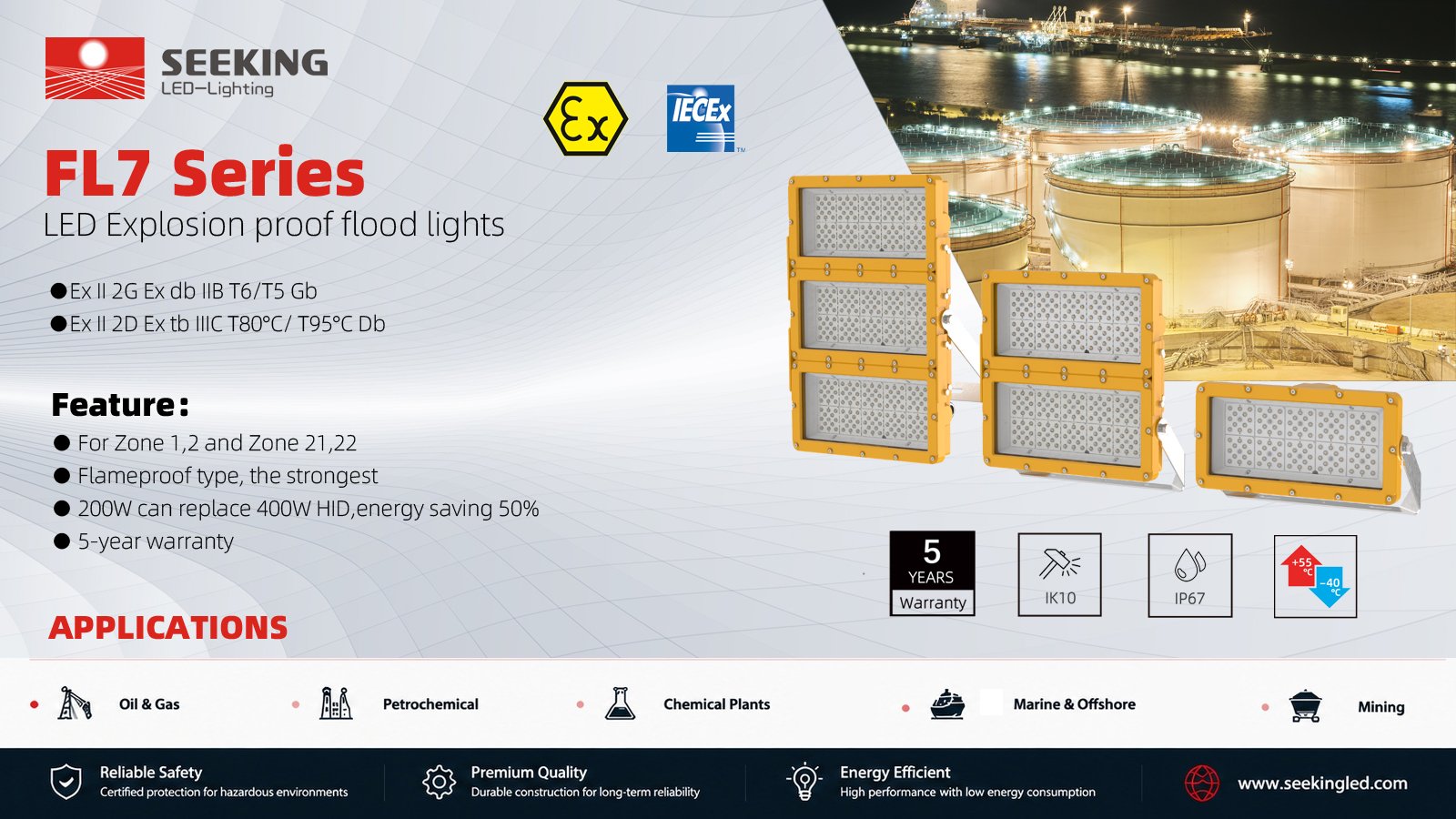
Ex d is the classic method for full-power lighting: FL7 Ex db flood lights, high bays, well-glass fittings. Modern LED versions inherit the flamepath engineering but run far cooler than HID equivalents, easing T-class compliance.
Side-by-Side Comparison
| Attribute | Intrinsically safe (Ex i) | Flameproof (Ex d) |
|---|---|---|
| Ignition strategy | Energy always below ignition threshold | Contains internal explosion |
| Typical power levels | Milliwatts to ~20 W | 20 W to 400+ W |
| Zones permitted | 0, 1, 2 (with ia/ib levels) | 1, 2 (Gb) |
| Live maintenance | Yes — can be worked on energised | No — de-energise or permit required |
| Cost driver | Certified barriers and drivers | Housing machining and testing |
| Typical lighting use | Hand lamps, task lights, torches | Floods, high bays, linear lights |
| Weight | Light | Heavy — pressure-rated housing |
Zone Permissions at a Glance
| Zone | Ex i | Ex d | Also acceptable |
|---|---|---|---|
| Zone 0 | ✔ (Ex ia) | ✘ | Ex ma encapsulation |
| Zone 1 | ✔ | ✔ | Ex eb increased safety |
| Zone 2 | ✔ | ✔ (over-spec) | Ex nR — best value |
How to Choose: A Decision Tree
- Zone 0? → Ex ia is effectively mandatory; for lighting, this rarely applies (there is usually no reason to light the inside of a tank)
- Need to work on it live? → Ex i removes the permit burden
- Area lighting >20 W in Zone 1? → Ex db (flameproof) flood/high-bay/linear families
- Zone 2 only? → Ex nR fixtures such as the FL8 series deliver compliance at the lowest cost — don't buy Ex d you don't need
- Portable inspection lighting? → Ex i hand lamps for confined spaces; Ex db/nR portable work lights for higher output
| Decision | Protection concept | Typical lighting fix |
|---|---|---|
| Zone 1 area lighting, no live maintenance needed | Ex db (flameproof) | FL7 floods, LO / BAY51 pendants |
| Zone 2 area lighting, budget-driven | Ex nR (non-sparking) | FL8 floods, LU linears |
| Confined-space inspection on live equipment | Ex i (intrinsically safe) | Hand lamps, inspection torches |
Frequently Asked Questions
What is the difference between intrinsically safe and flameproof?
Intrinsically safe (Ex i) equipment limits the electrical energy in circuits so it can never ignite a gas mixture — even under fault conditions. Flameproof (Ex d) equipment allows internal ignition but contains it inside a certified enclosure that cools the flame before it escapes. Ex i limits the energy to an extremely low level, so even an open-circuit or short-circuit fault cannot become an ignition source; Ex d contains the explosion.
Is intrinsically safe better than flameproof?
Neither is universally better. Ex i is the only option for Zone 0 and suits low-power devices (indicators, sensors, small task lights). Ex d handles full mains-powered luminaires in Zone 1 and is the workhorse of industrial lighting. Most lighting projects use Ex d or Ex e for Zone 1 and Ex nR for Zone 2.
Are there intrinsically safe LED lights?
Yes, but power is the constraint: intrinsic safety caps the energy in the circuit, so Ex i lighting is limited to low-lumen task lights, hand lamps and portable inspection lights. For area lighting at 100–300 W, Ex db or Ex nR are the applicable methods.
Which is cheaper, Ex i or Ex d?
For equivalent light output, Ex d fixtures are more cost-effective above roughly 20 W because Ex i requires energy-limiting barriers and certified low-energy drivers that don't scale with power. Below that threshold — hand lamps, torches, panel lights — Ex i is often the simpler, cheaper route.
Can I use flameproof lights in Zone 2?
Yes. Ex db equipment is Category 2 (Gb) and may be used in Zone 1 and Zone 2. But for pure Zone 2 areas, Ex nR (Gc) fixtures achieve compliance at a lower cost, weight and installation effort — over-specifying Zone 1 gear across a Zone 2 site wastes 30–60% of the lighting budget.
Get a Quote for Your Project
Send us your hazardous area classification (zone, gas group, temperature class) and target lux levels — our engineers will reply with a full lighting layout and FOB Shenzhen quotation within 24 hours.
Email: sales02@seekingled.com | Exporting to 70+ countries · 1,000,000+ units shipped per year
- About Us
- Products
- Explosion proof light
- Portable explosion proof lighting
- Explosion proof emergency light
- Explosion proof LED T8 tube
- Explosion proof Junction Box
- Explosion proof street light
- Service
- FAQ
- Docs download
Service hotline
Tel:+86 755 29846615
Work time:9:00-20:00
E-mail:sales02@seekingled.com
address:5F, Building 5, Guole Science and Technology Park, Lirong Road, Dalang Street, Longhua, Shenzhen, China