

Explosion Proof Lights: The Buyer's Guide for 2026 Projects
Buying explosion proof lights is a compliance decision before it is a lighting decision. This guide walks the full procurement path — from area classification to supplier verification and total cost of ownership — based on what certified manufacturers actually get asked on live projects.
Step 1: Match the Zone to the Equipment Category
Every genuine quotation starts from the area classification drawing. Convert zones to required protection:
| Your zone | Minimum marking | Typical LED solution |
|---|---|---|
| Zone 0 / 20 | Ex ia / Ex ma (Ga) | Intrinsically safe or encapsulated — rarely lighting |
| Zone 1 / 21 | Ex db, Ex eb (Gb) | Flameproof or increased-safety floods, high bays, linear lights |
| Zone 2 / 22 | Ex nR, Ex ic (Gc) | Non-sparking restricted-breathing — best value LED range |
Two mistakes we see repeatedly: over-specifying Zone 1 fittings across an entire site that is mostly Zone 2 (wasting 30–60% of the budget), and under-specifying general industrial lights into Zone 2 because "it's only occasionally hazardous" — a direct compliance violation.
Step 2: Decode the LED Spec Sheet
Certified LED fixtures should be compared on:
| Spec | What good looks like | Red flags |
|---|---|---|
| Lumens per fixture | 13,000–42,000 lm for 100–300 W floods | No lm/W stated; 'excellent brightness' language |
| Efficacy | ≥130 lm/W for quality LED | Below 110 lm/W = old-generation LED |
| Driver | Isolated constant-current, 100–277 VAC, surge ≥4 kV | No surge spec; 'driver included' unqualified |
| T-class at full load | T6 or T5 at rated wattage | T-rating only at derated wattage |
| IP rating | IP67 minimum outdoors | IP65 for exposed offshore/marine use |
| Warranty | 3–5 years | 1 year or silent |
Step 3: Choose the Right Product Family
Mapping the four core families to project applications:
| Family | Power range | Zones | Best applications |
|---|---|---|---|
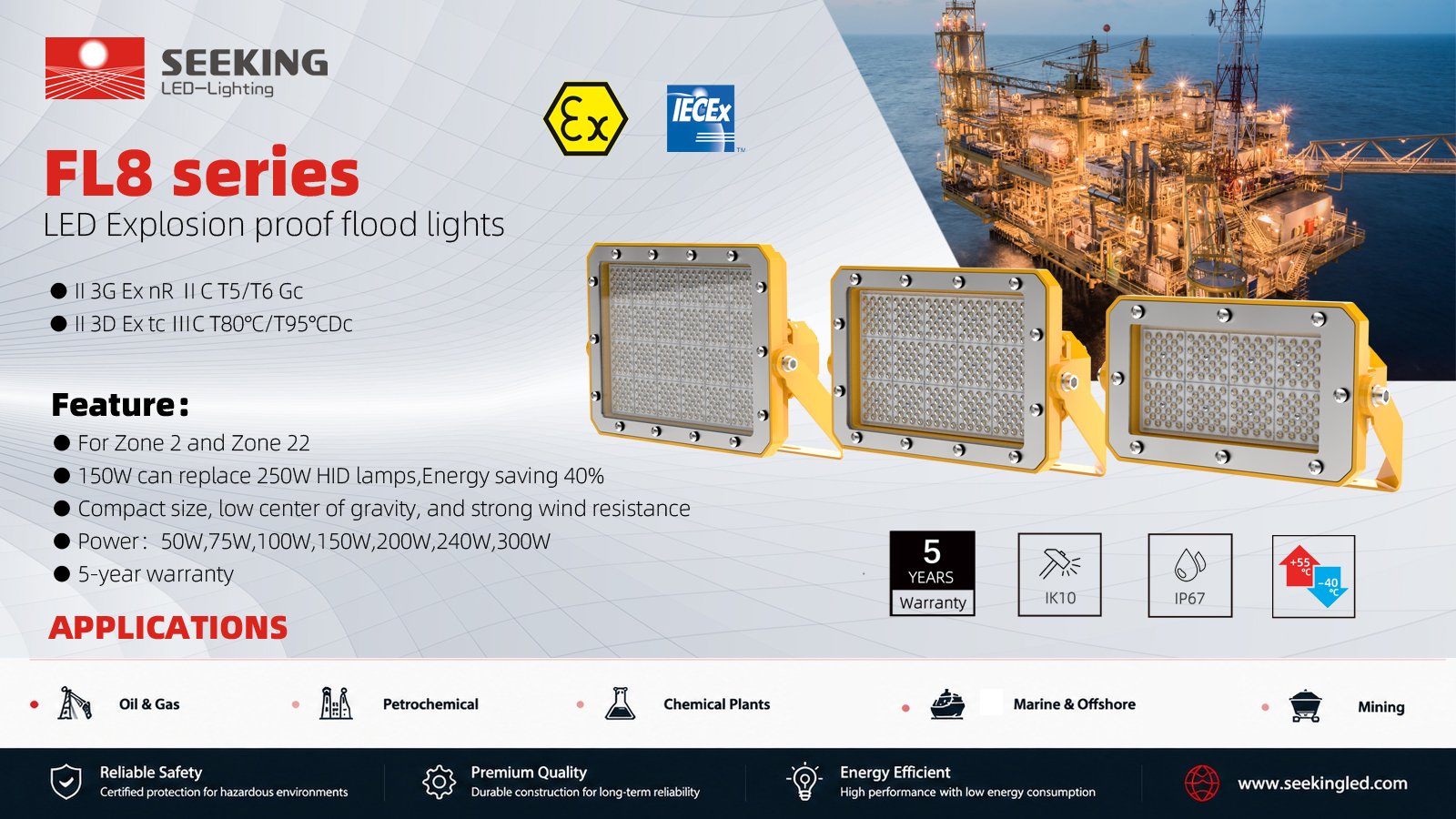
| Flood light (Ex db / Ex nR) | 50–400 W | 1/2 & 21/22 | Perimeter, derrick, tank farm, loading bays |
| High bay (Ex db) | 15–300 W | 1/21 | Hazardous warehouses, production halls |
| Canopy light (Ex nR) | 100–200 W | 2/22 | Petrol station forecourts |
| Linear light (Ex db / Ex nR) | 20–60 W | 1/2 | Pipe racks, corridors, workshops, paint booths |
Drill-down pages for the two most-specified families: BAY51 flameproof pendant light (Zone 1/21) and LU LED linear light (Zone 2/22).
Step 4: Supplier Due Diligence (5 Checks)
- Certificates: ATEX (e.g. TÜV CY 26 ATEX 0207611 X) or IECEx — verify the number on the issuing body's public database; model numbers must match
- Manufacturing scale: a factory shipping ~1 million fixtures a year to 70+ countries has the process control that certification assumes (SEEKINGLED reference point: 0.3% defect rate)
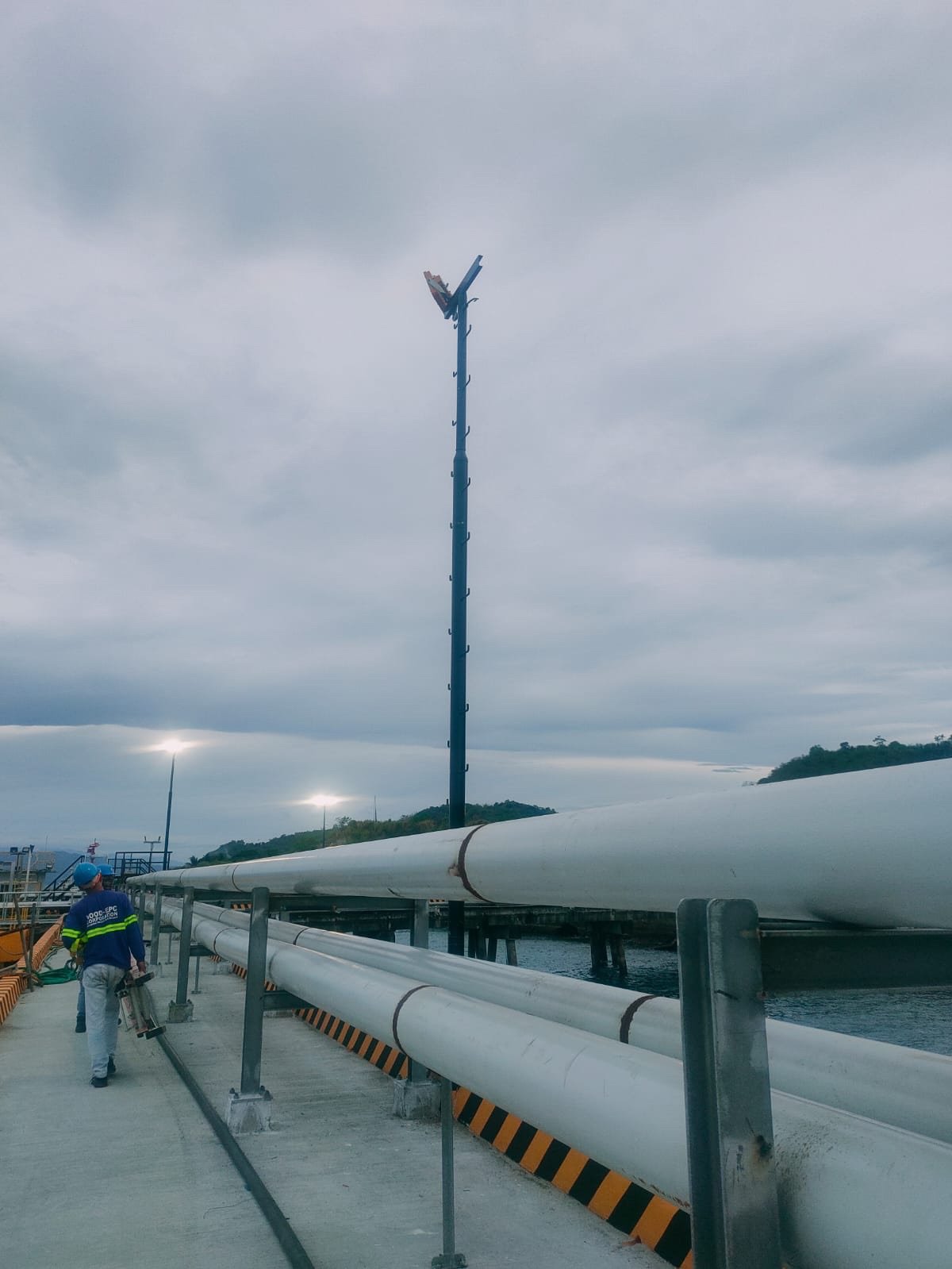
- Project record: real installations with photos and destinations — e.g. FL8 floods shipped to a Philippine power plant project; LO linear lights deployed in the UAE
- Engineering response: send a layout request; a real manufacturer returns DIALux calculations and IES files, not just a price list
- Spares & support: confirm driver/LED module availability for 5+ years and warranty claim process
Step 5: Total Cost of Ownership
Certified fixtures cost more upfront but LED pays back through power and maintenance:
| Cost item | 400 W metal halide flood | 200 W LED explosion proof flood |
|---|---|---|
| Energy (4,000 h/yr, $0.10/kWh) | $160/yr | $80/yr |
| Relamping | Every 1.5–2 yr, hot work permit in hazardous area | 100,000 h L70 — typically no relamp |
| Hazardous-area labour | Permit + 2 technicians per lamp change | Near zero |
| 10-year TCO per fixture | ≈$2,400+ | ≈$1,000 incl. fixture |
In most industrial tariffs, LED payback lands between 18 and 30 months — faster where relamping requires hot-work permits.
Step 6: Ordering Checklist
- Zone / gas group / T-class confirmed against classification drawing
- Model numbers on certificates match quotation line items
- Photometric layout approved (lux uniformity at working plane)
- FOB/CIF terms, volume tier pricing, lead time in writing
- Spare parts ratio agreed (1–3%)
- Marking labels and installation drawings included in shipment docs
Frequently Asked Questions
What are explosion proof lights?
Explosion proof lights are certified light fixtures that cannot ignite flammable gases, vapors or dusts around them. The housing either contains any internal explosion (Ex d), limits surface temperature, restricts gas ingress (Ex nR), or limits electrical energy (Ex i). They are mandatory in Zone 0/1/2 and Zone 20/21/22 areas under ATEX, IECEx or NEC rules.
How much do explosion proof lights cost?
Certified LED explosion proof lights range roughly from $150 for small Zone 2 fittings to $600 for high-wattage Zone 1 flood lights, FOB China. Volume tiers (typically 100+ or 500+ units) bring significant reductions. Always budget for certified spares — 1–3% of the project quantity is standard practice.
Zone 1 vs Zone 2 lights: what is the price difference?
Zone 1 (Ex db) fixtures cost 30–60% more than equivalent Zone 2 (Ex nR) fixtures because flameproof housings need certified flame paths and heavier construction. If your area classification drawing shows Zone 2, do not over-specify — the savings on a 500-fixture project are substantial.
How do I verify an explosion proof light is genuinely certified?
Ask for the ATEX/IECEx certificate PDF and check: the model number matches the nameplate, the certificate is issued by a real notified body (verify the 4-digit body code), and the certificate is still valid on the issuer's public database. Counterfeit markings are common in low-price quotations.
Which countries require which certification?
EU requires ATEX. The Middle East, Southeast Asia, Australia and most of Africa/Asia accept IECEx. North America requires UL/ETL to NEC Class/Division or zone standards. For projects spanning regions, dual-certified product lines (like SEEKINGLED's LO linear series, ATEX + IECEx) simplify procurement.
Get a Quote for Your Project
Send us your hazardous area classification (zone, gas group, temperature class) and target lux levels — our engineers will reply with a full lighting layout and FOB Shenzhen quotation within 24 hours.
Email: sales02@seekingled.com | Exporting to 70+ countries · 1,000,000+ units shipped per year
- About Us
- Products
- Explosion proof light
- Portable explosion proof lighting
- Explosion proof emergency light
- Explosion proof LED T8 tube
- Explosion proof Junction Box
- Explosion proof street light
- Service
- FAQ
- Docs download
Service hotline
Tel:+86 755 29846615
Work time:9:00-20:00
E-mail:sales02@seekingled.com
address:5F, Building 5, Guole Science and Technology Park, Lirong Road, Dalang Street, Longhua, Shenzhen, China