

Main Explosion-Proof Types and Working Principles of Explosion-Proof Lights
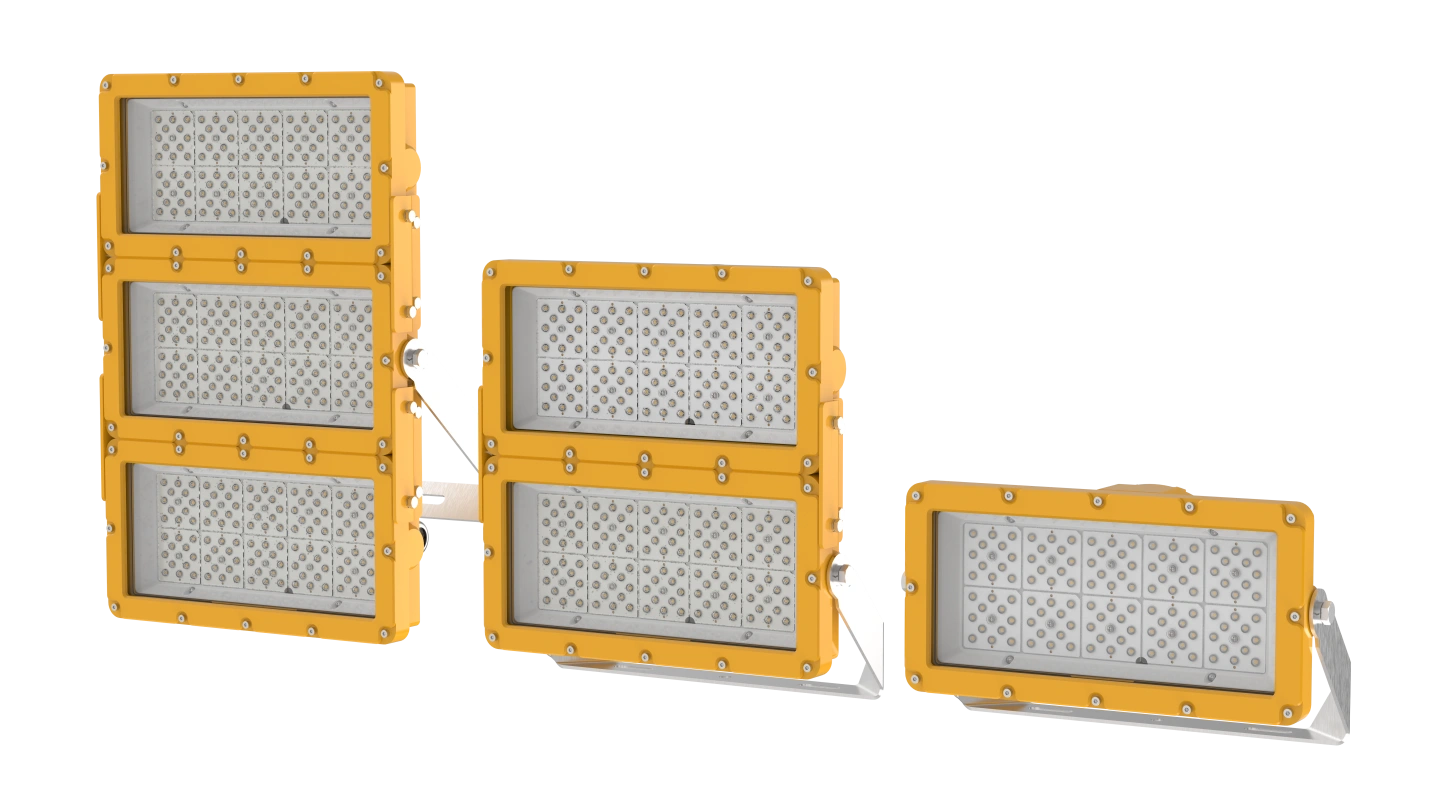
Explosion-proof lights prevent explosions primarily by ensuring the luminaire itself does not become an ignition source for the surrounding hazardous atmosphere. Below is a technical overview of the main protection methods used in hazardous area lighting:
1. Flameproof Enclosure — Ex d
Principle: Allows an internal explosion but prevents flame propagation to the external atmosphere.
- The lamp uses a robust, high-strength metal enclosure (typically die-cast aluminum or stainless steel) capable of withstanding the pressure of an internal explosion.
- All joints, flanges, and threaded covers feature precisely engineered flame paths (narrow, long gaps). Hot explosion gases and flames are cooled and their energy is reduced below the ignition temperature of the external mixture as they pass through these gaps.
- Most commonly used for high-power lighting in Zone 1 areas.
2. Increased Safety — Ex e
Principle: Prevents the generation of sparks, arcs, or excessive surface temperatures under both normal and fault conditions.
- Achieved through enhanced insulation, temperature-controlled design, high-integrity terminals, and robust mechanical construction.
- Often combined with other types (e.g., Ex de) for terminal boxes and supporting components.
3. Encapsulation / Potting — Ex m
Principle: Hazardous electrical components are completely encapsulated in resin or compound, physically isolating them from the explosive atmosphere.
- Even if an internal fault occurs, sparks or heat cannot reach the surrounding gas or dust.
- Commonly applied to LED drivers, small modules, and emergency circuits. It offers low maintenance but requires effective thermal management.
4. Type n Protection — Ex n
Principle: Simplified protection for lower-risk areas through energy limitation and prevention of ignition-capable sparks.
Main variants:
- Ex nA: Non-sparking — no arcs or sparks during normal operation.
- Ex nR: Restricted breathing — the enclosure limits gas exchange so internal concentration stays below explosive levels.
Primarily intended for Zone 2 areas where explosive atmospheres are unlikely and of short duration.
5. Other Common Types
- Intrinsic Safety — Ex i: Strictly limits electrical energy to levels too low to cause ignition, even under fault conditions. Mainly used for portable lights and low-power devices.
- Dust Explosion Protection (Zones 21/22): Uses Ex tb / Ex tc "protection by enclosure" combined with strict surface temperature control.
Summary Table
| Protection Type | Code | Core Principle | Typical Zone | Common Applications |
|---|---|---|---|---|
| Flameproof | Ex d | Contains & cools internal explosion | Zone 1/2 | High-power floodlights, bulkheads |
| Increased Safety | Ex e | Prevents sparks & hot surfaces | Zone 1/2 | Terminal boxes, auxiliary parts |
| Encapsulation | Ex m | Fully potted electrical components | Zone 1/2 | LED drivers, compact modules |
| Type n | Ex n | Non-sparking + energy limitation | Zone 2 | Lower-risk area lighting |
| Intrinsic Safety | Ex i | Energy limitation | Zone 0/1/2 | Portable & emergency lights |
Important Notes
- Modern LED explosion-proof luminaires frequently use combined protection methods (e.g., Ex de mb n) to balance safety, cost, and performance.
- Explosion-proof lights cannot withstand an external explosion. Their only purpose is to prevent the luminaire from igniting the surrounding hazardous atmosphere.
- Proper selection must always match the exact Zone, gas/dust group (IIA/IIB/IIC), and temperature class (T1–T6).
- Products
- Explosion proof light
- Portable explosion proof lighting
- Explosion proof emergency light
- Explosion proof LED T8 tube
- Explosion proof Junction Box
- Explosion proof street light
- Service
- FAQ
- Docs download
Service hotline
Tel:+86 755 29846615
Work time:9:00-20:00
E-mail:sales02@seekingled.com
address:5F, Building 5, Guole Science and Technology Park, Lirong Road, Dalang Street, Longhua, Shenzhen, China