

Explosion Proof Lighting for Paint Booths: Requirements and Product Choices
Spray booths concentrate everything that makes lighting difficult: ignitable vapour, sticky overspray, aggressive cleaning chemicals and a zone classification that starts at the gun. This guide sets out the requirements and the LED options that satisfy them.
Why Spray Areas Are Classified Zone 1
Paint spraying creates an aerosol of flammable liquid in air — close to ideal ignition conditions. Classification practice (NFPA 70, IEC 60079-10-1) places:
| Location | Typical classification |
|---|---|
| Inside the spray zone / booth interior | Zone 1 (sometimes Zone 0 at the nozzle region) |
| Directly around open spraying (open-faced booths) | Zone 1 |
| Adjacent areas with solvent transfer (mixing rooms) | Zone 1 or Zone 2 |
| Drying/curing areas with solvent off-gassing | Zone 2 by assessment |
Zone 1 means lighting must be Category 2 (Gb): Ex db flameproof or Ex eb increased safety. This is non-negotiable — an ordinary sealed LED batten is not a substitute, no matter how "industrial" it looks.
Temperature Class: Driven by the Solvent
| Common solvent | Auto-ignition temp | Implication |
|---|---|---|
| Toluene | 480°C+ | T1 would technically do — but practice demands more |
| Xylene | 460°C+ | Same |
| Acetone / MEK | ~460–540°C | Same |
| Ethyl acetate | 427°C | T2 minimum |
| Classification practice for booths | — | T4 (135°C) or better, with margin for paint accumulation |
The margin matters: fixtures in booths accumulate paint residue that insulates and raises surface temperature. Specifying T4/T5-rated LED fittings turns a marginal case into a comfortable one.
Placement Rules That Survive Inspection
- Fixtures outside the direct spray cone where booth geometry allows (behind protected panels in many booth designs)
- Maintained illuminance on the work piece: 500–1,000 lux is typical for paint quality inspection; 750 lux at the spray surface is a common spec
- Colour rendering matters in booths: CRI 80+ and consistent CCT across all fixtures, or colour matching drifts between panels
- Emergency lighting for booth exit paths: certified Ex emergency units (not standard exit signs)
Certified Fixture Options
| Fixture family | Protection | Zones | Booth role |
|---|---|---|---|
| LO linear light (Ex db IIB T6 Gb, ATEX CSANe 25ATEX1229X + IECEx CSA 25.0093X) | Flameproof | 1 / 21 | Booth and mixing room general lighting — dual certified for cross-border projects |
| LU linear light (Ex nR IIC T6 Gc, TÜV CY 26 ATEX 0207613 X) | Non-sparking | 2 / 22 | Drying areas, adjacent Zone 2 |
| BAJ52 emergency lights | Certified Ex | 1/2 | Exit and standby illumination |
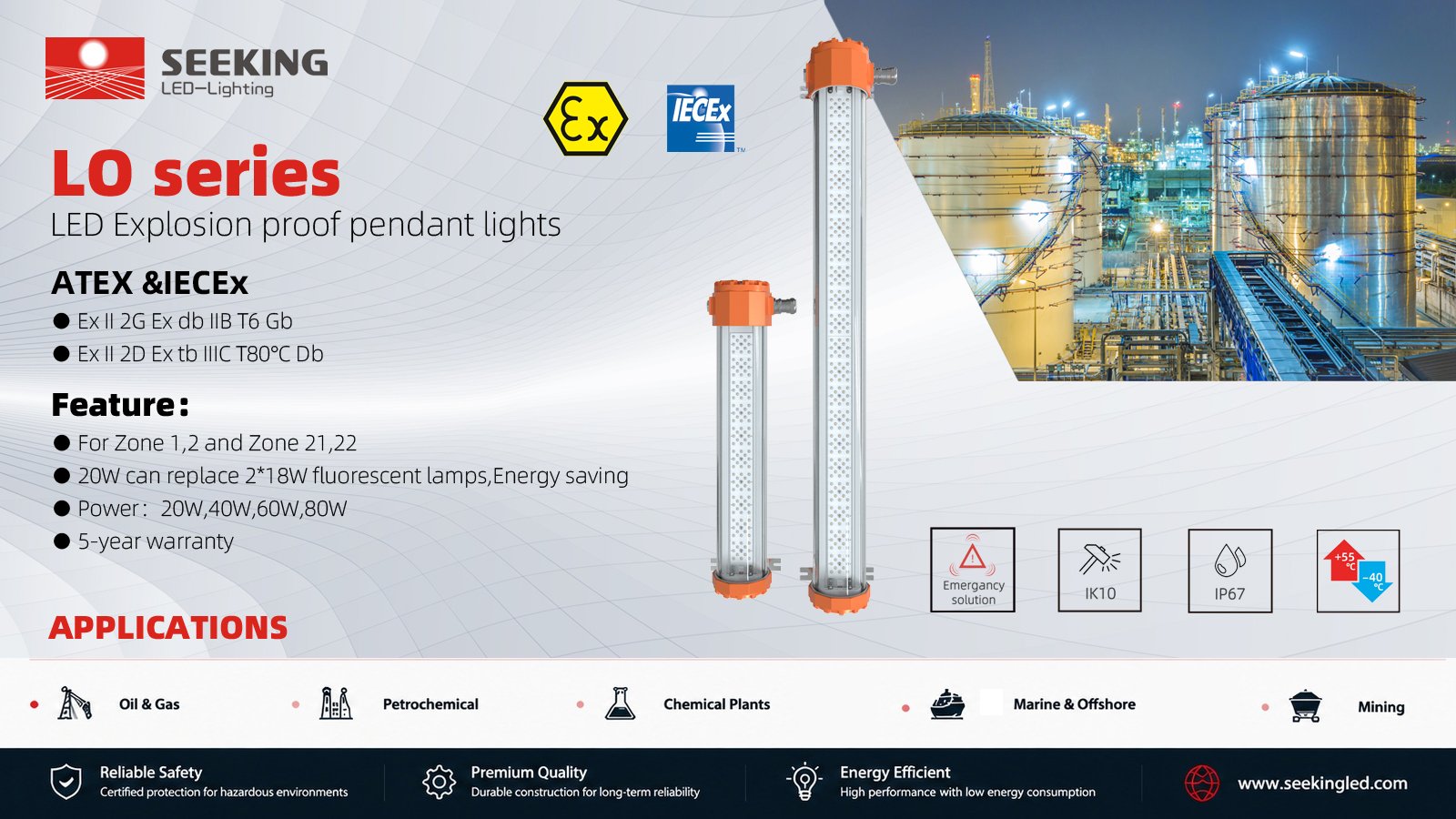
Dual certification (ATEX + IECEx on the same model) matters for coating equipment OEMs who ship booths into both EU and Middle East/Asia markets from one BOM.
LED Retrofit: What Improves
| Metric | Fluorescent Ex fixture | LED Ex linear |
|---|---|---|
| Fixture power for equivalent lux | 2×36 W + ballast losses | 36–50 W |
| Surface temperature margin | Ballast hot spots | Cooler driver topology — easier T-class |
| Light depreciation in paint environment | Diffusers cloud within months | Sealed optics, slower soiling |
| Restrike after cleaning-cycle cutout | Flicker/strike wear | Instant |
| Colour consistency between fixtures | Drifts with lamp batch | Binned LEDs, stable CCT |
Frequently Asked Questions
What kind of lighting is required in a paint booth?
Spray application areas are typically classified Zone 1 (gas group IIA/IIB depending on solvents), so luminaires must be at least Category 2 (Gb) — Ex db flameproof or Ex eb increased safety. Linear LED fixtures with T4 or better rating are the modern standard; surface temperature must stay below the auto-ignition temperature of the solvent vapours in use.
Why do paint booths need explosion proof lighting?
Paint spraying atomises solvent-based coatings into a fine mist mixed with air — an optimally ignitable atmosphere. Ignition sources including ordinary light fixtures' switches and hot surfaces must be excluded from the classified zone around and inside the booth.
What temperature class do paint booth lights need?
Most common paint solvents (xylene, toluene, ketones) have auto-ignition temperatures above 400°C, but classification practice assigns T4 (135°C) or better to booth lighting to keep margin over varnish accumulation on fixtures. T4 covers virtually all coating solvents; T5/T6 adds margin where hot spots from dusted-on paint residue are a concern.
Can LED lights be used in a paint booth?
Yes — certified Ex db or Ex eb LED linear lights are now the default choice. They run cooler than fluorescent or HID equivalents (easier T-class compliance), restore instantly after cleaning-cycle power cuts, and their sealed optics resist the paint mist that clouds older fixture diffusers.
Do paint mixing rooms need the same lighting as the booth?
Yes, and often stricter: mixing rooms handle open liquid solvent, so the zone typically extends across the whole room. Use the same certified fixture family throughout booth, mixing room and adjacent drying areas to keep the inspection file consistent.
Get a Quote for Your Project
Send us your hazardous area classification (zone, gas group, temperature class) and target lux levels — our engineers will reply with a full lighting layout and FOB Shenzhen quotation within 24 hours.
Email: sales02@seekingled.com | Exporting to 70+ countries · 1,000,000+ units shipped per year
- About Us
- Products
- Explosion proof light
- Portable explosion proof lighting
- Explosion proof emergency light
- Explosion proof LED T8 tube
- Explosion proof Junction Box
- Explosion proof street light
- Service
- FAQ
- Docs download
Service hotline
Tel:+86 755 29846615
Work time:9:00-20:00
E-mail:sales02@seekingled.com
address:5F, Building 5, Guole Science and Technology Park, Lirong Road, Dalang Street, Longhua, Shenzhen, China