

Portable Explosion Proof Lighting: Choosing Hand Lamps and Work Lights for Hazardous Areas
Fixed lighting covers normal operation. Turnarounds, vessel entries and night call-outs run on portable lighting — the equipment most often found uncertified during hazardous area audits. Here is how to specify the portable fleet correctly.
Where Portable Ex Lighting Earns Its Keep
| Scenario | Why fixed lighting isn't enough |
|---|---|
| Turnaround / shutdown | Area lighting often de-energised; vessel-entry permits require local task lighting |
| Confined space entry | Interior of tanks, towers, sewers — Zone 0/1 by classification |
| Night emergency repair | Local illumination at the failure point |
| Inspection rounds | Hand lamps for close visual checks of flanges, seals |
Two Classes of Portable Lighting
| Class | Protection | Power | Use |
|---|---|---|---|
| Hand lamps / inspection torches | Ex i (intrinsically safe) | 1–20 W | Confined spaces, close inspection — lightest, safest class |
| Portable work lights / tripod floods | Ex db or Ex nR | 30–300 W | Area task lighting during turnarounds |
The division follows power: intrinsic safety caps stored energy, so high output requires flameproof or non-sparking construction — but with the battery pack and driver engineered to the same category. Fleet starting points: HB21 portable explosion proof lighting (Ex db, Zone 1/2) for high-output task lighting, and FL8 portable work light (Ex nR, Zone 2/22) for general turnaround areas.
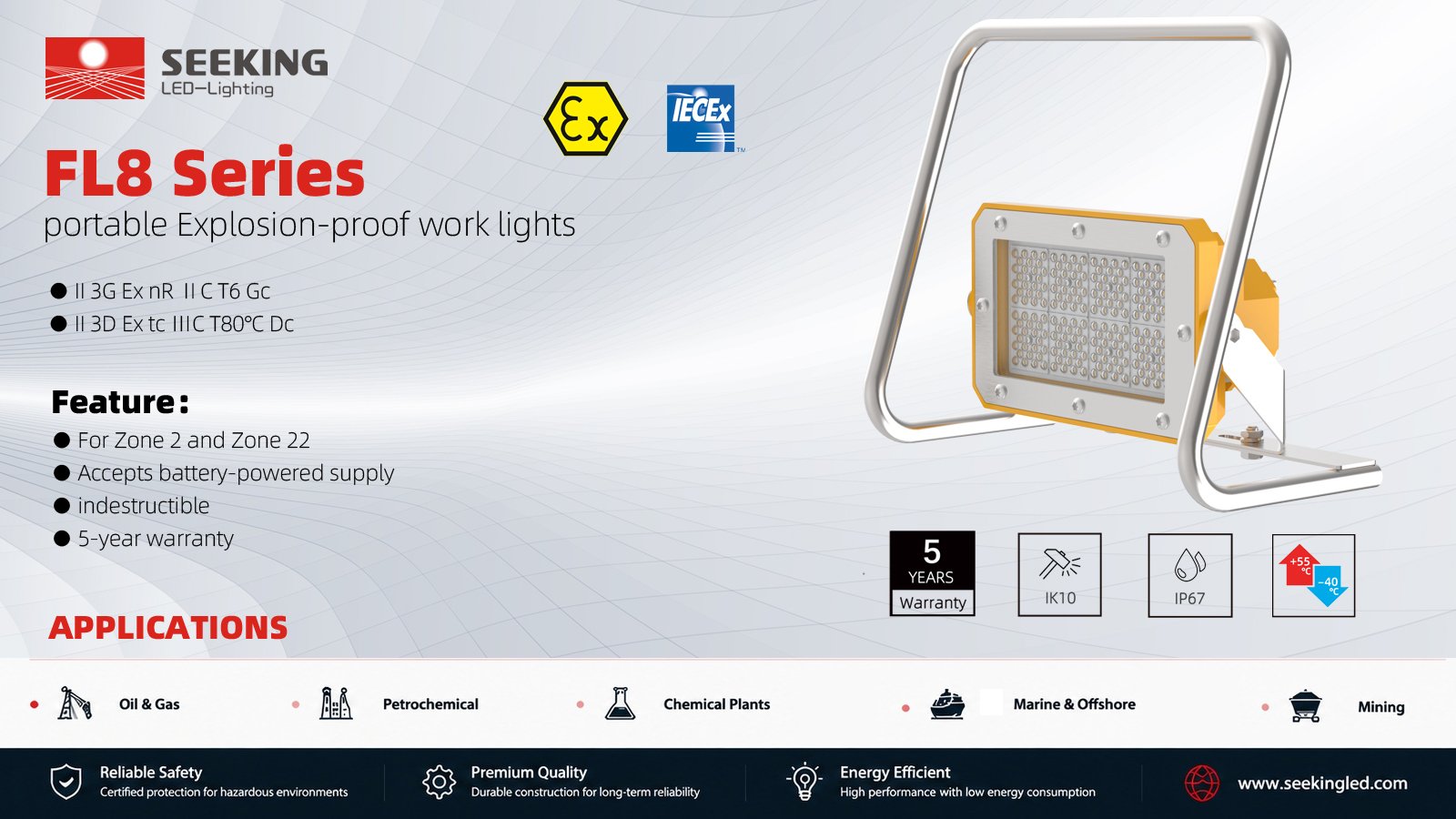
Specifying the Portable Fleet
| Requirement | Hand lamp (Ex i) | Portable work light (Ex db/nR) |
|---|---|---|
| Certification scope | Lamp including cells | Lamp + battery + charger per certificate |
| Zones | 0/1/2 as per ia/ib level | 1/2 or 2/22 per marking |
| Light output | 100–1,500 lm | 3,000–40,000 lm |
| Runtime | 6–12 h typical | 4–10 h or mains-powered |
| Charging rule | Outside the hazardous area (usual special condition) | Per certificate conditions |
| Accessories | Static-safe hooks, guards | Tripods, magnetic mounts, cable reels (certified) |
Battery Rules That Catch Buyers Out
- Charging location: most certificates require charging outside the hazardous area — printing this on the charger prevents the classic audit finding
- Cell replacement: field-replacing cells with non-certified equivalents voids the Ex certificate; buy cells from the fixture manufacturer
- Stored energy limits: Ex i models constrain capacity by design; do not "upgrade" capacity with third-party packs
- Labels survive the job: portable gear gets scraped and painted — order spare Ex nameplates with the fleet
Fleet Standardisation Pays
Sites that standardise one portable family per zone report simpler inspection documents and lower loss rates. A practical fleet for an oil & gas facility:
- Zone 1 turnarounds: Ex db portable floods (FL8/FL7-derived portable work lights at 50–300 W) + Ex i hand lamps for vessel entry
- Zone 2 general: Ex nR portables — lighter and cheaper for the large routine fleet
- Fixed companion: certified emergency and exit lighting from the same manufacturer's portfolio
Frequently Asked Questions
What is portable explosion proof lighting?
Portable explosion proof lighting covers movable certified luminaires — hand lamps, task lights, tripod work lights and magnetic-mount floods — carrying Ex markings for the zone where they are used. Anything brought into a hazardous area by a technician, including torches and headlamps, falls under the same certification requirement.
Do I need certified torches in a hazardous area?
Yes. A torch carried into a Zone 1 or Zone 2 area is equipment and must be certified for that zone — the switch in an ordinary torch is a spark source. This is a frequent inspection finding: personal devices are the most common uncertified equipment found in process units.
Ex i or Ex db for portable work lights?
For low-power hand lamps and inspection lights, Ex i (intrinsically safe) is standard and lightest. For higher output — 50–300 W portable floods on tripods — Ex db or Ex nR constructions apply, with the battery/driver section certified to match. If the work area is Zone 2 only, Ex nR portables save weight and cost.
What about battery-powered portable lights in hazardous areas?
Batteries store energy, so they receive specific attention: certified portable lights use protected cell packs, certified charging arrangements (charging outside the hazardous area is a common special condition), and energy-limited circuits for Ex i models. Follow the certificate's special conditions on charging and cell replacement exactly.
When is portable lighting most used?
Turnarounds and shutdowns (permanent lighting is de-energised for vessel entry), confined-space entry and inspection, night maintenance on rotating equipment, and emergency response. Sites standardise portable fleets per zone so technicians never have to judge suitability under time pressure.
Get a Quote for Your Project
Send us your hazardous area classification (zone, gas group, temperature class) and target lux levels — our engineers will reply with a full lighting layout and FOB Shenzhen quotation within 24 hours.
Email: sales02@seekingled.com | Exporting to 70+ countries · 1,000,000+ units shipped per year
- About Us
- Products
- Explosion proof light
- Portable explosion proof lighting
- Explosion proof emergency light
- Explosion proof LED T8 tube
- Explosion proof Junction Box
- Explosion proof street light
- Service
- FAQ
- Docs download
Service hotline
Tel:+86 755 29846615
Work time:9:00-20:00
E-mail:sales02@seekingled.com
address:5F, Building 5, Guole Science and Technology Park, Lirong Road, Dalang Street, Longhua, Shenzhen, China