

ATEX Lights: How to Read and Verify Ex Certification
An ATEX certificate is only as good as the marking behind it. This guide decodes the full Ex marking string on a luminaire, explains how equipment categories map to zones, and sets out what a buyer should cross-check before releasing payment.
ATEX in One Paragraph
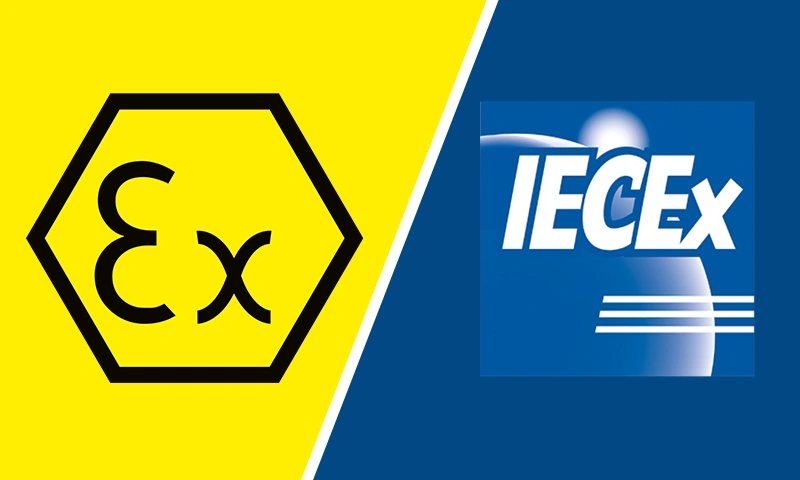
"ATEX" comes from the French ATmosphères EXplosibles. Luminaires sold for explosive atmospheres in the EU are placed on the market under Directive 2014/34/EU, and three things travel together: the hexagonal Ex mark and CE marking on the body, an EU declaration of conformity referencing the certificate number, and — for Category 1 and 2 equipment — an independent certificate covering the design.
Equipment Categories Map to Zones
| Category | Marking suffix | Zones | Certification requirement |
|---|---|---|---|
| 1 | Ga / Da | 0, 1, 2 / 20-22 | Notified body certificate + QA |
| 2 | Gb / Db | 1, 2 / 21-22 | Notified body certificate |
| 3 | Gc / Dc | 2 / 22 | Internal control or notified body |
For lighting, most real-world demand is Category 2 (Zone 1, Ex db/eb Gb) and Category 3 (Zone 2, Ex nR Gc). The "X" suffix on a certificate number means special conditions apply — read them; they often concern mounting orientation or torque values on cable glands.
Decoding the Full Marking String
Take this real-world example from a Zone 2 LED flood light:
Ex nR IIC T6 Gc
| Element | Meaning |
|---|---|
| Ex | Explosion-protected equipment |
| nR | Non-sparking with restricted breathing enclosure |
| IIC | Gas group IIC — covers hydrogen/acetylene, the most demanding (IIA and IIB are subsets) |
| T6 | Max surface temperature 85°C |
| Gc | Gas environment, Category 3 → Zone 2 only |
A Zone 1 flameproof equivalent would read Ex db IIB T5 Gb. Note what changes and what doesn't: the protection method and category move with the zone; the gas group and T-class move with the process fluid, not the zone.
Certificate Portfolio: A Real Example
A credible manufacturer publishes its certificate map across product families. SEEKINGLED's current portfolio (EX Catalog, September 2026):
| Series | Product | Protection | Zones | ATEX certificate |
|---|---|---|---|---|
| FL8 | LED flood light | Ex nR IIC T6/T5 Gc | 2 / 22 | TÜV CY 26 ATEX 0207611 X |
| GS | Petrol station canopy light | Ex nR IIC T6/T5 Gc | 2 / 22 | TÜV CY 26 ATEX 0207612 X |
| LU | Linear light | Ex nR IIC T6 Gc | 2 / 22 | TÜV CY 26 ATEX 0207613 X |
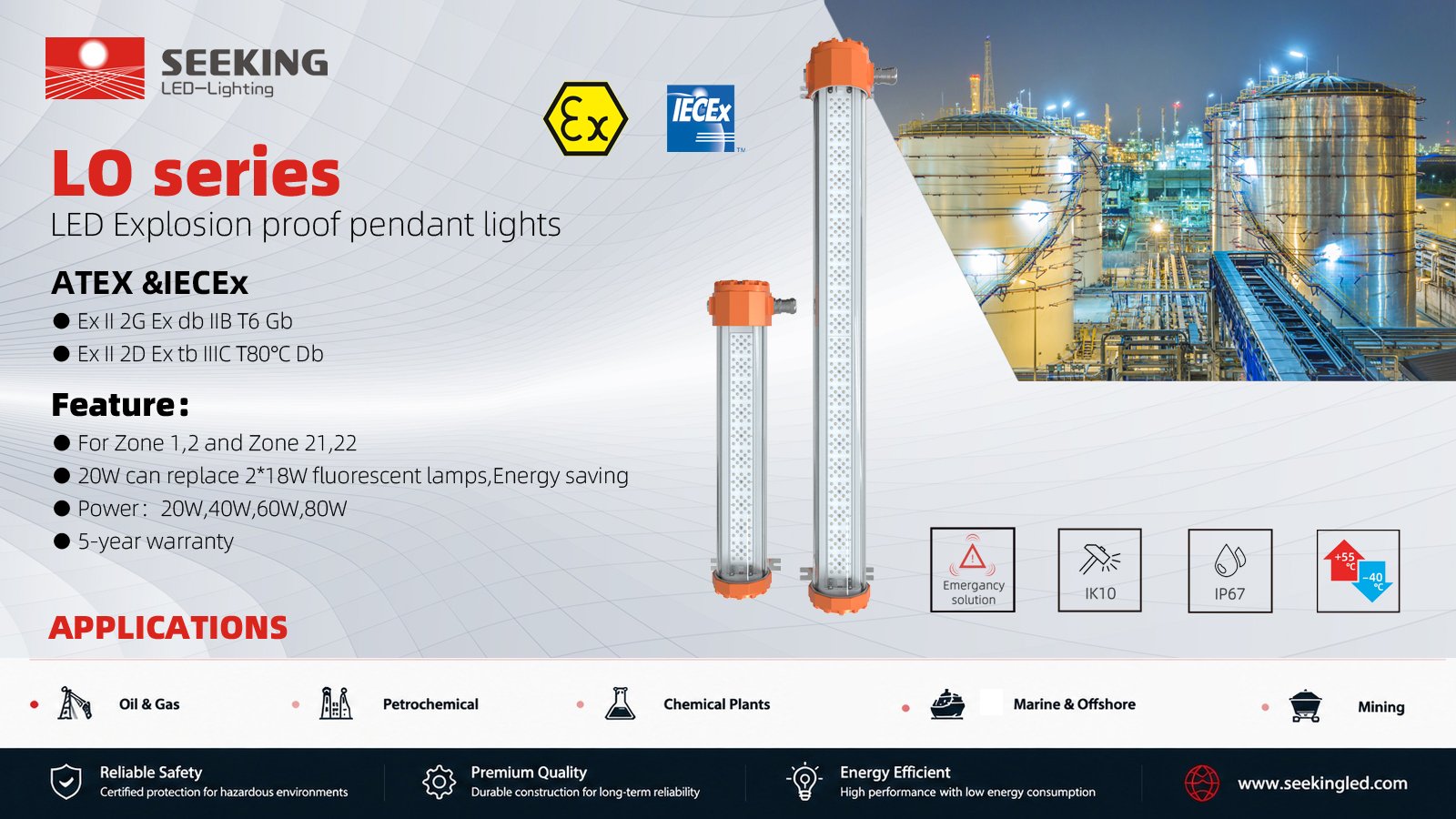
| LO | Linear light | Ex db IIB T6 Gb | 1 / 21 | CSANe 25 ATEX 1229X + IECEx CSA 25.0093X |
| FL7 | LED flood light | Ex db IIB T6 Gb | 1 / 21 | Flameproof range for Zone 1 |
| HB21 | LED high bay | Ex db IIC T6/T5 Gb | 1 / 21 | Flameproof range for Zone 1 |
This spread illustrates a procurement principle: one manufacturer, two certification tiers — flameproof (Zone 1) and restricted-breathing (Zone 2) — lets a project source both categories from a single supplier with consistent spares.
The LO linear series carries both marks — see its ATEX & IECEx certified linear light specifications.
Checking a Certificate Before You Pay
A certificate PDF is a starting point, not proof. What decides whether a quotation is backed by real certification is whether the marking on the product, the certificate and the quotation all describe the same thing. The checks below do most of the work, and none of them depend on the supplier's cooperation.
Step 1: Decode the marking on the fixture
Start on the product, not on the paper. Every certified luminaire carries a permanently marked string on the body. If the marking is missing, unreadable or applied on a sticker that peels off, stop there — that alone is a non-compliance.
| Component | Example | What it tells you |
|---|---|---|
| Equipment group | II | Surface industry (I is mining only). Luminaires for refineries, chemical plants and fuel depots are group II. |
| Category | 2 | Category 2 = usable in Zone 1 with a certified protection method. Category 3 = Zone 2 only. |
| Atmosphere | G / D | G = explosive gas atmosphere, D = combustible dust. Both letters on one fixture means dual gas and dust certification. |
| Protection type | db | db = flameproof enclosure. Other common types on luminaires: eb (increased safety), nR (restricted breathing, Zone 2), tb / tc (dust enclosure protection). |
| Gas group | IIB / IIC | IIB covers ethylene-class gases; IIC covers hydrogen and acetylene — the most demanding group. |
| Temperature class | T6 | Maximum surface temperature: T6 = 85 °C, T5 = 100 °C, T4 = 135 °C. The class must sit below the ignition temperature of the surrounding gas. |
| Equipment protection level | Gb / Gc | Gb = high protection, suitable for Zone 1. Gc = enhanced protection, Zone 2. Db / Dc are the dust equivalents. |
A full string such as II 2 G Ex db IIC T6 Gb therefore reads: surface industry, category 2, gas, flameproof enclosure, hydrogen-class gas group, 85 °C maximum surface temperature, Zone 1 capable. Cross-read the same string against your area classification before the order goes out — a Category 3G fixture specified into a Zone 1 area is a non-compliant installation, regardless of how genuine its certificate is.
Step 2: Cross-check three things against the certificate
| Check | What a pass looks like |
|---|---|
| Model designation | The exact model and power rating you are ordering appears in the certificate scope — not just the family name. |
| Certificate holder | The certificate is held by the entity you are buying from, not by an unrelated factory the seller cannot name. |
| Marking consistency | The Ex string on the certificate matches the nameplate and the datasheet — gas group, temperature class and equipment protection level all line up. |
These three checks catch the two most common problems in Ex procurement: a certificate that belongs to a factory the seller has no relationship with, and a genuine certificate stretched to cover a model or power rating outside its scope.
Eight red flags of a counterfeit, stale or misused certificate
| Red flag | What it usually means |
|---|---|
| The certificate is only ever shown as a photograph of a nameplate | Nameplate photos are not certificates. A genuine supplier sends the certificate PDF on request, without hesitation. |
| The model designation on the certificate does not match the quotation character for character | Common with trading companies routing a certificate from a different product, or from a discontinued revision. |
| The certificate covers only part of the power range you are ordering | Scope limits are normal (a certificate may cover 50–150 W of a series only). Ordering 300 W on a 150 W certificate is buying uncertified equipment. |
| The certificate holder cannot be confirmed by the issuing body | The certification cannot be traced to the entity actually named on it. |
| The certificate number returns nothing when the issuing body is asked directly | Either it never existed, or it has been superseded and the supplier is quoting an old document. |
| An "X" certificate without the special conditions of use | The document is genuine but incomplete — installation conditions are a mandatory part of it. |
| The document is a test report or a voluntary certification mark, not an EU-Type Examination Certificate | Test reports are useful evidence, and voluntary marks are worth having, but neither is a conformity assessment certificate under the directive. If the route requires a notified body, only the certificate discharges that requirement. |
| The certificate relies on harmonised standards withdrawn years ago, with no gap analysis offered | An older certificate can still be formally valid, but the manufacturer must show that the safety requirements have not changed. A supplier who cannot explain the standards position has not looked at it. |
What to request from a supplier before you pay
Five documents, all of which a genuine manufacturer releases on request. Our own paperwork for every series is collected in our document library.
| Document | Why you need it |
|---|---|
| ATEX and/or IECEx certificate PDF (not a photo) | Contains the exact model designations, power range, protection types, gas group, temperature class and any X conditions. |
| Production-phase approval and its number | Shows the factory — not just the design — is approved to keep producing certified equipment. |
| EU Declaration of Conformity | The manufacturer's signed legal statement of compliance under Directive 2014/34/EU — a separate obligation from the certificate itself. |
| Product datasheet for the quoted model | Lets you verify that the specification offered matches the specification certified — the two are not automatically the same document. |
| Installation and maintenance instructions | Mandatory for compliant installation, and particularly for X certificates where special conditions govern the mounting, cable entries or environment. |
Frequently Asked Questions
What are ATEX lights?
ATEX lights are luminaires certified under the EU's ATEX Directive 2014/34/EU for use in explosive atmospheres. The certification confirms the fixture's protection method (Ex d, Ex e, Ex nR etc.), gas group, temperature class and the zones where it may be installed.
Is IECEx the same as ATEX?
No. ATEX is EU law and requires an EU declaration of conformity and CE marking; IECEx is the international Ex certification under IEC 60079, accepted in the Middle East, Asia and Australia. The technical standards are largely harmonized, and many products — like SEEKINGLED's LO linear series — carry both ATEX and IECEx certificates for the same model.
What does Ex db IIB T5 Gb mean?
Ex = explosion-protected; db = flameproof enclosure; IIB = suitable for gas group IIB (e.g. ethylene); T5 = max surface temperature 100°C; Gb = equipment suitable for Zone 1 (gas). The same string with 'nR IIC T6 Gc' would be a non-sparking Zone 2 fixture covering the most demanding gas group.
How do I check an ATEX certificate is real?
Ask for the certificate PDF and confirm three things: the model designation on the certificate matches the nameplate and the quotation, the certificate is held in the name of the manufacturer you are dealing with, and the Ex marking is identical across the certificate, the nameplate and the datasheet. Where the ATEX route is used, the certificate can also be confirmed directly with the body that issued it.
Do I need ATEX lights outside the EU?
Legally, ATEX applies only in the EU/EEA. Practically, most Middle East and Southeast Asian projects specify IECEx or accept ATEX-marked equipment, and the same dual-marked products are widely accepted there.
What is the difference between Ex d and Ex e?
Ex d (flameproof) contains an internal explosion and quenches it through flame paths, so the enclosure itself is the safety device. Ex e (increased safety) prevents ignition from occurring at all, by applying extra margins to terminals, creepage distances and surface temperature. They are frequently combined: our Bay 51 pendant light carries Ex db eb mb IIC T6/T5 Gb, where Ex d handles the enclosure, Ex e covers the terminal compartment and Ex m (encapsulation) protects the LED module — the combination is what allows it into Zone 1 with gas group IIC, which includes hydrogen.
Does an ATEX certificate expire?
ATEX certificates do not carry an expiry date, but they can be withdrawn and the product must continue to comply with the directive as amended. In practice three things matter more: the EU-Type Examination certificate becomes void if the product is modified, the manufacturer's quality system (QAN) is audited periodically — ours is CSANe 26 ATEX M076 — and many buyers now require a certificate less than three years old as a procurement condition. Always check the issue date, not just the existence, of a certificate.
Get a Quote for Your Project
Send us your hazardous area classification (zone, gas group, temperature class) and target lux levels — our engineers will reply with a full lighting layout and FOB Shenzhen quotation within 24 hours.
Email: sales02@seekingled.com | Exporting to 70+ countries · 1,000,000+ units shipped per year
Email sales02@seekingled.com · WhatsApp +86 134 1860 0102 · or browse the full certified range.
- About Us
- Products
- Explosion proof light
- Portable explosion proof lighting
- Explosion proof emergency light
- Explosion proof LED T8 tube
- Explosion proof Junction Box
- Explosion proof street light
- Service
- FAQ
- Docs download
Service hotline
Tel:+86 755 29846615
Work time:9:00-20:00
E-mail:sales02@seekingled.com
address:5F, Building 5, Guole Science and Technology Park, Lirong Road, Dalang Street, Longhua, Shenzhen, China