

LED Canopy Lights for Gas Stations: Zones and Specs
The forecourt is the most publicly visible hazardous area in the world — every station needs certified lighting above the pumps. This guide covers the zone classification under canopies, the specs that matter, and the economics of LED retrofits.
Zone Classification Under the Forecourt Canopy
National codes differ in detail, but the consensus geometry around petrol dispensers:
| Location | Typical zone | Lighting requirement |
|---|---|---|
| Within the dispenser casing | Zone 1 | Ex db or Ex eb (Gb) |
| Beneath canopy, up to ~1 m above ground near dispensers | Zone 1 or 2 by code | Ex nR minimum for Zone 2 |
| Beyond 3–4.5 m horizontally from dispensers | Non-hazardous or Zone 2 | Ex nR if inside Zone 2 envelope |
| Tank filling points and vents | Zone 1 / Zone 2 | Certified per local code |
In practice, most forecourt canopy fixtures sold internationally are Ex nR IIC T6/T5 Gc (Zone 2) with flameproof (Ex db) options where local code extends Zone 1 under the canopy.
The forecourt is one of several classified environments a station must light — our hazardous area lighting guide maps the rest, from tank farms to jetty loading arms.
The Specs That Matter for Forecourt Lighting
| Spec | Recommended | Why |
|---|---|---|
| Certification | Ex nR IIC T6 Gc (Zone 2) | Covers petrol vapour; T6 headroom on ignition temp |
| Power / output | 150–200 W · 19,000–24,000 lm | Standard 2-island canopy coverage |
| Efficacy | ≥130 lm/W | Energy cost on 24/7 runtime |
| Beam optics | Asymmetric / wide flood spread | Pushes light to pump faces and driveway |
| Surge protection | ≥4 kV (10 kV better) | Fuel site grids see frequent transients |
| CCT / CRI | 5000 K · CRI 70+ | CCTV performance, brand-standard appearance |
| IP & corrosion | IP67, coastal-grade finish | Fuel vapour + car-wash humidity |
Lux Targets Across the Station
| Area | Maintained lux (typical standard) |
|---|---|
| Dispenser/pump area under canopy | 150–200 lux |
| Forecourt driveway | 30–50 lux |
| Canopy fascia (signage) | 150+ lux vertical |
| Perimeter / entry | 20–30 lux |
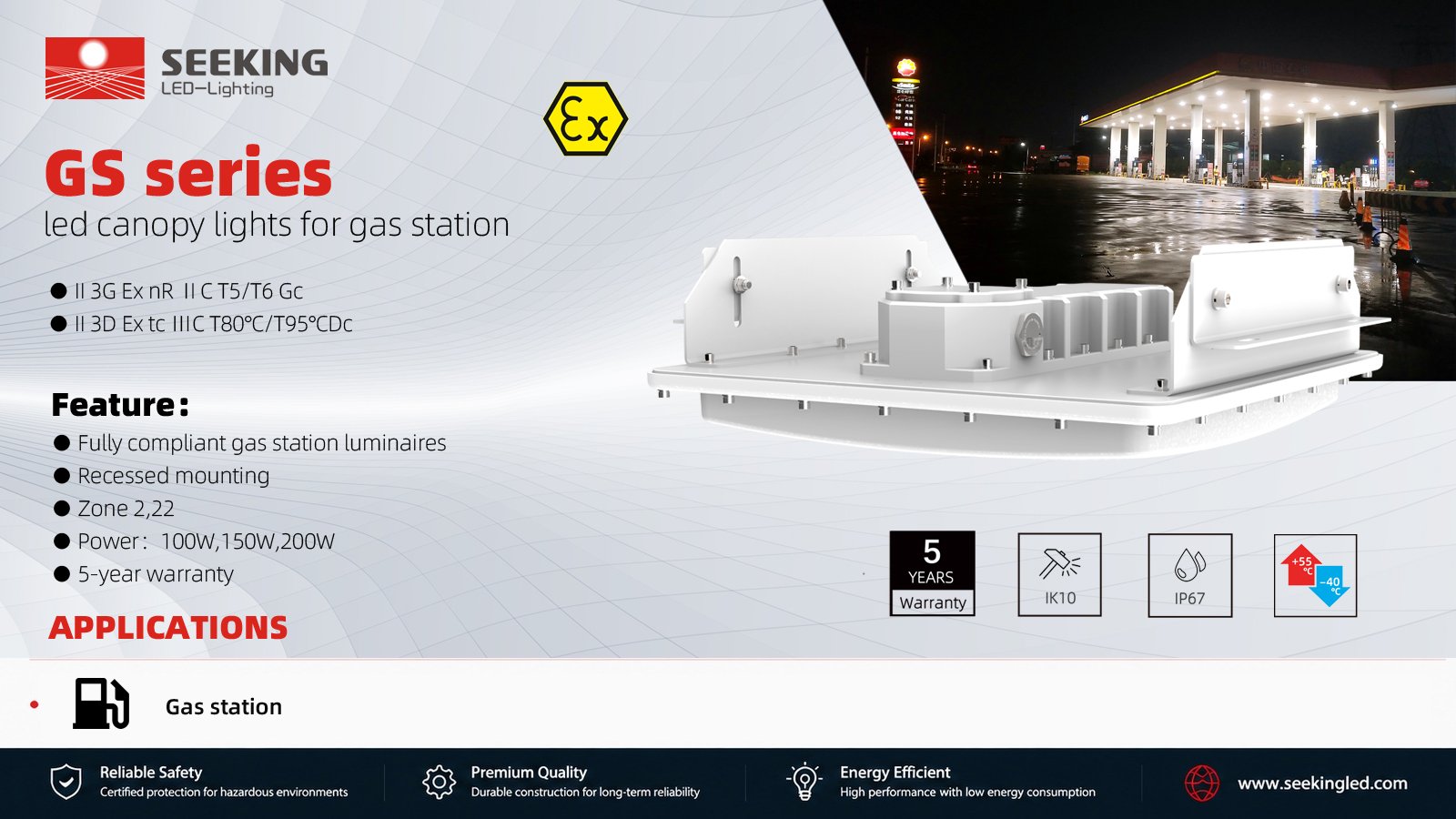
Product Example: SEEKINGLED GS Series
| Parameter | GS Series canopy light |
|---|---|
| Certification | ATEX TÜV CY 26 ATEX 0207612 X |
| Protection method | Ex nR IIC T6/T5 Gc — Zone 2 / 22 |
| Power range | 100–200 W |
| Zones | 2 (gas) / 22 (dust) |
| Application | Petrol station canopies, forecourts, loading canopies |
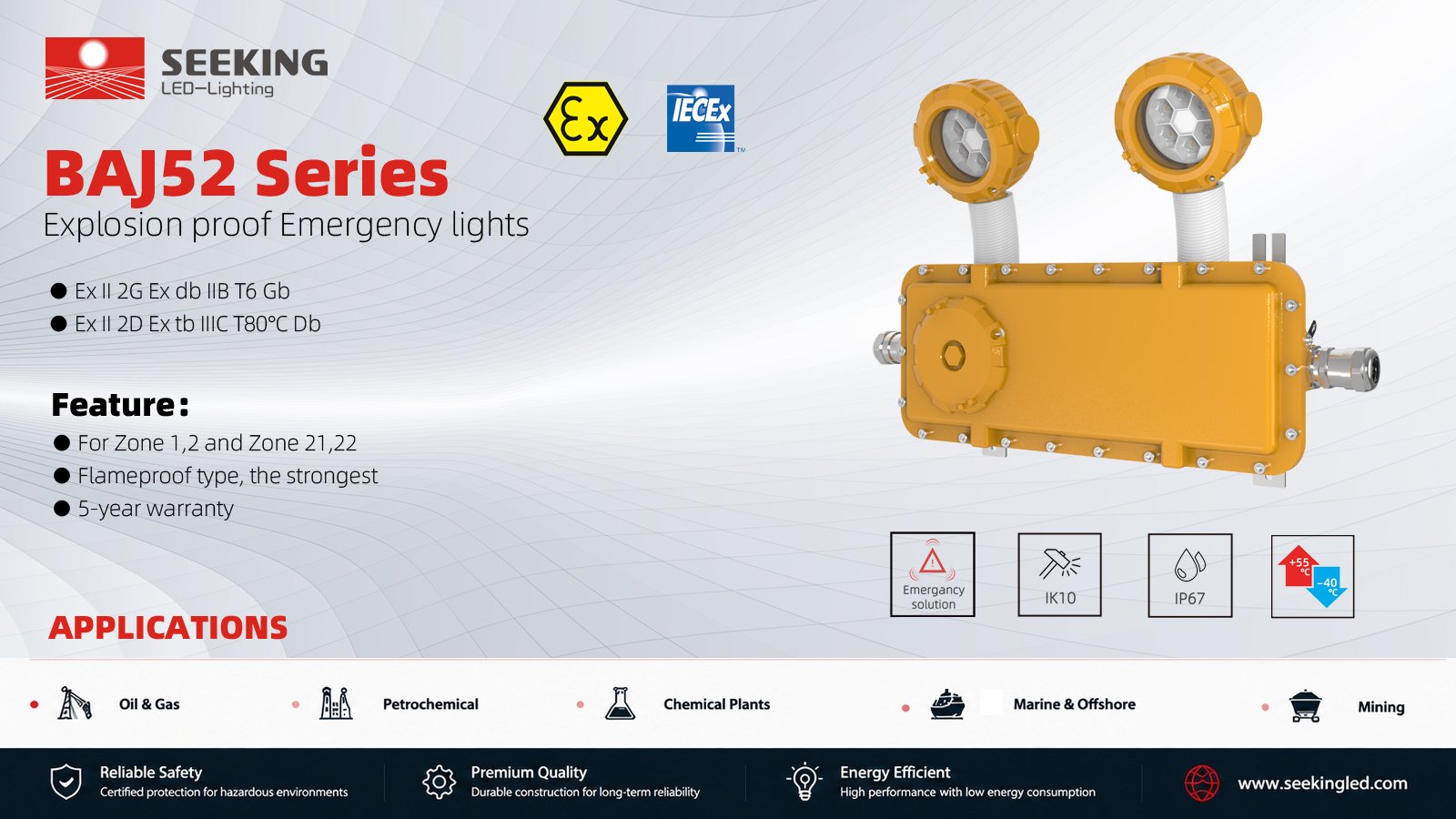
Pairing the canopy lights with Ex-certified emergency lighting and junction boxes from the same certificate portfolio keeps inspection paperwork simple — one manufacturer file instead of five.
Full specifications, photometric files and the ATEX certificate for the GS Series LED canopy light are on the product page.
Retrofit Economics (Per Fixture, 24/7 Operation)
| Item | 250 W HID canopy fixture | 150 W LED canopy fixture |
|---|---|---|
| Energy @ $0.12/kWh, 8,760 h | $263/yr | $158/yr |
| Lamp/ballast replacement | Every 2–3 yr | 100,000 h L70 driver+LED |
| Light output maintenance | ~60% at end of life | ≥90% through service life |
| Typical payback | — | 18–30 months on energy alone |
For a 12-fixture station, LED retrofit typically saves $1,200–1,600 per year in energy and eliminates the maintenance lifts — which under a canopy are lane closures, not just costs.
Frequently Asked Questions
Do gas station canopy lights need to be explosion proof?
Yes. Under the forecourt canopy, fuel vapour can accumulate during refuelling and tank filling, which makes the space beneath the canopy a Zone 1 or Zone 2 hazardous area depending on the national code. Canopy lights there must carry an Ex rating — typically Ex nR (non-sparking, restricted breathing) for Zone 2 or Ex db for Zone 1.
How many lumens does a petrol station canopy light need?
A typical double-sided canopy light delivering 18,000–20,000 lm per fixture keeps the forecourt at 150–200 lux, which matches most retail fuel brand standards. Four to six fixtures cover a standard two-island canopy at 5–6 m mounting height.
What is the difference between canopy light and gas station light?
Nothing in product terms — the names vary by market. US buyers search 'led canopy lights for gas station' (720/mo), UK and Commonwealth markets use 'petrol station canopy lights', and the industry shortens both to canopy lights. Always check the Ex marking, not the marketing name.
Can I retrofit LED canopy lights under an existing canopy?
Yes, if the replacement fixture is certified for the zone and the canopy structure supports the weight. Check the cable entry size, gland type and whether the driver voltage range covers your supply. Certified LED canopy lights typically weigh less than the HID fixtures they replace.
What CCT is best for gas station canopy lighting?
5000 K (daylight) is the standard choice: it maximises perceived brightness and CCTV colour rendering at night. CRI 70+ is sufficient for forecourts; driver surge protection matters more than CRI given grid quality at fuel sites.
What IP rating do gas station canopy lights need?
IP67 as a practical minimum. Forecourts combine fuel vapour with high-pressure car-wash overspray and driving rain, so a fixture rated only IP65 will take on moisture over time and fail early. Impact protection matters just as much: IK10 covers knocks from tanker hoses and cleaning equipment. Our GS series is rated IP67 & IK10 and finished to C4 (ISO 12944) for coastal and high-humidity sites.
How far apart should canopy lights be spaced?
At a typical 5–6 m mounting height, standard canopy luminaires are spaced 3.5–4.5 m apart, which produces even coverage without hot spots between the islands. Tighter spacing at lower wattage almost always looks better than wider spacing at higher wattage — it reduces glare for drivers and improves CCTV facial recognition. Ask for a photometric layout before fixing the spacing.
Are LED canopy lights worth it for a small station?
The payback is shortest where the lights run all night. A 12-fixture station operating 24/7 typically saves roughly $1,200–1,600 per year in energy and maintenance after an LED retrofit, so payback usually lands inside 2–3 years even on a small forecourt. The larger hidden saving is maintenance access: certified LED fixtures are sealed units, so the annual relamping and re-gasketing that HID canopies need largely disappears.
Get a Quote for Your Project
Send us your hazardous area classification (zone, gas group, temperature class) and target lux levels — our engineers will reply with a full lighting layout and FOB Shenzhen quotation within 24 hours.
Email: sales01@seekingled.com | Exporting to 70+ countries · 1,000,000+ units shipped per year
Email sales01@seekingled.com · WhatsApp +86 134 1860 0102 · or browse the full certified range.
- About Us
- Products
- Explosion proof light
- Portable explosion proof lighting
- Explosion proof emergency light
- Explosion proof LED T8 tube
- Explosion proof Junction Box
- Explosion proof street light
- Service
- FAQ
- Docs download
Service hotline
Tel:+86 755 29846615
Work time:9:00-20:00
E-mail:sales02@seekingled.com
address:5F, Building 5, Guole Science and Technology Park, Lirong Road, Dalang Street, Longhua, Shenzhen, China