

Explosion Proof Lighting Thailand: TIS 899, DIW Licensing and the Map Ta Phut Replacement Cycle
Explosion Proof Lighting Thailand: TIS 899, DIW Licensing and the Map Ta Phut Replacement Cycle
Thailand runs a structured hazardous-area entry system. Three things decide whether a luminaire can be imported, placed on the Thai market and installed at a refinery or chemical site: TISI certification anchored on TIS 899 for electrical equipment in explosive atmospheres; the Factory Act licensing run by the Department of Industrial Works (DIW), under which refineries and chemical plants are Category 3 factories that must hold a Ror Ngor 4 licence; and the risk assessment Category 3 plants file with their licence application. The honest reading: the overseas maker holds the IECEx or ATEX evidence; the Thai importer or local agent holds the TISI certificate. Equipment already carrying IECEx or ATEX clears the Thai path in 8–16 weeks, because TIS 899 aligns with IECEx.
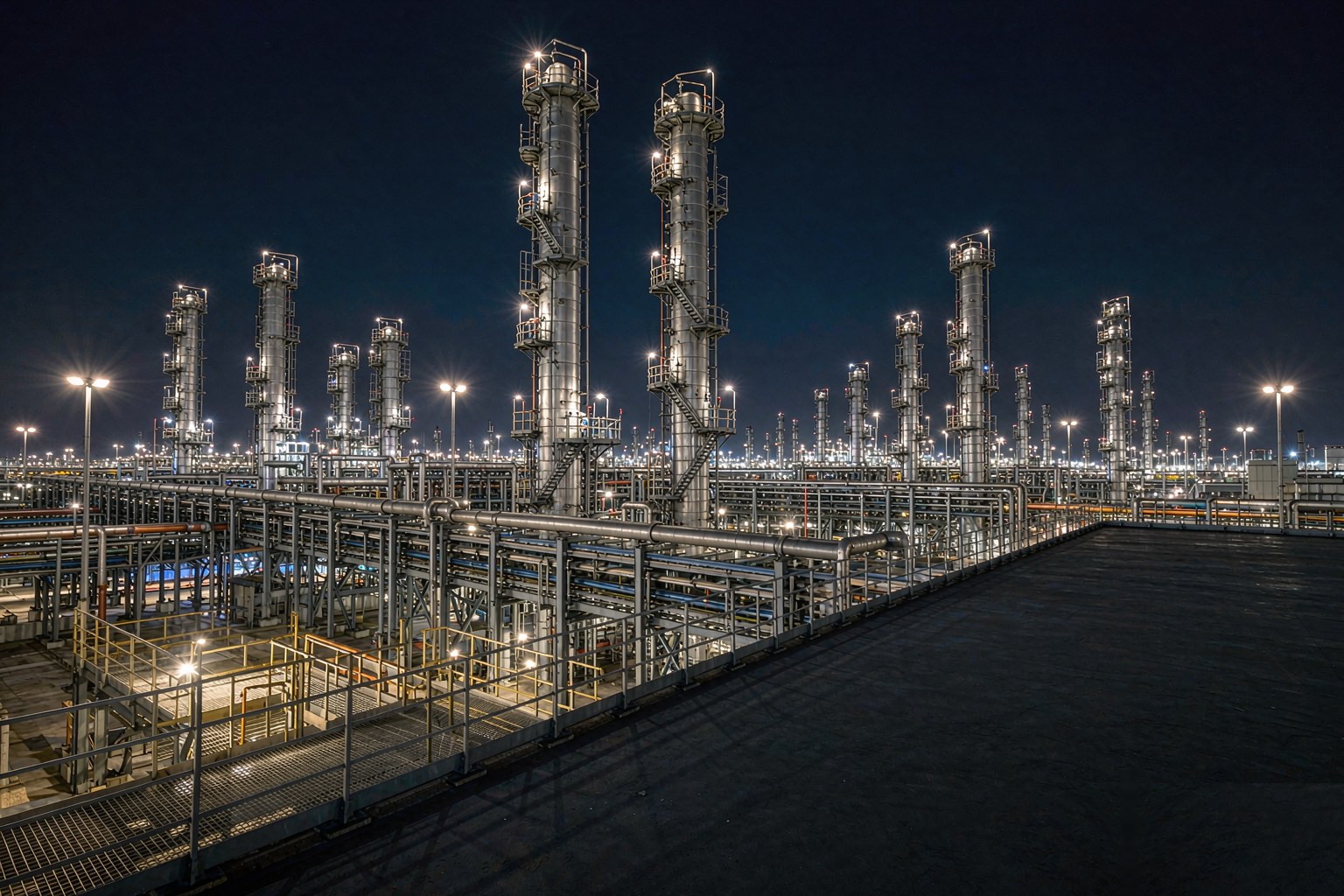
Thailand's hazardous-area rulebook at a glance
Thailand has no single "explosion-proof licence" a foreign factory obtains directly; the regime layers a product-conformity body, an industrial-licensing authority and a risk-assessment duty.
| Layer | Body / instrument | What it controls |
|---|---|---|
| Product conformity | TISI, under the Ministry of Industry, founded 1969 | Dual-track certification: mandatory standards (147 cumulative, as of 2025-07) and voluntary; TIS 899 covers hazardous-area electrical equipment |
| Core technical standard | TIS 899 (electrical apparatus for explosive atmospheres) | Largely aligned with IECEx; import files need a certificate of conformity, an accredited-lab test report, and a manufacturer's declaration of compliance |
| Factory licensing | Factory Act B.E. 2535 (1992), amended by Factory Act (No. 2) B.E. 2562 (2019), DIW-enforced | Three factory classes; refineries and chemical plants are Category 3 and must hold a Ror Ngor 4 licence; the 2019 amendment removed the 5-year renewal and introduced accredited private inspectors |
| Risk assessment | MI Announcement No.3 B.E. 2542; DIW rules B.E. 2543 | Category 3 plants (petroleum refineries, category 49; chemicals, 42/44) file a risk assessment report with the licence application; risk management must cover control, recovery and corrective action plans |
| Area classification | IEAT best practice | Zone 0 inside containers/pipes; Zone 1 from 1.5 m out from tank/pipe surfaces; Zone 2 from 1.5 m to 3 m (outdoor) or 1.5 m to 7.62 m (indoor); in-zone apparatus must be explosion-protected |
Two approvals run in parallel. TISI / TIS 899 settles whether the luminaire type may be imported and sold; the DIW licence and risk file settle whether the plant may operate — a compliant fixture sits unused if the owner's Ror Ngor 4 and risk file are not in order.
The certification path: how long, and what shortens it
TISI's general flow is application → sample testing → factory audit → certificate → market surveillance, with a normal cycle of 8–10 weeks. For hazardous-area luminaires the anchor is TIS 899, and Thai customs and the importer need a certificate of conformity, an accredited-lab test report, and the manufacturer's declaration of compliance.
| Starting point | Path | Typical duration |
|---|---|---|
| No prior international certification | Full TIS 899 evaluation via TISI / accredited Thai lab | Full testing and audit cycle applies |
| Already holds IECEx Certificate of Conformity | Thai certification on the IECEx basis; local testing or acceptance of the foreign test report by a Thai-recognised lab | 8–16 weeks |
| Already holds ATEX certificate | Technical input; TIS 899 alignment is IECEx-based, so IECEx is what shortens the route | 8–16 weeks where IECEx also held |
| Mandatory vs voluntary scope | Mandatory TISI standards are required before import/sale; voluntary are market-driven | 147 mandatory standards in force as of 2025-07 |
The lever is IECEx: because TIS 899 is largely aligned with the IECEx scheme, a luminaire already carrying an IECEx Certificate of Conformity enters the Thai route at the 8–16 week band, and that evidence is what the Thai side accepts.
Where the classified areas are, and how Thailand draws the zones
Thailand's hydrocarbon and chemical industry concentrates on the Eastern Seaboard — Sriracha and Chonburi (Thai Oil), and the Map Ta Phut / EEC corridor across Chonburi, Rayong and Chachoengsao; the IEAT zone distances below are the drawing rule, tighter indoors than many suppliers assume.
| Zone | Definition (IEAT practice) | Equipment rule |
|---|---|---|
| Zone 0 | Inside containers and pipes where the explosive atmosphere is present continuously | Apparatus rated for continuous presence |
| Zone 1 | From the outer surface of tanks and pipes outward 1.5 m (same indoors and outdoors) | Explosion-protected; commonly Ex db (flameproof) |
| Zone 2 — outdoor | From 1.5 m to 3 m out from the source | Explosion-protected; often Ex nR acceptable |
| Zone 2 — indoor | From 1.5 m to 7.62 m out from the source | Explosion-protected; the 7.62 m indoor band is wider than the 3 m outdoor band |
Two points follow: the indoor Zone 2 envelope reaches 7.62 m, so pump rows and sampling points inside a building carry more protected points than a 3 m plan suggests, and every point inside these envelopes must be explosion-protected — lighting is not an exemption.
Project map: the 2026–2030 procurement window
The replacement and expansion money sits on the Eastern Seaboard; luminaire packages are procured months ahead of mechanical completion, and the table lists projects driving specification work through the early 2030s.
| Project | Location / scope | Status driving 2026–2030 specification |
|---|---|---|
| Thai Oil Clean Fuel Project (CFP) | Sriracha / Chonburi refinery | Budget THB 63.02 billion; capacity 275,000 → 400,000 bpd; Nelson 9.8 → 12.0; 97% complete; 15,000–18,000 on site; Full COD 2028; Euro-5 |
| Map Ta Phut / EEC | Chonburi–Rayong–Chachoengsao | Braskem-SCG bio-ethylene: THB 19.3 billion, 200,000 tpy (BOI 2024-06); PTTGC bio-based polyethylene |
| Nong Fab LNG terminal | Rayong | CTCI + Saipem EPCC, USD 925 million (awarded 2026-04) |
| Map Ta Phut LNG Terminal 3 (Phase 2) | Rayong | Gulf Energy + PTT Tank Terminal; 8 million tpy; start 2025 Q4 |
| Aging-plant replacement | Map Ta Phut and Sriracha | Units built 2005–2015 enter a replacement peak in the early 2030s |
The window is compound. Thai Oil CFP reaches Full COD in 2028 with 15,000-plus workers on site during finishing, and the 2005–2015 vintage hits its replacement peak in the early 2030s — together they make 2026–2030 the dense buying period for hazardous-area luminaires.
Specifying for Thai sites: zone, gas group, temperature class, ambient, protection
Once the certificate route is settled, selection turns on five conditions; a spec that treats only "an Ex mark and a wattage" as criteria tends to fail at commissioning.
| Selection factor | What it changes | Our data point |
|---|---|---|
| Zone | Zone 1 calls for Ex db (flameproof); Zone 2 often allows Ex nR at lower cost for the same output | Ex db Zone 1 (FL7 / HB21); Ex nR Zone 2 (FL8 / GS / LU) |
| Gas group | Most streams are IIA / IIB; some chemical service is IIC and must be matched per point | Group matched to the classified-area drawing; IIC handled where required |
| Temperature class | T-rating read against the actual ambient, not a 40 °C default; derating where needed | T-class stated against the marked ambient for FL7, HB21, FL8, GS, LU |
| Ambient temperature | Coastal and process sites push enclosures; confirmed per project | Ambient confirmed per project before selection |
| Protection / enclosure | Saline coastal and process atmospheres raise corrosion duty; sealing must be genuine | Enclosure, fasteners, coating and seals to the project corrosion class |
Concentrated points — tank tops, loading areas, perimeter — carry output with a floodlight; pipe racks, walkways and long process runs use a linear luminaire with fewer fittings. We supply the FL8 Series explosion-proof floodlight for concentrated points and the LU Series LED linear luminaire for continuous runs. Both ship with the IECEx and ATEX evidence listed below.
Five mistakes that stall Thai hazardous-area lighting jobs
Most Thai non-conformances sit between a certificate and a working installation; the five that surface most often:
1. Assuming ATEX alone clears Thai import. TIS 899 is IECEx-aligned; the IECEx Certificate of Conformity is the evidence the Thai side accepts. ATEX supports the file but does not substitute for it.
2. Treating the factory licence as someone else's problem. A refinery or chemical plant is a Category 3 factory that must hold a Ror Ngor 4 licence, and the risk assessment report (control / recovery / corrective plans) travels with it.
3. Drawing Zone 2 at 3 m everywhere. The IEAT indoor band runs to 7.62 m. Underestimating it leaves unprotected points inside a classified area.
4. Matching the gas group per site, not per point. A plant mixing IIA, IIB and IIC under one luminaire type is a specification error. Group must follow the drawing point by point.
5. Ignoring the certificate holder. The TISI certificate is held locally — by the Thai importer or agent, not the overseas maker. Quotes implying the manufacturer holds it fail verification.
Frequently asked questions
Is an ATEX or IECEx certificate enough to import explosion-proof lighting into Thailand?
Not by itself. Thailand's anchor is TIS 899, administered by TISI; imported equipment needs a certificate of conformity, an accredited-lab test report and a manufacturer's declaration of compliance. IECEx is the evidence that shortens the Thai route because TIS 899 is largely aligned with IECEx; ATEX supports but does not substitute.
How long does Thai certification take if we already hold IECEx or ATEX?
Equipment already holding an IECEx Certificate of Conformity typically clears the Thai path in 8–16 weeks. A standard TISI product cycle runs 8–10 weeks; the 8–16 week band reflects the extra TIS 899 evaluation for hazardous-area apparatus.
What factory licence does a refinery or chemical plant need in Thailand?
Under the Factory Act B.E. 2535, amended by Factory Act (No. 2) B.E. 2562 (2019) and DIW-enforced, refineries and chemical plants are Category 3 factories and must hold a Ror Ngor 4 licence. The 2019 amendment removed the 5-year renewal and introduced accredited private inspectors. Category 3 plants — refineries (category 49) and chemicals (42/44) — also file a risk assessment report with control, recovery and corrective action plans.
How are hazardous zones defined in Thai petrochemical projects?
Following IEAT practice: Zone 0 is inside containers and pipes; Zone 1 runs from the outer tank/pipe surface outward 1.5 m, indoors and outdoors alike; Zone 2 runs 1.5 m to 3 m outdoors, but 1.5 m to 7.62 m indoors. Every apparatus inside these envelopes must be explosion-protected.
Do you hold the Thai TISI or TIS 899 certificate?
No, and we do not claim it. The TISI certificate and the TIS 899 declaration are held by the Thai importer or local agent, not the overseas manufacturer. What we provide is the IECEx and ATEX technical evidence (certificates, test reports, quality reports) on which the local importer builds the Thai file. For certificate details and project documentation, contact sales02@seekingled.com.
Fact check
| Fact as stated | Source | How verified |
|---|---|---|
| TISI under the Ministry of Industry, founded 1969; dual-track certification; 147 mandatory standards as of 2025-07; normal cycle 8–10 weeks | TISI / Ministry of Industry | TISI programme documentation |
| TIS 899 largely aligned with IECEx; import files need certificate of conformity, accredited-lab test report, manufacturer's declaration of compliance | TIS 899 scope; Thai import practice | IECEx scheme and TISI filing requirements |
| Equipment holding IECEx or ATEX clears Thai certification in 8–16 weeks | Thai practice for IECEx-based products | TISI / accredited-lab routing |
| Factory Act B.E. 2535 (1992), amended by Factory Act (No. 2) B.E. 2562 (2019), DIW-enforced; Category 3 needs Ror Ngor 4; 2019 removed 5-year renewal | Thai Factory Act and 2019 amendment; DIW | DIW and legislative texts |
| Risk assessment: MI Announcement No.3 B.E. 2542; DIW rules B.E. 2543; Category 3 files risk report with control / recovery / corrective plans | MI Announcement No.3 B.E. 2542; DIW rules B.E. 2543 | DIW rules |
| IEAT zones: Zone 0 inside; Zone 1 from 1.5 m; Zone 2 1.5–3 m outdoor / 1.5–7.62 m indoor; in-zone apparatus explosion-protected | IEAT classification best practice | IEC 60079-10 classification |
| Thai Oil CFP: THB 63.02 billion; 275,000 → 400,000 bpd; Nelson 9.8 → 12.0; 97% complete; 15,000–18,000 on site; Full COD 2028; Euro-5 | Thai Oil disclosures; project reporting | Thai Oil and industry press |
| Map Ta Phut / EEC: Braskem-SCG bio-ethylene THB 19.3 billion, 200,000 tpy (BOI 2024-06); Nong Fab LNG EPCC USD 925 million (2026-04); Map Ta Phut LNG T3 Phase 2, 8 million tpy, 2025 Q4 | BOI; CTCI / Saipem; Gulf Energy / PTT Tank Terminal | BOI and contractor announcements |
| Plants built 2005–2015 enter replacement peak in early 2030s; Map Ta Phut and Sriracha are upgrade zones | Industry analysis of Thai refinery vintage | Project-cycle reporting |
| Our certificate numbers (ATEX CSANe 25 ATEX 1229X; IECEx CSA 25.0093X; ATEX QAN CSANe 26 ATEX M076; IECEx QAR GB/CSAE/QAR26.0002/00; TÜV CY 26 ATEX 0207611/0207612/0207613 X) | Our certificate files, issuers CSA Group and TÜV | Each number verifiable with the issuer |
What we provide — and what we do not claim
The Thai TISI certificate and the TIS 899 declaration are applied for and held on the Thai side by the Thai importer or local agent, not the overseas manufacturer; we state precisely which technical evidence we hold and let the importer build the Thai file on top of it.
| Document | Number | Issued by / covers |
|---|---|---|
| ATEX Type Examination Certificate | CSANe 25 ATEX 1229X | CSA Group (Netherlands) — LO series |
| IECEx Certificate of Conformity | IECEx CSA 25.0093X | CSA Group — LO series |
| ATEX Quality Assurance Notification (QAN) | CSANe 26 ATEX M076 | CSA Group Netherlands — LO series |
| IECEx Quality Assessment Report (QAR) | GB/CSAE/QAR26.0002/00 | CSA Group (UK) — LO series |
| ATEX Type Examination Certificates | TÜV CY 26 ATEX 0207611 / 0207612 / 0207613 X | TÜV (Cyprus); FL8, GS, LU series |
In practice we supply the IECEx test reports, IECEx Certificates of Conformity, the IECEx Quality Assessment Report and the ATEX certificates and quality notifications, as the technical basis for a Thai importer's TISI application and TIS 899 declaration. We do not claim to hold the Thai TISI certificate or the TIS 899 declaration — those are held locally by the importer or agent. Across the Eastern Seaboard the model is the same: we provide the IECEx / ATEX technical evidence and the local party holds the Thai statutory certificate.
Related market pages: Vietnam · Oman · Saudi Arabia · Malaysia.
- About Us
- Products
- Explosion proof light
- Portable explosion proof lighting
- Explosion proof emergency light
- Explosion proof LED T8 tube
- Explosion proof Junction Box
- Explosion proof street light
- Service
- FAQ
- Docs download
Service hotline
Tel:+86 755 29846615
Work time:9:00-20:00
E-mail:sales02@seekingled.com
address:5F, Building 5, Guole Science and Technology Park, Lirong Road, Dalang Street, Longhua, Shenzhen, China