

Explosion Proof Lighting Saudi Arabia: IECEx & SABER Rules
Explosion-Proof Lighting in Saudi Arabia: What Actually Clears Customs and Site Gates
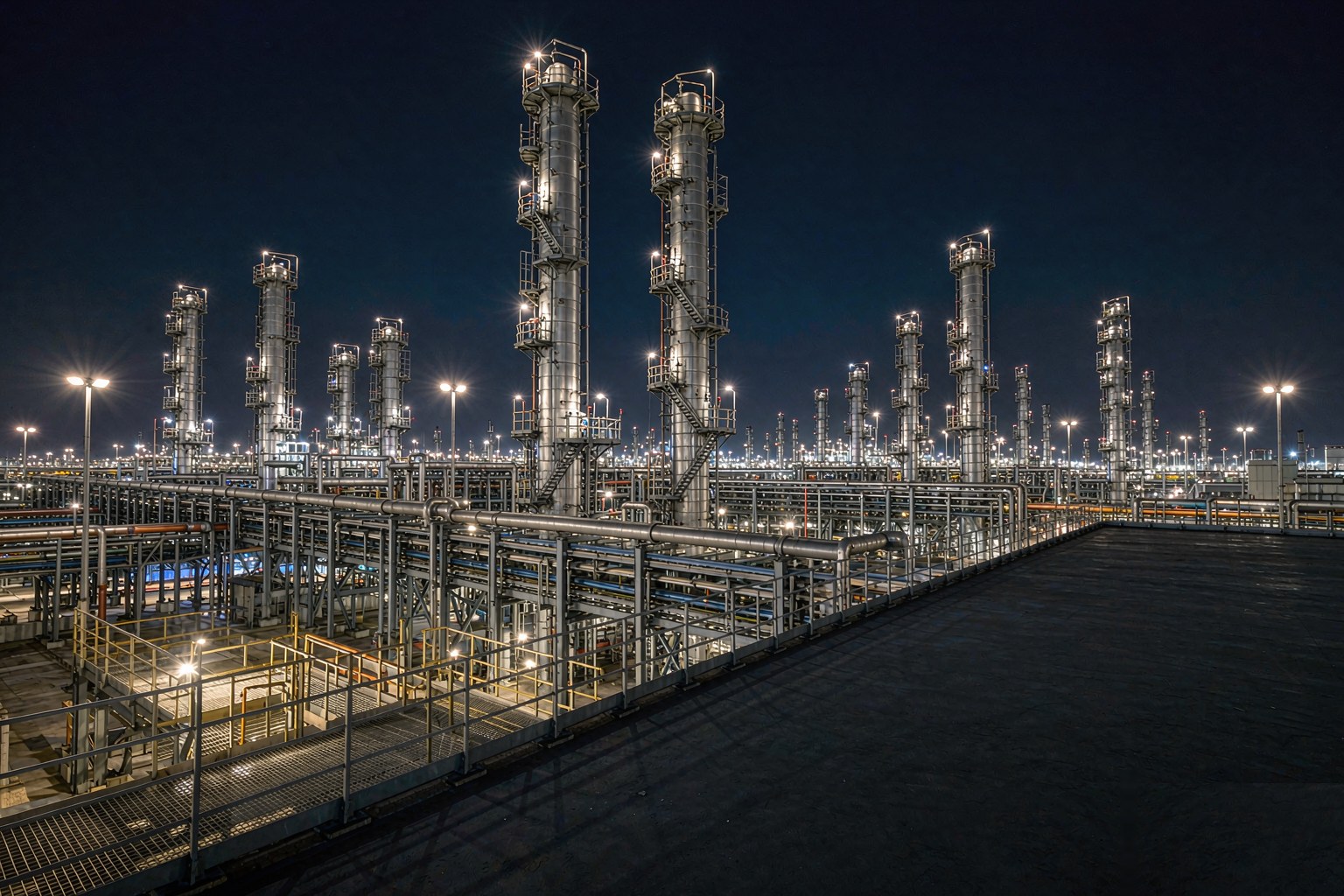
Saudi Arabia is spending on hazardous-area construction at a scale no other market in the region matches, and the money is landing exactly where classified areas sit. At Jafurah in the Eastern Province, the largest unconventional gas development outside the United States has moved from construction into production, with Phase 1 facilities running at 450 million standard cubic feet per day and a ramp to about 2 billion cubic feet per day of sales gas targeted by 2030. At Jubail, the Amiral petrochemical complex is adding a mixed-feed steam cracker with 1.65 million tonnes per year of ethylene capacity plus two polyethylene lines. Both are, in lighting terms, thousands of Zone 1 and Zone 2 points inside pipe racks, tank farms, compressor houses and loading areas.
For a luminaire manufacturer, however, the question that decides whether a quotation is usable is not the project list. It is whether the fixture's certification is the type Saudi Arabia actually recognises — and a large share of suppliers, especially those who lead with European paperwork, get this wrong at the first step. Two questions settle it: which certificate does SASO accept for equipment in explosive atmospheres, and does an ATEX certificate on its own clear Saudi customs and a Saudi site gate? The answers are "IECEx, recognised through SASO" and "no" — and both are worth stating plainly before any technical selection begins.
Where Saudi Arabia's classified areas actually are
Saudi demand is not spread across the Kingdom. It sits on two industrial axes — the Eastern Province (Jubail, Dammam, Ras Tanura, Al Ahsa and the Jafurah field) and the Red Sea coast (Yanbu, Rabigh) — plus a growing set of new developments around gas, hydrogen and petrochemicals. The table below maps what is driving specification work now and over the next three years.
| Location | Facility type | Status driving 2026–2028 specification |
|---|---|---|
| Jafurah, Eastern Province | Unconventional (shale) gas field and gas plant | Phase 1 producing 450 MMscf/d; ramp toward about 2 Bscf/d of sales gas by 2030; Phase 2 (≈US$12.4 bn) covers compression, additional processing trains and the Riyas NGL facility in Jubail; Phase 3 (≈US$8.8 bn) expands the Master Gas System |
| Tanajib | Gas plant processing associated gas from Marjan and Zuluf | Operational since December 2025; raw gas processing capacity heading toward 2.6 Bscf/d in 2026 |
| Jubail Industrial City | Petrochemical and refining complex; Amiral complex | Amiral mixed-feed steam cracker under construction: 1.65 mtpa ethylene plus two 500 kt/yr polyethylene lines |
| Yanbu and Rabigh | Refining and petrochemical complexes on the Red Sea coast | Operating; ongoing unit additions and turnarounds sustaining replacement and expansion lighting demand |
| Marjan, Zuluf, Berri, Dammam | Offshore and onshore oil increments | Increment projects scheduled across 2025–2027; Zuluf adds a central processing facility for up to 600,000 bpd of Arabian Heavy |
| NEOM / Oxagon | Green hydrogen and industrial development | US$8.4 bn NEOM Green Hydrogen complex with 4 GW of solar and wind; first green ammonia exports targeted for 2027 |
The procurement consequence is a timing one. Large Saudi projects procure luminaire packages months ahead of mechanical completion, and the certification route — not the fixture — is usually the critical path. If the IECEx evidence is not already in place when the material requisition is raised, the package slips regardless of how well the product performs.
The admission gate: SASO, SABER and the IECEx Recognition Certificate
All regulated goods entering Saudi Arabia pass through the Saudi Product Safety Programme, known as SALEEM, whose electronic platform is SABER. SABER issues two certificates in sequence: a Product Certificate of Conformity (PCoC) covering the product or model, and then a Shipment Certificate of Conformity (SCoC) per consignment, which is what customs clears against. Without a valid PCoC, no SCoC can be issued, and without an SCoC the consignment is held.
For equipment used in explosive atmospheres, SASO does not run its own independent explosion-proof scheme from scratch. It recognises the IECEx system and issues a SASO IECEx Recognition Certificate (SIRC) — and SASO is the only body authorised to issue it. Since 1 November 2021, SIRC has been mandatory for a defined list of hazardous-location products, and fixed linear lighting is on that list. That is the direct reason why a linear luminaire line without an IECEx basis can fail to clear Saudi customs even while an ATEX certificate sits in the same folder.
| Step | Who acts | What it produces |
|---|---|---|
| Hazardous-location products reach the SABER platform | Saudi importer or authorised representative | Product record created under SALEEM, technical regulation selected |
| IECEx basis verified | SASO / authorised certification body | SASO IECEx Recognition Certificate (SIRC), where the product type is in scope |
| Certificate of Conformity, product level | SABER issues on the importer's account | PCoC (product/model level) |
| Certificate of Conformity, shipment level | SABER issues per consignment | SCoC — the document customs clears against |
| Site acceptance | Owner / EPC and site safety authority | Compliance with the project's engineering standards and the site's area classification, verified at material receiving and commissioning |
Two lines run in parallel here and should not be conflated. SABER and SIRC settle whether the equipment may be placed on the Saudi market and released through customs. Site acceptance is a separate, project-level process driven by the owner's engineering standards and the site's classified-area drawings. A shipment can hold a valid SCoC and still be rejected at a site gate if the equipment does not match the project's specification — which is why the qualification step below matters as much as the certificate step.
Why an ATEX certificate alone does not clear Saudi Arabia
ATEX is European Union law. It has no jurisdiction in the Kingdom, and Saudi import systems and Aramco engineering requirements reference IECEx, not ATEX. Both schemes are built on the same underlying IEC 60079 series, so the engineering content is nearly identical — but only one of them is recognised on Saudi paperwork. Equipment shipped with ATEX documentation only, and no IECEx Certificate of Conformity, has been held at Saudi customs and rejected at site gates; the failure is in the paperwork, not the product.
| Item | ATEX | IECEx |
|---|---|---|
| Legal nature | EU directive (2014/34/EU) — mandatory inside the EU/EEA | International certification scheme — voluntary, built for cross-border recognition |
| Standards base | EN/BS EN 60079 and EN ISO 80079 series | IEC 60079 and ISO/IEC 80079 series |
| Third-party evidence | EU-Type Examination Certificate; QAN from a notified body for production quality | IECEx Certificate of Conformity (CoC), ExTR test report, and QAR for production quality |
| Public verification | Notified body listed in NANDO; certificates held by the body or manufacturer | Every CoC published in the IECEx Online Certification System, independently verifiable |
| Recognised by SASO / SABER | No — no legal standing in Saudi Arabia | Yes — basis of the SASO IECEx Recognition Certificate (SIRC) |
| Role in a Saudi submittal | Supporting material only | The certificate that clears customs and satisfies site submittals |
What we provide — and what we do not claim
Saudi SIRC and SABER registration are applied for and held on the Saudi side: the certificate-holder is the Saudi importer or authorised representative, not the overseas manufacturer. So the honest position for a manufacturer is to state precisely which technical evidence it holds, and let the importer build the SABER file on top of it. That is what follows below.
| Document | Number | Issued by / covers |
|---|---|---|
| ATEX Type Examination Certificate | CSANe 25 ATEX 1229X | CSA Group (Netherlands notified body) — LO series |
| IECEx Certificate of Conformity | IECEx CSA 25.0093X | CSA Group — LO series |
| ATEX Quality Assurance Notification (QAN) | CSANe 26 ATEX M076 | CSA Group Netherlands — LO series; valid to 2029-01-26 |
| IECEx Quality Assessment Report (QAR) | GB/CSAE/QAR26.0002/00 | CSA Group (UK) — LO series |
| ATEX Type Examination Certificates | TÜV CY 26 ATEX 0207611 / 0207612 / 0207613 X | TÜV (Cyprus); correspond to the FL8, GS and LU series |
What this means in practice: we supply the IECEx test reports, IECEx Certificates of Conformity, the IECEx Quality Assessment Report, the ATEX certificates and the quality assurance notification, as the technical basis on which a Saudi importer applies for SIRC and builds the SABER PCoC/SCoC file. We do not claim to hold a SIRC ourselves, because that certificate is issued by SASO and held locally. We also do not claim to be listed on Saudi Aramco's approved vendor list; projects that require vendor listing go through the owner's own qualification route, and we support that with documentation rather than assert a status we do not hold.
Specifying for Saudi conditions: heat, dust, gas group and corrosion
Once the certificate route is settled, selection turns on four site conditions that Saudi Arabia pushes harder than almost any other market. A specification that treats only "IP rating and an Ex certificate" as the criteria tends to fail at commissioning.
| Site condition | What it changes in selection | Our data point |
|---|---|---|
| High ambient temperature | Shade temperatures on site routinely reach the high 40s °C, and local heating (pump houses, compressor enclosures) adds further margin. The temperature class (T-rating) must be read against the actual ambient, not a 40 °C default, and derating applied where needed | T-class stated against marked ambient for the FL7, HB21, FL8, GS and LU series; ambient conditions confirmed per project before selection |
| Gas group, including hydrogen | Most hydrocarbon streams are IIA or IIB, but hydrogen, and some chemical service, are IIC. New gas, hydrogen and ammonia projects mix the groups on one site, so one type cannot be specified for all points | HB21 rated Ex db IIC T6/T5 Gb; FL7 rated Ex db IIB T6 Gb; group matched to the classified-area drawing per point |
| Dust and sand ingress | Deposited dust degrades heat dissipation and optical output, so protection and sealing have to be genuine rather than nominal | Whole range IP67 and IK10; BT8 series is designed to IP33 as specified |
| Corrosion (coastal, saline, process) | Coastal and Red Sea sites, plus process atmospheres, raise corrosion duty well above inland norms | C4 to ISO 12944 as the selection baseline for enclosure, fasteners, coating and seals |
On zone and protection type, the rule is unchanged from IEC 60079-14: match the equipment protection level to the zone. Zone 1 gas duty is commonly met with Ex db (flameproof) construction; Zone 2 can often use Ex nR (restricted breathing), which usually costs less for the same light output; dust duty (Zone 21/22) calls for Ex tb enclosure protection. Where a project mixes zones under one luminaire type number, that is a specification error, not a saving.
For concentrated lighting points — tank tops, loading areas, perimeter and large open process areas — a floodlight format carries the output. For pipe racks, walkways and long process runs where uniform light along a line matters more than throw, a linear format does the work with fewer fittings. Internal reference: FL8 floodlight for concentrated points; LO / LU linear series for continuous runs. Both are supplied with the IECEx and ATEX evidence listed above; the exact certificate that applies to a given type is confirmed against the certificate table, not assumed from the series name.
Installation and inspection: the half that certificates never cover
Certification proves the design. It does not prove the installation, and in Saudi project practice the gap between the two is where most non-conformances appear. Working from IEC 60079-14 (design, selection and erection of electrical installations in hazardous areas), the items that most often surface at material receiving and commissioning are:
Cable entries and glands. The entry must match the cable type, diameter and armouring, using certified stopping plugs or sealing glands, with no unused entries left open. An uncertified gland on a certified enclosure creates a compliance gap on its own.
Earthing and bonding. Enclosure earth continuity must be verified after installation, with particular attention to metal pipe racks and structural steel mounting.
Temperature class versus mounting position. Avoid mounting directly over heat sources or in recesses where dust accumulates, and keep the certified spacing so the marked T-rating holds in service.
Maintenance access. Driver and terminal compartment access must be confirmed at design stage; otherwise later maintenance needs scaffolding that was never planned.
Spare-part consistency. Replacement drivers, light engines and seals must match the certified construction. Any substitution can invalidate the type certificate and, in a dust-laden environment, the protection concept with it.
These five points are the fixed content we cover in technical handover to project clients — because in hazardous areas, compliance is half certificate and half field.
Frequently asked questions
Is an ATEX certificate enough to sell explosion-proof lighting in Saudi Arabia?
No. ATEX is European Union law and has no legal standing in the Kingdom. Saudi Arabia's SABER platform and Aramco engineering requirements recognise IECEx, and for certain hazardous-location products — including fixed linear lighting — a SASO IECEx Recognition Certificate has been mandatory since 1 November 2021. An ATEX certificate is useful supporting material, but the IECEx Certificate of Conformity is the document Saudi customs and site submittals check.
What is the SASO IECEx Recognition Certificate, and do I need one?
It is a certificate issued by SASO — the only body authorised to issue it — recognising that a hazardous-location product rests on the IECEx system. For the product types covered by the mandatory list, it is required before a Certificate of Conformity can be obtained through SABER. Whether a specific luminaire type needs it depends on the scope definition, which is checked through the SABER portal product record; fixed linear lighting is expressly within scope, so a linear line intended for Saudi projects should be treated as covered.
What is the difference between SABER, SALEEM, PCoC and SCoC?
SALEEM is the Saudi Product Safety Programme; SABER is its electronic platform. On that platform, a Product Certificate of Conformity (PCoC) is issued for the product or model, and then a Shipment Certificate of Conformity (SCoC) is issued for each consignment. Customs clears against the SCoC, and no SCoC can be issued without a valid PCoC.
Can a luminaire certified only to ATEX be used on a Saudi Aramco project?
Not on the strength of ATEX alone. Aramco's own engineering requirements reference the IECEx Certified Equipment Scheme and require equipment to be qualified through the owner's approval route. In practice, even where a project is not scoped to Aramco, ATEX-only equipment risks being held at customs or rejected at the site gate for lack of an IECEx basis. The safe approach is to hold IECEx and let the local importer complete SIRC and SABER.
Do you hold a SIRC or a Saudi Aramco vendor listing?
No, and we do not claim either. SIRC is issued by SASO and held by the Saudi importer or authorised representative; Aramco vendor listing is granted by the owner through its own qualification process. What we provide as the manufacturer is the technical evidence — IECEx test reports, IECEx Certificates of Conformity, the IECEx Quality Assessment Report, ATEX certificates and the ATEX quality assurance notification — on which the local importer builds the SABER file. For certificate details and project documentation, contact sales02@seekingled.com.
Fact check
| Fact as stated | Source | How verified |
|---|---|---|
| SABER is the electronic platform of the SALEEM (Saudi Product Safety) programme; two-stage PCoC then SCoC; customs clears against the SCoC | SASO / SABER programme documentation; certification-body guidance (Intertek, CVC) | Cross-checked across certification-body sources |
| SASO IECEx Recognition Certificate (SIRC); SASO is the only body authorised to issue it; mandatory from 1 November 2021 for a defined list that includes fixed linear lighting | Intertek SASO IECEx announcement; SASO notification carried by multiple certification bodies | Product list cross-checked across four independent sources |
| ATEX has no jurisdiction in Saudi Arabia; SASO and Aramco requirements reference IECEx | Certification and industry guidance on ATEX versus IECEx for Saudi projects | Consistent across independent sources |
| Jafurah: 229 Tscf raw gas and 75 billion barrels of condensate; total investment about US$100 bn; Phase 1 at 450 MMscf/d with about 2 Bscf/d of sales gas targeted by 2030; first production announced December 2025 | Saudi Ministry of Finance 2026 budget statement; Saudi Aramco; Saudi Gazette; Gulf Construction | Cross-checked across official statement and industry press |
| Tanajib gas plant operational since December 2025; raw gas capacity heading toward 2.6 Bscf/d in 2026; processes associated gas from Marjan and Zuluf | Saudi Aramco; Saudi Gazette | Cross-checked |
| Amiral complex at Jubail: mixed-feed steam cracker, 1.65 mtpa ethylene, two 500 kt/yr polyethylene lines | Industry reporting on the Jubail expansion | Cross-checked |
| Our certificate numbers (ATEX CSANe 25 ATEX 1229X and TÜV CY 26 ATEX 0207611/12/13 X; IECEx CSA 25.0093X; QAN CSANe 26 ATEX M076; QAR GB/CSAE/QAR26.0002/00) | Our certificate files, issuers CSA Group and TÜV | Each number verifiable with the issuing body |
- About Us
- Products
- Explosion proof light
- Portable explosion proof lighting
- Explosion proof emergency light
- Explosion proof LED T8 tube
- Explosion proof Junction Box
- Explosion proof street light
- Service
- FAQ
- Docs download
Service hotline
Tel:+86 755 29846615
Work time:9:00-20:00
E-mail:sales02@seekingled.com
address:5F, Building 5, Guole Science and Technology Park, Lirong Road, Dalang Street, Longhua, Shenzhen, China