

Explosion Proof Lighting Kuwait: Al-Zour, Mina Al-Ahmadi and Refinery Selection
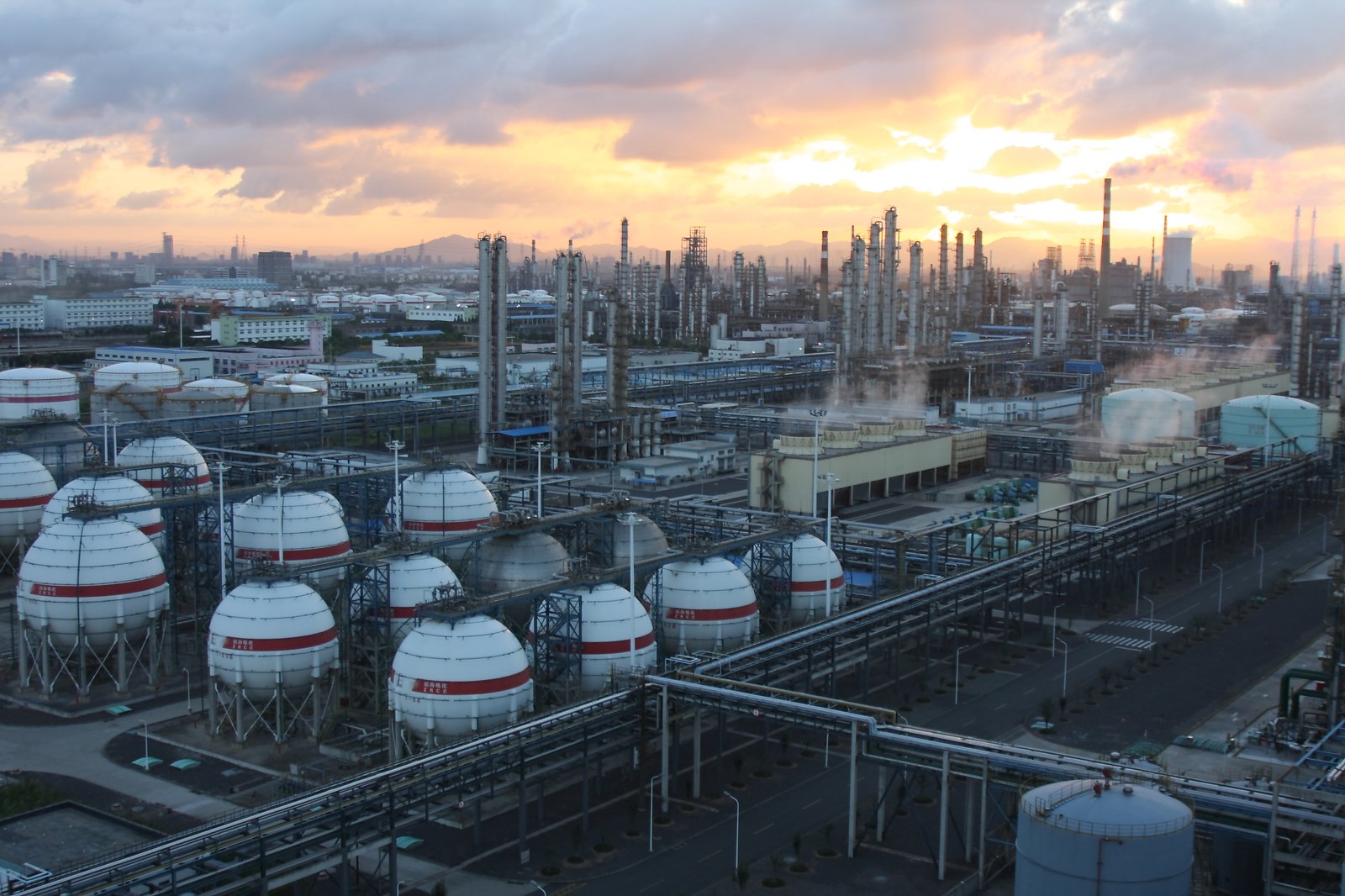
Kuwait's hazardous-area lighting demand runs on two layers at once: a regionally significant new refinery that is now at full tilt, and a thick base of ageing coastal refineries whose lighting is quietly entering its replacement cycle. That split shapes the whole specification conversation. At Al-Zour, commissioned in 2024, the structures were built around modern fixtures; at Mina Al-Ahmadi, commissioned in 1949, points are dense, access openings are small, and pole and rack loads were sized for an earlier era. The same luminaire family rarely serves both without a selection decision — and in a coastal, dust-laden, extreme-temperature belt where most points are retrofits, weight and mounting interface can matter more than lumen output.
Where Kuwait's hazardous-area lighting demand sits
Kuwait's refining capacity sits inside KNPC, whose three refineries together exceed 940,000 bpd. The table below separates new build from the replacement base, because the two behave differently: one releases packages ahead of commissioning, the other releases them against a maintenance and turnaround cycle.
| Asset | Scale | Timeline / status |
|---|---|---|
| Al-Zour refinery | 615,000 bpd | Heavy crude to low-sulfur fuel and petrochemical feedstock; full commissioning 2024; phased gasoline, then aromatics and olefins, then export facilities |
| Al-Zour petrochemical (PRIZe) | ~USD 10–10.5 billion | Integrated with Al-Zour; KIPIC merged into KNPC on 2026-06-02; budget FY 2025/26; not yet at FID; main EPC not awarded — pre-award |
| Clean Fuel Project (CFP) | ~USD 12 billion; launched 2002 | Phase III completed 2020; sulphur to 10 ppm at Euro V; maintenance and lighting-replacement cycle now follows |
| KPC 2040 strategy | 14.5 million t/yr petrochemicals | Direction of spend; 2050 carbon-neutrality goal set |
Al-Zour is the headline new asset: 615,000 bpd, processing heavy crude into low-sulfur fuel and petrochemical feedstock. It advanced in phases — gasoline units, then aromatics and olefins, then export facilities including a port and onshore and offshore pipelines — and reached full commissioning in 2024.
PRIZe is the petrochemical complex integrated with Al-Zour, with an industry estimate of roughly USD 10–10.5 billion. On 2026-06-02 Kuwait approved the merger of KIPIC into KNPC, moving Al-Zour's assets and the petrochemical development to KNPC. The budget was approved in FY 2025/26, but the project has not reached final investment decision and the main EPC contract is not yet awarded — so it is at a pre-award stage, not construction. For a specifier, that means the enclosure, gas group and form-factor groundwork is worth settling now, ahead of the packages.
Public production estimates for PRIZe differ, so both are stated rather than merged:
| Product | Public source A | Public source B |
|---|---|---|
| Polypropylene | 945,000 t/yr | In "aromatics + polypropylene about 2.7 million t/yr" |
| Para-xylene (aromatics) | 1.4 million t/yr | In "aromatics + polypropylene about 2.7 million t/yr" |
| Gasoline | 2 million t/yr | About 1.7 million t/yr |
| Benzene | 421,000 t/yr | Not separately stated in source B |
One source gives polypropylene 945,000 t/yr, para-xylene 1.4 million t/yr, gasoline 2 million t/yr and benzene 421,000 t/yr; another summarises the complex as "aromatics plus polypropylene about 2.7 million t/yr and gasoline about 1.7 million t/yr." The 2.0 versus 1.7 million t/yr gasoline gap and the different aromatics grouping reflect two public framings; the figures are not added together.
The refinery belt: new build and the replacement base
KNPC's existing refineries are the replacement heart of the market, and their age is the point. Mina Al-Ahmadi, about 467,000 bpd and commissioned in 1949, is the oldest and largest in the region; Mina Abdullah, about 473,000 bpd, followed in 1968; Al-Zour, 615,000 bpd, is listed on its own. The three are shown individually and not summed: their aggregate exceeds the ~940,000 bpd headline because phase overlaps sit inside the published figures.
| Refinery | Capacity | Commissioned | Note |
|---|---|---|---|
| Mina Al-Ahmadi | ~467,000 bpd | 1949 | Oldest and largest in the region |
| Mina Abdullah | ~473,000 bpd | 1968 | Mid-life coastal refinery |
| Al-Zour | 615,000 bpd | 2024 (full) | Listed separately, not summed |
The Clean Fuel Project frames the replacement rhythm. Launched in 2002 with total investment around USD 12 billion, its Phase III completed in 2020, pulling diesel and gasoline sulphur to 10 ppm at Euro V. The unit transformation is done; what follows is the operation, maintenance and lighting-replacement cycle of units that are cleaner but still old in their fixtures. KPC's 2040 target of 14.5 million t/yr petrochemicals and 2050 neutrality sets the direction without changing the retrofit reality.
What the Kuwait environment does to a luminaire
Selection in Kuwait is decided less by wattage than by the environmental loads the refinery belt applies. Each load converts into a selection rule.
| Site condition | What it changes in selection | Our data point |
|---|---|---|
| Extreme ambient temperature | Kuwait summers among the most extreme in the Gulf; T-rating read against certified Ta, not a 40°C default; derate if site exceeds | Ta range stated per certificate; confirmed per project |
| Sand and fine dust | Inland dust load high; sealing and enclosure integrity are life-determining | Enclosure sealing treated as a service-life control |
| Coastal salt spray | Al-Zour, Mina Al-Ahmadi and Mina Abdullah all coastal; corrosion is the main life driver | Corrosion-rated, salt-spray tested construction |
| Hazardous-area grade | Refinery units are Zone 1 / Zone 2 mix; Zone 1 needs Ex db | FL7 / HB21 Ex db for Zone 1; FL8 / GS / LU Ex nR for Zone 2 |
| Existing-plant retrofit | Dense points, small access, limited pole and rack load | Weight and interface checked before lumen output |
The first load is ambient temperature. Kuwait summers are among the most extreme in the Gulf, so a T-rating read against a 40°C default is unsafe; it must be read against the certified ambient (Ta) range and derated where the site exceeds it. The other loads act together: inland dust degrades sealing and enclosure integrity, coastal salt spray makes corrosion the main service-life driver, and the Zone 1 / Zone 2 mix means a Zone 1 point needs an Ex db fixture.
Specifying for these sites
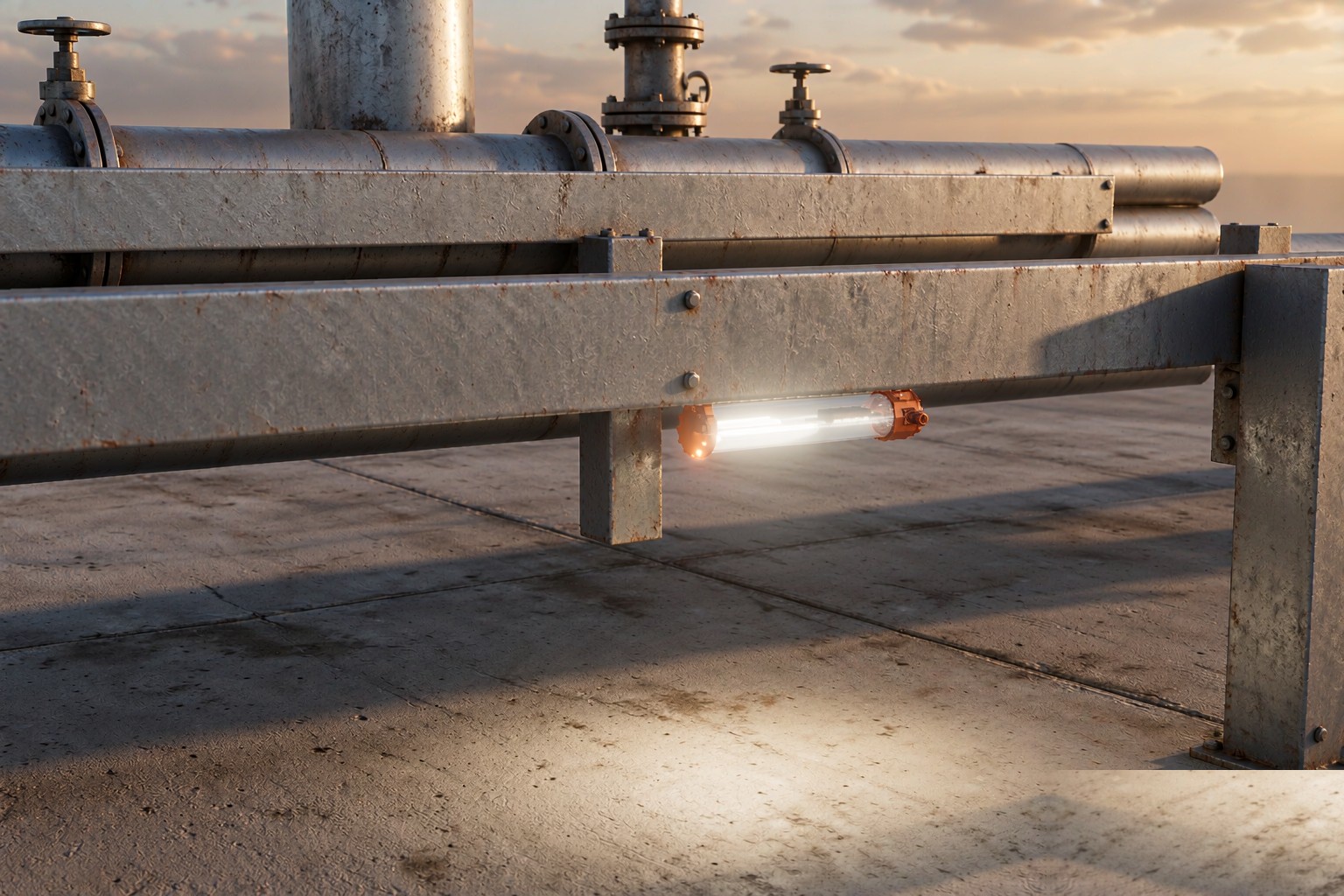
With the environment set, selection follows the IEC 60079-14 rule unchanged: match the equipment protection level to the zone. The table below maps each duty to a recommended form.
| Zone / environment | Recommended form | Selection note |
|---|---|---|
| Zone 1 gas duty | Ex db flameproof (FL7, HB21) | Compressor houses, pump houses, process areas |
| Zone 2 gas duty | Ex nR restricted breathing (FL8, GS, LU) | Usually lower cost for the same output |
| Coastal salt-spray sites | Corrosion-rated enclosure | Applied to every coastal point |
| Continuous runs (pipe racks, walkways) | Linear (LU) | Uniform light along a line, fewer fittings |
| Concentrated points (tank tops, loading, perimeter) | Floodlight (FL8) | Carries output and throw over a wide area |
| Retrofit into existing structures | Weight and mounting interface first | Confirm before lumen output |
For concentrated points — tank tops, loading areas, perimeter and open process areas — a floodlight format carries the output; our FL8 Series explosion-proof floodlight is built for that Zone 2 duty. For pipe racks, walkways and long process runs, a linear format does the work with fewer fittings; our LU Series LED linear luminaire covers those Zone 2 continuous runs. Zone 1 gas duty uses FL7 and HB21, Ex db flameproof. Both linked products ship with the IECEx and ATEX evidence listed below.
The point that surprises buyers from other markets: in older plants, weight and the mounting interface decide the job more than lumen output. With dense points, small access openings and limited pole and rack load, a heavier fixture may fail the structural check, and a mount that does not match the existing interface may need rework. On a retrofit, confirm weight and interface before the photometric number — the light only matters once the fitting is up.
What we provide
The manufacturer's side of the technical file is what we hold and what we hand over. Every number below is stated as issued, and the certificate for a given type is the one listed against that type.
| Document | Number | Issued by / covers |
|---|---|---|
| ATEX Type Examination Certificate | CSANe 25 ATEX 1229X | CSA Group (Netherlands) — LO series |
| IECEx Certificate of Conformity | IECEx CSA 25.0093X | CSA Group — LO series |
| ATEX Quality Assurance Notification (QAN) | CSANe 26 ATEX M076 | CSA Group Netherlands — LO series |
| IECEx Quality Assessment Report (QAR) | GB/CSAE/QAR26.0002/00 | CSA Group (UK) — LO series |
| ATEX Type Examination Certificates | TÜV CY 26 ATEX 0207611 / 0207612 / 0207613 X | TÜV (Cyprus); FL8, GS and LU series |
In practice we supply the IECEx test reports, the IECEx Certificates of Conformity, the IECEx QAR, the ATEX certificates and the quality assurance notification, together with installation manuals and the parameter set behind each series — the technical evidence a project needs in order to assess the equipment.
What we need from you to quote
For a quote and lead time, please provide: the area-classification drawing (Zone 1 / Zone 2, gas group, temperature class); the site ambient temperature range and the mounting height; the existing mounting interface and any weight limit on the rack or pole; the required illuminance and uniformity for the task; the supply voltage and frequency; and the project node and required arrival time. With those we can match the EPL, the certified ambient range and the format to the duty, and return a bill of materials rather than a single catalogue item.
Frequently asked questions
Which luminaire type fits a refinery unit that mixes Zone 1 and Zone 2?
Match the protection level to the zone per IEC 60079-14. Zone 1 gas duty uses Ex db flameproof construction (our FL7 and HB21); Zone 2 can usually use Ex nR restricted breathing (our FL8, GS and LU), which typically costs less for the same output. A site that mixes zones but is specified under one luminaire type number is a specification error, not a saving — group and zone are matched per point against the classified-area drawing.
What ambient temperature rating do Kuwait refineries require?
Kuwait summers are among the most extreme in the Gulf, so the temperature class must be read against the certified ambient (Ta) range on the certificate, confirmed per project, not a 40°C default, and derated where the site exceeds it. We state the Ta range per certificate and confirm it before selection; a fixture whose Ta does not cover the measured site temperature will fail at commissioning regardless of its catalogue performance.
Why does weight and the mounting interface matter more than lumen output in older plants?
At Mina Al-Ahmadi (1949) and Mina Abdullah (1968) the points are dense, the access openings are small, and the pole and pipe-rack loads were sized for an earlier era. A heavier fixture can fail the structural check, and a mount that does not match the existing interface may need rework. On a retrofit, confirm weight and interface before the photometric figure — the light only matters once the fitting is up.
Which of your products cover Zone 1 versus Zone 2 for Kuwait refinery work?
For Zone 2 gas duty we offer the FL8 Series explosion-proof floodlight and the LU Series LED linear luminaire (both Ex nR), plus the GS linear and high-bay type. For Zone 1 gas duty, FL7 and HB21 are Ex db flameproof. All ship with the IECEx and ATEX evidence listed in the certificate table; the exact certificate for a given type is confirmed against that table rather than assumed from the series name.
How is a retrofit point on an ageing refinery assessed?
Start from the structure, not the photometric curve. Confirm the existing mounting interface (bracket, pole, pipe-rack rail), the weight and wind-load the support can carry, and the access arrangement for maintenance. Where the point sits in a dense, small-opening area, a compact form that drops into the existing interface avoids re-engineering the support. Zone, gas group and certified ambient range are then matched to the point as on any new build.
- About Us
- Products
- Explosion proof light
- Portable explosion proof lighting
- Explosion proof emergency light
- Explosion proof LED T8 tube
- Explosion proof Junction Box
- Explosion proof street light
- Service
- FAQ
- Docs download
Service hotline
Tel:+86 755 29846615
Work time:9:00-20:00
E-mail:sales02@seekingled.com
address:5F, Building 5, Guole Science and Technology Park, Lirong Road, Dalang Street, Longhua, Shenzhen, China