

Explosion Proof Lighting UAE: ADNOC Capex and the Project Ledger
One cluster, five parallel builds
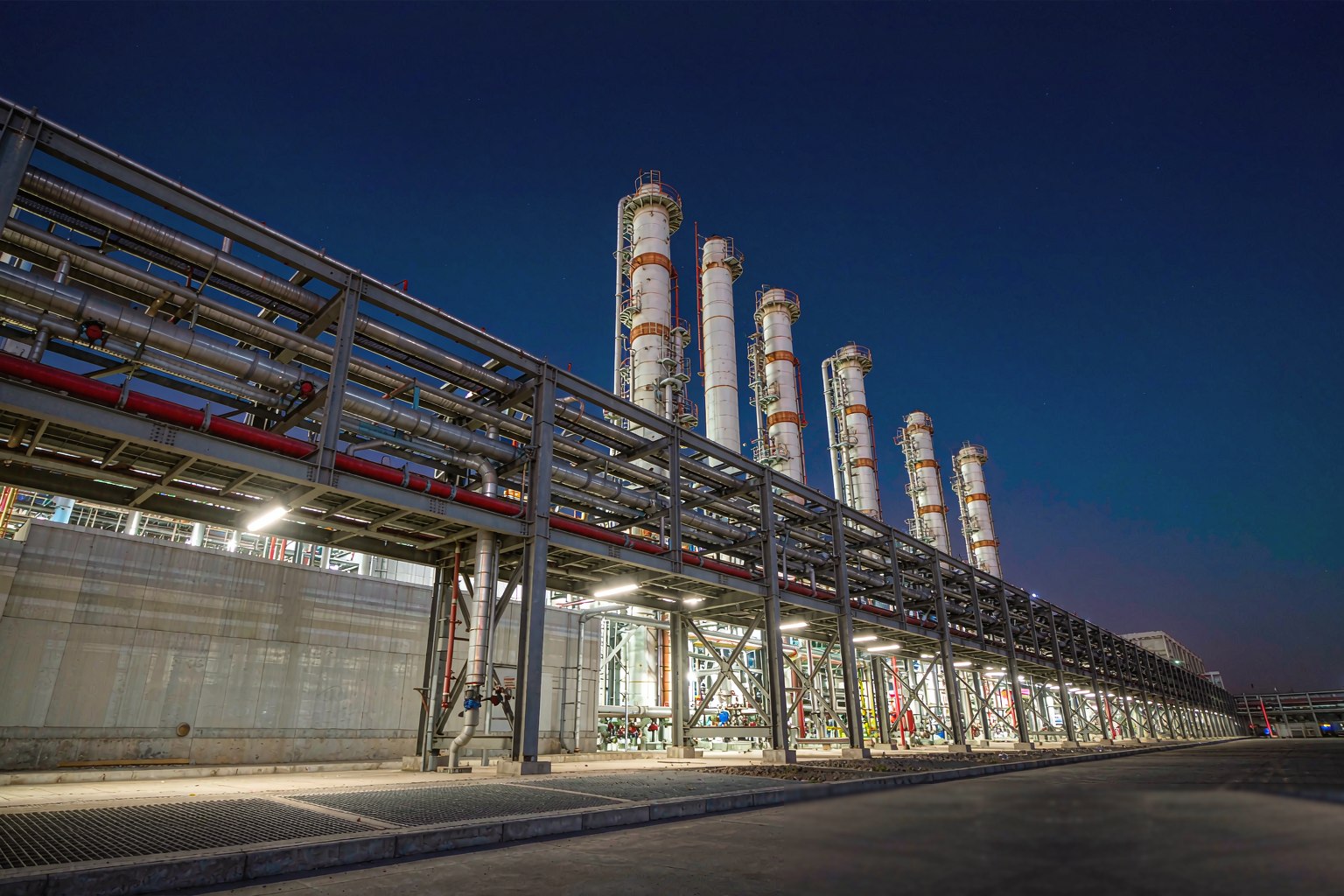
To size hazardous-area lighting demand, start from the owner's capital plan, not the refinery count — lighting rides with the plant as electrical material. In the UAE that plan is clear: ADNOC's board approved a 2026–2030 capex of US$150 billion (AED 551 billion) in Nov 2025, with about US$60 billion returned through the In-Country Value (ICV) programme, aimed at upstream, gas, and downstream chemicals. Where the money lands is unusually concentrated: Al Ruwais Industrial City west of Abu Dhabi, and the Habshan–Bab–Ghasha gas line.
Ruwais is not one project but a cluster: LNG, chemicals, polyolefins and gas processing rising in parallel. For a buyer of certified luminaires that means the same fitting is bought repeatedly inside one project cluster — every electrical-package release is a batch.
The project ledger west of Abu Dhabi
The table lists verifiable projects in execution and what each one means for lighting. It is a demand map, not a reference list — we make no claim to have supplied any project below.
| Project | Owner / JV | Scale and stage | What it means for lighting |
|---|---|---|---|
| Ruwais LNG | ADNOC (ADNOC Gas plans to acquire 60% in 2028) | 9.6 Mt/yr (two trains of 4.8); EPC ~US$5.5 billion; commercial operation 2028; offtake above 90% of capacity by Jul 2026 | Liquefaction, tank farms, jetties and pipelines form a wide hazardous area; lighting releases in batches with the electrical packages |
| TA'ZIZ phase 1 | ADNOC + ADQ JV | 4.7 Mt/yr chemicals (1 Mt ammonia, 1.8 Mt methanol, 1.9 Mt PVC); start-up 2027–28 | Chemical frames, pump shelters, packaging and warehousing in Zone 1/2 and dust |
| Borouge 4 | ADNOC + OMV (Borouge operates) | +1.4 Mt/yr polyolefins, 6.4 Mt/yr in total — the largest single-site polyolefin base; built end-2025, ramping through 2026 | Late-phase electrical packages and replenishment of a site in ramp-up |
| Hail & Ghasha | ADNOC 70% + Eni / PTTEP / OMV / LUKOIL | 1.8 bscfd gas; EPC ~US$17 billion; 2028 | Artificial islands, drilling centres, 300+ km of subsea lines and onshore sour-gas processing — the densest lighting scope of the set |
| Habshan gas processing | ADNOC Gas | Supplies about 60% of UAE gas demand; CCUS ~1.5 Mt/yr | Operating plus continuous revamp: turnarounds and expansions are the steadiest batch-replenishment source |
Tanks, jetties and the second demand line
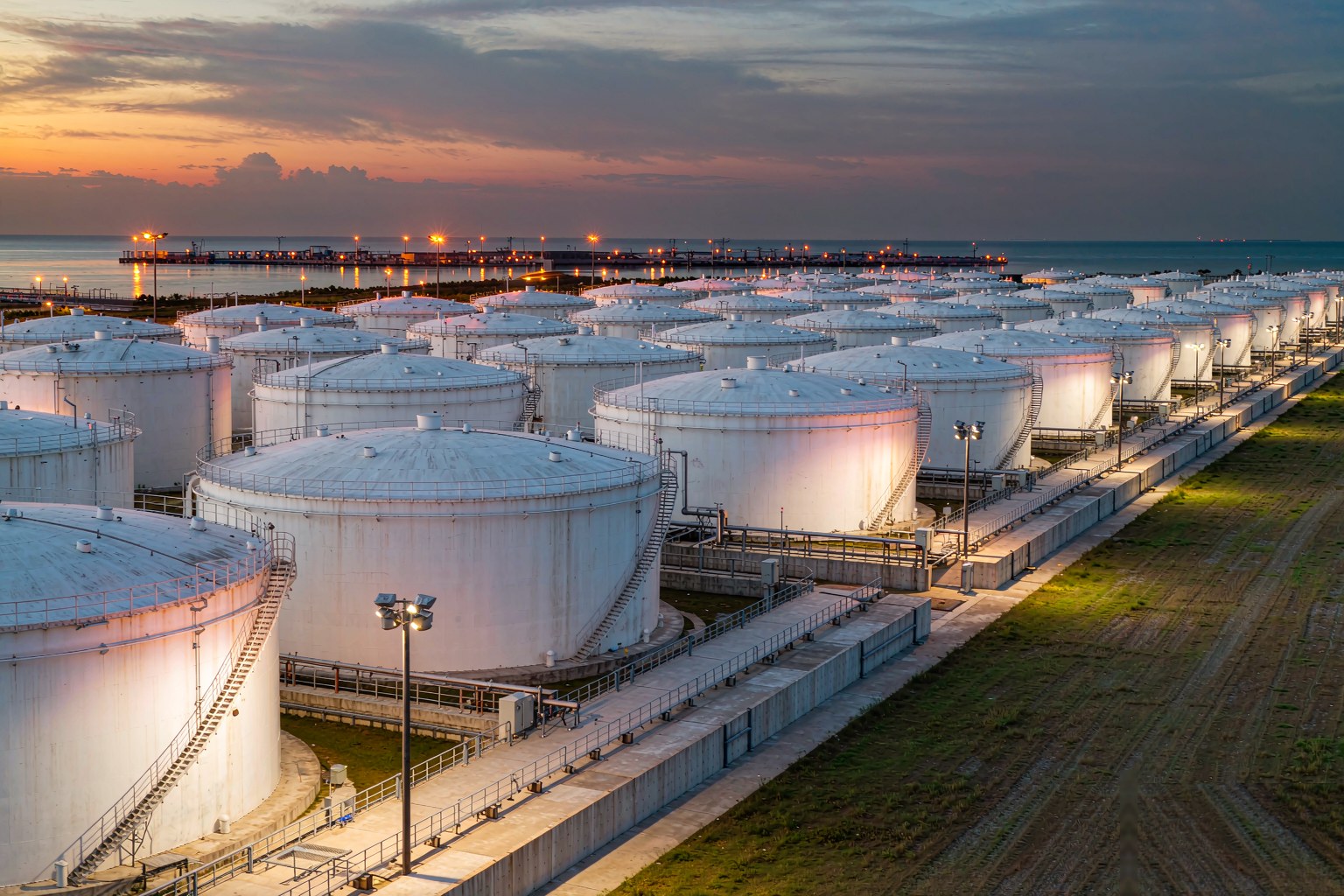
Beyond Abu Dhabi's plant zone sits a second demand line: storage and ports — large areas, scattered points, high night-time intensity, and old facilities refurbished alongside new ones. The Fujairah storage cluster (FOIZ) alone holds about 9.8 million m³ of tank capacity across 14 terminal operators (end 2024), with the industry expecting above 11.2 million m³ by end 2026. Fujairah port phase 3/3A adds roughly 1.09 million m³ and is in detailed design and EPC finalisation — exactly the stage where lighting and electrical packages enter procurement. The second east-west pipeline (~1.5 million b/d, 2027) brings its own pump stations and terminals.
Jebel Ali refinery (ENOC, ~210,000 b/d, an upgrade to ~250,000 b/d proposed) and KEZAD / Khalifa Port (550 km², about 55% of the UAE's industrial land) anchor the park-level demand: oil depots, pump stations and wastewater (biogas) lighting serving the manufacturing and warehousing clusters around Dubai Industrial City.
Remember the difference in rhythm: Abu Dhabi is plant-type demand bought by package; the Northern Emirates are storage-type demand bought by batch — different cycles, different price sensitivity.
What happens between turnarounds
Looking only at new projects misses more than half the UAE market. Three existing-asset demands are always present:
- Turnaround and inspection windows — plants shut down on a cycle; replacing electrical and lighting during a turnaround is the easiest single batch order.
- Capacity-expansion revamps — old plants keep the original model but change type when it is discontinued and spares run out, which reopens the luminaire specification for the affected areas.
- Recovery works — in H1 2026, some UAE energy facilities saw shutdowns and maintenance from regional volatility, then concentrated recovery in Q2–Q3, normally with a full inspection and replacement of electrical and lighting systems.
Where the model gets locked — and why it stays locked
The luminaire model on a UAE plant is not chosen at construction. It enters the electrical equipment list at design stage — FID and FEED, where the owner and the design house's electrical team fix type, area suitability, protection and corrosion grade — and is then held: the EPC firms up the electrical package at award, the main batch releases follow the MEP packages in mid-construction (pipe racks, unit frames, tank farms and jetties, zone by zone), commissioning adds emergency and special-point fittings, and operation runs the longest cycle of all: spares, replacements and expansion replenishment.
Why so rigid? An explosion-proof luminaire is one certified assembly — housing, light source, driver, seals and brackets must match — and projects reject close-enough substitutes once the type is in the equipment list. Changing the type late means re-opening the equipment list, re-checking the area classification against the new certificate and re-planning the batch schedule; the later the change, the higher the cost.
Rack runs, tank tops and the fittings they take
The common hazardous-area points on UAE projects fall into four shapes, and the project's area drawing is always final. Long structural runs — pipe racks, trestles, walkways — take linear fittings laid along the rack: runs the drawing shows as wholly Zone 2 are covered by the LU Series LED linear luminaire (Ex nR), and runs crossing a Zone 1 pocket by the LO Series explosion-proof linear light, an Ex db type certified for Zone 1 and Zone 2 as well as Zone 21 and Zone 22. Concentrated points — tank tops, loading racks, jetties — take floodlights, where mounting height and throw decide whether the tank top sees light or glare; that is the FL8 floodlight's duty, with coastal corrosion in mind. Pump shelters, compressors and frames combine high-bay and flood, with maintenance access and heat sources in mind. Powder and granular storage (Zone 21/22) takes Ex tb dust-deposition-resistant construction that balances cleaning against heat dissipation. Escape routes and emergency points must match the grade of the area they serve and run on an independent circuit.
Market-entry paperwork: ECAS-Ex, in brief
Certificates alone do not put a luminaire on a UAE site — there is a market-access layer on top. Explosive-atmosphere equipment entering the UAE falls under ECAS-Ex, administered by the Ministry of Industry and Advanced Technology (MOIAT) under Cabinet Resolution No. 23 of 2016. It is a mandatory certificate of conformity (CoC), and the evidence base is the IECEx system rather than ATEX: the file rests on an IECEx test report (TR), test certificate (TC) and a factory quality assessment report (QAR) issued within the last 12 months — an ATEX quality assurance notification does not substitute. The CoC is valid for three years with annual surveillance, and the application is filed by the UAE importer or local agent, not by the overseas manufacturer. For a UAE project file, that makes the IECEx side of our evidence the first set to prepare: certificate IECEx CSA 25.0093X and QAR GB/CSAE/QAR26.0002/00 for the LO series.
Before you shortlist a supplier
Ten items in an enquiry return a right-first-time quotation: hazardous-area grade and scope, with the area drawing; gas and dust groups; temperature class and maximum ambient — the most overlooked line in UAE summer; protection type (Ex db / Ex nR / Ex tb); ingress protection — genuine dust-proof build, IP67 + IK10 across the range (BT8 designed to IP33); corrosion grade, usually C4 (ISO 12944) on the coast; mounting and height; illuminance and uniformity; emergency-lighting requirements; and spares for long-term supply.
On the manufacturer's side, every number is stated as issued, and the certificate for a given type is the one listed against that type, not assumed from the series name: ATEX type-examination certificate CSANe 25 ATEX 1229X and quality assurance notification (QAN) CSANe 26 ATEX M076 for the LO series, both issued by CSA Group (Netherlands notified body); type-examination certificates TÜV CY 26 ATEX 0207611 / 0207612 / 0207613 X for the FL8, GS and LU series, issued by TÜV NORD; and the IECEx evidence as in the section above.
The project information on this page is public information only; we make no claim to have supplied any specific project listed above.
- About Us
- Products
- Explosion proof light
- Portable explosion proof lighting
- Explosion proof emergency light
- Explosion proof LED T8 tube
- Explosion proof Junction Box
- Explosion proof street light
- Service
- FAQ
- Docs download
Service hotline
Tel:+86 755 29846615
Work time:9:00-20:00
E-mail:sales02@seekingled.com
address:5F, Building 5, Guole Science and Technology Park, Lirong Road, Dalang Street, Longhua, Shenzhen, China