

Hazardous Area Lighting UK: ATEX, UKCA & CE Rules in 2026
Explosion-Proof Lighting in Great Britain: What the Rules Actually Require in 2026
Great Britain's hazardous-area map is being redrawn, and not in the direction most suppliers expect. Refining has contracted — Grangemouth and the Prax Lindsey refinery have both stopped refining — while the same industrial clusters are being rebuilt around hydrogen, carbon capture and import terminals. National Gas is repurposing more than 2,400 km of the national gas transmission network to carry 100% hydrogen under Project Union, supported by £164 million of public funding confirmed through 2026, with the St Fergus–Grangemouth–Teesside corridor now in advanced engineering design and completion targeted for the mid-2030s. At Stanlow, Essar's HyNet project is scheduled to deliver 1 GW per year of low-carbon hydrogen, and the site now supplies around 18% of UK road fuel and 12.5% of jet fuel.
That shift matters to anyone buying luminaires, because hydrogen is an IIC gas, and the new projects sit exactly where the old ones did. But before any technical selection, two questions decide whether a quotation is usable in Great Britain at all: does the fixture need a UK certificate, and does an ATEX certificate on its own make an installation legal? The answers are "not necessarily" and "no" — and both are routinely mis-stated, including by suppliers who should know better.
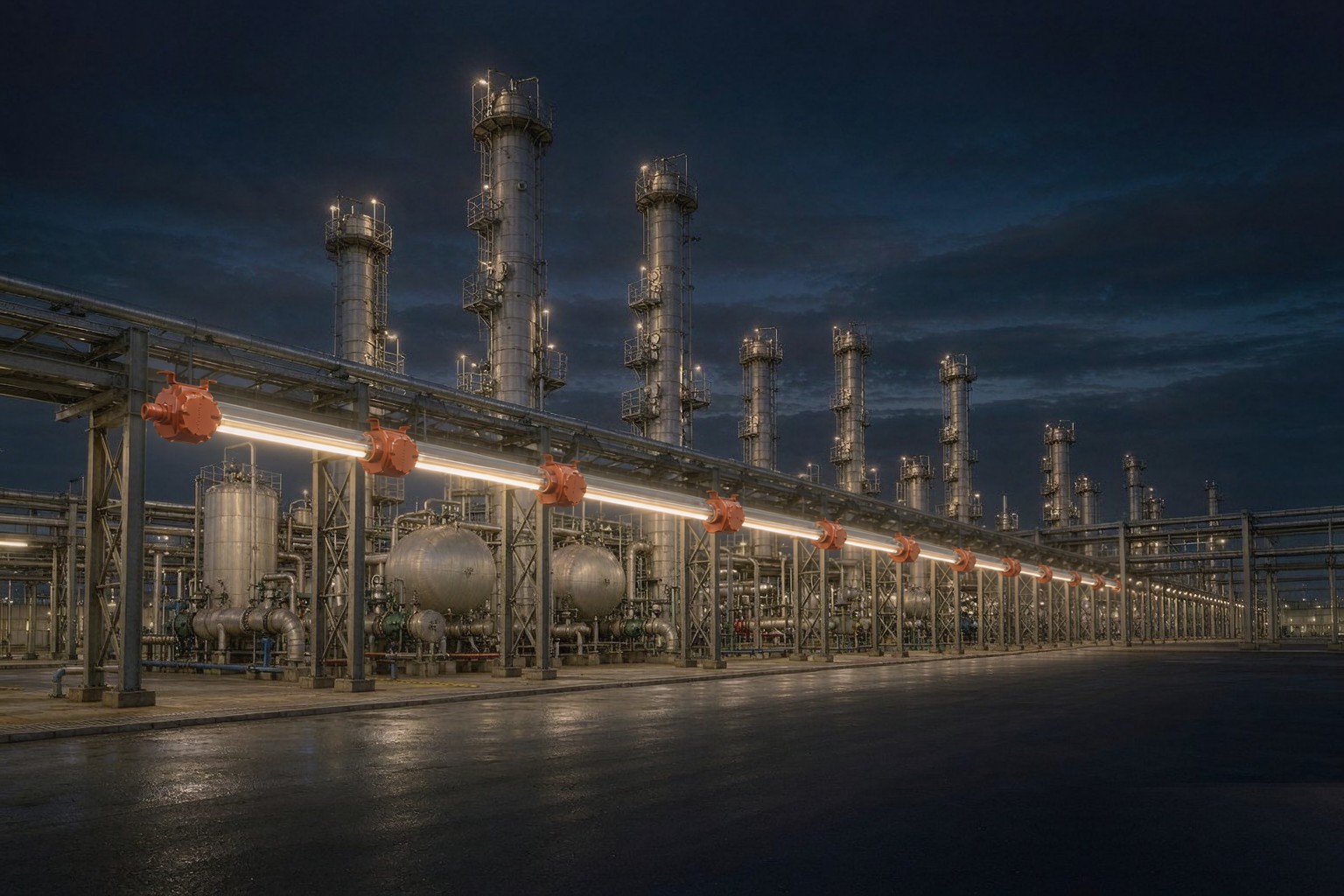
Where Great Britain's hazardous areas actually are
GB demand is not spread evenly across the country. It clusters on the industrial estuaries and around the gas terminals, and the composition of that demand is changing faster than the sites themselves. The table below maps what is driving specification work in 2026 and 2027.
| Location | Facility type | Status in 2026 |
|---|---|---|
| Grangemouth, Scotland | Refinery site converting to import terminal, low-carbon fuels and hydrogen | Refining ended; site pivoting to fuel import, biofuel and a low-carbon hydrogen project linked to the Acorn CO2 cluster |
| Stanlow, North West England | Refinery and HyNet hydrogen hub | Operating; largest remaining UK refinery by throughput, anchor of the HyNet industrial cluster |
| Teesside, North East England | Hydrogen production and carbon capture cluster | East Coast Cluster projects in development; hydrogen network phase in design |
| Humber and Immingham | Refining, bulk liquid terminals, hydrogen | Operating; part of the East Coast Cluster and the Project Union route |
| St Fergus, Aberdeenshire | Gas terminal, hydrogen network starting point | Operating; the northern anchor of the Project Union hydrogen backbone |
| Milford Haven, Wales | LNG import terminals and refinery | Operating; identified as a future hydrogen network extension |
| Isle of Grain, Bacton, Southampton | Gas and LNG terminals, fuel storage | Operating; named in National Gas plans for later hydrogen network extension |
| United Kingdom Continental Shelf | Offshore oil and gas platforms | Mature basin in managed decline, with a growing decommissioning and late-life modification workload |
| Salt cavern and depleted field storage | Underground gas storage; planned hydrogen storage | Operating for natural gas; sites under assessment for large-scale hydrogen storage |
The procurement consequence is a timing one. A hydrogen or CCS project that takes its final investment decision in 2026 specifies its luminaire packages roughly six to nine months ahead of construction. If the certification route is still being debated at that point, the paperwork — not the product — becomes the critical path.
The UKCA question: what changed on 1 October 2024
This is the single most important paragraph on this page, and it is the one most competitors get wrong. A large number of supplier websites, and a surprising number of recent articles, still tell buyers that equipment placed on the GB market must carry the UKCA mark and a UK-Type Examination Certificate. That has not been true since 1 October 2024.
The Product Safety and Metrology etc. (Amendment) Regulations 2024 (SI 2024/696) were made on 23 May 2024 and came into force on 1 October 2024. They extend recognition of EU requirements, including the CE marking, indefinitely in Great Britain, covering 21 product regulations — among them the Equipment and Protective Systems Intended for Use in Potentially Explosive Atmospheres Regulations 2016 (SI 2016/1107), which is the GB transposition of the ATEX Directive 2014/34/EU. In plain terms: ATEX-certified equipment bearing the CE mark, assessed by an EU notified body where a notified body is required, can be placed on the GB market with no UK certificate at all.
Two clarifications that follow from this, and which are worth stating explicitly because they cause avoidable purchase orders:
| Item | ATEX route (CE) | UK route (UKCA, commonly called "UKEX") |
|---|---|---|
| Legal basis | Directive 2014/34/EU, as recognised by SI 2024/696 | SI 2016/1107 as amended |
| Third-party body | EU notified body, listed in NANDO | UK approved body, listed in the UK Market Conformity Assessment Bodies database |
| Type examination | EU-Type Examination Certificate | UK-Type Examination Certificate |
| Production quality | Quality assurance notification from a notified body | Equivalent notification from a UK approved body |
| Declaration | EU Declaration of Conformity | UK Declaration of Conformity |
| Marking | CE + notified body number + Ex hexagon + group and category | UKCA + approved body number + Ex hexagon + group and category |
| Accepted in Great Britain | Yes, indefinitely, since 1 October 2024 | Yes |
| Accepted in Northern Ireland | Yes — and it is the required route | No; CE alone, or CE + UKNI if a UK body is involved |
| Accepted in the EU / EEA | Yes | No |
"UKEX" is not a term in the legislation. It is certification-industry shorthand for UKCA certification of Ex equipment under the 2016 Regulations, and it appears on quotation sheets far more often than it appears in law. When a supplier quotes "UKEX certification", the correct question is which UK approved body issued the certificate, and whether that certificate number can be verified in the UK Market Conformity Assessment Bodies database.
Two practical points on marking and labelling. Until 31 December 2027, the UKCA marking may be affixed to a label or to a document accompanying the equipment rather than to the equipment itself, and importer details may be given on the packaging or accompanying documentation. And because the Product Regulation and Metrology Act 2025 gives ministers powers to change product rules through secondary legislation, the position should be re-checked against current Department for Business and Trade guidance before a long-running framework order is fixed — not assumed from a page written in 2023.
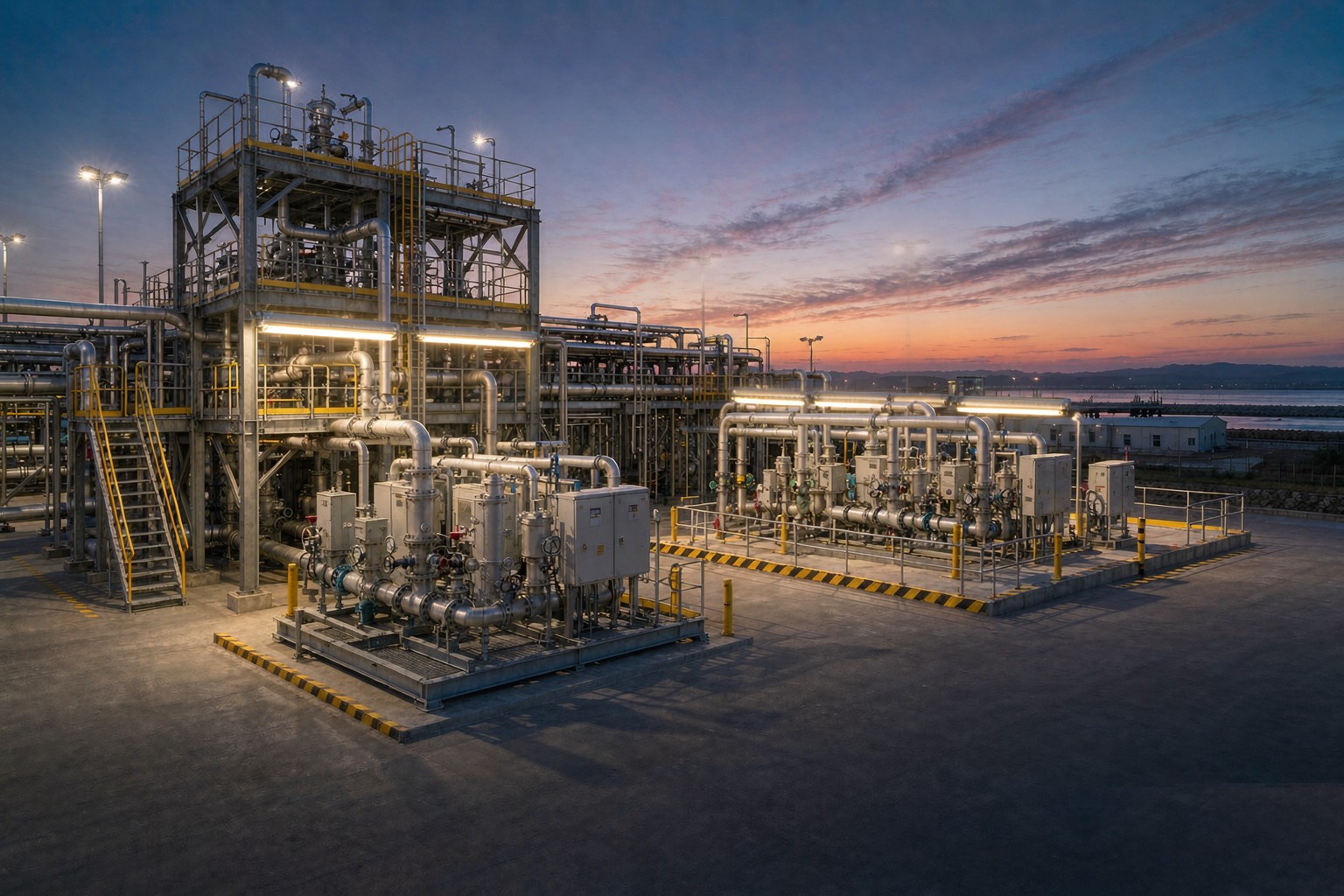
Certification is only half of it: DSEAR and the site-side duty
The second misconception is more expensive, because it surfaces at commissioning rather than at purchase. A CE or UKCA marked luminaire being legally placed on the GB market does not make the installation compliant. Product law and workplace law are separate regimes, and in Great Britain the workplace side is governed by the Dangerous Substances and Explosive Atmospheres Regulations 2002 (DSEAR, SI 2002/2776).
DSEAR transposes the ATEX workplace Directive 1999/92/EC into GB law, and since a 2015 amendment it also covers gases under pressure and substances corrosive to metals. It places the duty on the employer or duty holder — not on the luminaire supplier — to assess and control fire and explosion risk from dangerous substances. The Health and Safety Executive enforces it at most workplaces; at petroleum-licensed premises the petroleum licensing authority takes the refuelling activities, and fire and rescue authorities cover general fire safety.
| DSEAR obligation | What it means for a lighting package |
|---|---|
| Written risk assessment (regulation 5) | Employers with five or more employees must record the significant findings, including where explosive atmospheres could form |
| Hazardous area classification | Zones are defined using BS EN 60079-10-1:2021 for gas and vapour, and BS EN 60079-10-2 for dust, and must be documented on hazardous area drawings — the single most requested document during an HSE intervention |
| Equipment selection and installation | Equipment EPL (Ga, Gb, Gc, Da, Db, Dc) must be matched to the zone in accordance with BS EN 60079-14; temperature class and gas group come from the same study |
| Inspection and maintenance | Installed equipment is inspected to BS EN 60079-17; the luminaire's certified assembly — including cable entries and glands — must be maintained as certified |
| Explosion protection document | HSE's approved code of practice L138 confirms that the EU requirement for a separate document is met in GB by the DSEAR risk assessment and the measures under regulations 5, 6 and 7 |
Hydrogen changes the gas group — and most new UK projects are hydrogen
Almost every new GB energy project on the list above involves hydrogen somewhere in the process, and hydrogen is a IIC gas. This is where a specification that looks correct on a data sheet becomes a non-compliant installation: equipment certified for gas group IIB, which covers most refinery hydrocarbon streams, cannot be installed in a hydrogen-classified area.
| Gas | Gas group | Temperature class | Typical GB application |
|---|---|---|---|
| Hydrogen | IIC | T1 (auto-ignition 560 °C) | Electrolyser plants, hydrogen pipelines, blending skids, storage and loading |
| Methane / natural gas | IIA | T1–T3 | Gas terminals, transmission and distribution, LNG regasification |
| Ethylene, hydrogen sulphide | IIB | T3–T4 | Petrochemical units, refinery process areas |
| Ammonia | IIA | T1 | Fertiliser and chemical plants, ammonia import terminals |
| LPG, solvents, aviation fuel vapour | IIA / IIB | T2–T3 | Bulk liquid terminals, tank farms, loading gantries |
The temperature class is the counter-intuitive part. Because hydrogen auto-ignites at 560 °C, T1 is technically sufficient, which leads some buyers to specify the cheapest available fixture. Gas group is the constraint that actually bites: IIC covers hydrogen, acetylene and carbon disulphide, and IIC-certified luminaires are a smaller and more expensive subset of the market. For a hydrogen area, specifying IIC is not optional and cannot be traded against a lower temperature class. If the boundary between Zone 1 and Zone 2 is still being argued at specification stage, our comparison of what actually changes between Zone 1 and Zone 2 lighting sets out the equipment consequences.
Specifying luminaires for British site conditions
Certification puts a fixture on site; specification keeps it working. Four conditions do most of the damage in Great Britain.
| Condition | Where it bites | Specification response |
|---|---|---|
| Marine and coastal corrosion | Milford Haven, Stanlow, Teesside, Grangemouth, any North Sea-adjacent site | C4 corrosion resistance to ISO 12944 as standard; 304 stainless steel cable entry hardware and plugs |
| Persistent wet and damp | Outdoor and semi-enclosed installations nationwide | IP67 sealing on the body, with correct cable entry and gland discipline — the gland is part of the certified assembly |
| Low ambient and temperature cycling | Scotland, northern England, offshore and exposed coastal sites | Luminaires rated from −20 °C, with thermal design that holds T6 at full power rather than derating the fixture |
| Vibration and mechanical abuse | Offshore platforms, pump houses, compressor areas, loading gantries | IK10 impact rating (20 J), vibration-tolerant mounting, no glass optic cover |
Our range addresses these as standard rather than as options: IP67 and IK10 across the series (the BT8 tube light is IP33 by design, since it fits an existing G13 enclosure), C4 corrosion resistance to ISO 12944, and 100–277 V AC input. For coastal sites, our note on lighting specification for marine and coastal environments covers the corrosion and ingress detail in more depth.
Which series fits which area
| Application | Typical zone | Series | Power range | Certification |
|---|---|---|---|---|
| Process unit general lighting, pipe racks | Zone 1 / 2, gas group IIB | FL7 flood light | 60–400 W | ATEX + IECEx |
| Hydrogen and IIC areas, high-bay workshops | Zone 1 / 2, gas group IIC | HB21 high bay | 15–300 W | ATEX + IECEx |
| Linear runs, corridors, cable tunnels | Zone 1 / 2, gas group IIB | LO linear light | 20–80 W | ATEX + IECEx |
| Terminal roads, tank farm perimeter | Zone 2, gas group IIC | FL8 street light | 50–200 W | ATEX + IECEx |
| Loading gantries, canopy areas, retail fuel | Zone 2 / 22 | GS canopy light | 100–200 W | ATEX |
| Dust-handling and process interiors | Zone 2 / 22 | LU linear light | 40–150 W | ATEX |
| Emergency egress and exit marking | Zone 1 / 2 | BAJ52 emergency, BAYD82 exit sign | 2×3 W / 6 W | ATEX + IECEx |
Note the certification column for the GB market specifically. The GS and LU series hold ATEX certification only, with no IECEx certificate. Under the pre-2024 rules that would have made them awkward for Great Britain; under the current recognition of CE marking, an ATEX certificate is a complete route onto the GB market. Buyers who were told these series need a UK certificate should ask a more precise question.
What to send us for a quotation
Full specifications, photometric data and the certificate set for each series are on the product pages — FL7 flameproof flood light, HB21 high bay, LO linear light and GS canopy light.
For a GB project the fastest route to a usable quotation is sending four things: the hazardous area drawing or a list of zones, gas groups and temperature classes; mounting positions and heights; the ambient temperature range at the site; and whether the order needs CE-marked ATEX equipment only, or a UKCA certificate alongside it. Send those to sales02@seekingled.com and we will return a lighting layout, the recommended series and wattage, and the certificate set for your technical file.
SEEKING LED-LIGHTING LIMITED supplies the certified luminaires and the documentary set behind them. The DSEAR risk assessment, the zoning study and the declaration of conformity for the installation remain with the duty holder and their competent person — and where a certificate's authenticity needs checking before payment, the method is set out in our guide to verifying an ATEX certificate before you pay, which applies unchanged to the certificate file behind a UKCA-marked unit.
Frequently Asked Questions
Does equipment placed on the GB market now have to be UKCA marked?
No, not for the equipment regulations in scope of SI 2024/696, which includes the Equipment and Protective Systems Regulations 2016 governing Ex equipment. Since 1 October 2024, CE marking has been recognised indefinitely in Great Britain, so an ATEX-certified unit with a CE mark can be placed on the GB market with no UK certificate. UKCA remains available as an alternative route, and the two may be used together where both sets of requirements are met.
Is "UKEX" the same as UKCA?
Effectively yes, with one caveat worth knowing. "UKEX" is not a term used in the legislation; it is certification-industry shorthand for UKCA certification of explosion-protection equipment under the 2016 Regulations. A quotation that says "UKEX certified" should be read as "UKCA certified by a UK approved body", and the certificate number should be verifiable in the UK Market Conformity Assessment Bodies database.
Can I still use CE-marked ATEX luminaires in Great Britain?
Yes. CE marking has been recognised indefinitely in Great Britain since 1 October 2024 under SI 2024/696, alongside UKCA marking. This is one of the most commonly mis-stated points on supplier websites, many of which still reflect the pre-2024 transitional position. Northern Ireland is different: it continues to follow EU rules and requires CE marking.
Do I need a UK certificate to sell into Great Britain from outside the UK?
No, provided the product carries CE marking and was conformity assessed in line with the ATEX Directive, including by an EU notified body where a notified body is required. There is no general requirement for a UK representative or UK certificate. Importers do have obligations — importer identification details must be traceable, and until 31 December 2027 those details may be placed on packaging or accompanying documentation rather than on the product.
What certificate should I request for a hydrogen project in the UK?
For equipment, request the EU-Type Examination Certificate and the quality assurance notification behind the CE mark, and confirm the gas group is IIC — hydrogen sits in gas group IIC, so IIB-certified luminaires cannot be installed in a hydrogen-classified area. Separately, the site's DSEAR risk assessment and hazardous area drawings must show the equipment EPL matched to the zone in accordance with BS EN 60079-14; that document set belongs to the duty holder, not to the luminaire supplier.
- About Us
- Products
- Explosion proof light
- Portable explosion proof lighting
- Explosion proof emergency light
- Explosion proof LED T8 tube
- Explosion proof Junction Box
- Explosion proof street light
- Service
- FAQ
- Docs download
Service hotline
Tel:+86 755 29846615
Work time:9:00-20:00
E-mail:sales02@seekingled.com
address:5F, Building 5, Guole Science and Technology Park, Lirong Road, Dalang Street, Longhua, Shenzhen, China