

Industrial Explosion Proof Lighting Guide: Refineries, Tank Farms and Terminals
Refineries and oil terminals carry the largest single concentrations of classified-area lighting on any industrial site. A single process unit can hold thousands of fixtures across pipe racks, pump rows, tank perimeters and the marine loading interface, and the demand repeats as the same plant type is built again across the Gulf, South and Southeast Asia. That repetition is what makes the specification worth getting right: the same selection logic is applied hundreds of times inside one project, and a fixture chosen for the wrong ambient or the wrong format is repeated with it. This page sets out where the demand sits, what drives the specification inside a refinery, and which formats carry the load. The fixture count is easy to underestimate for the same reason: the classified points sit where the process runs, not where the people are.
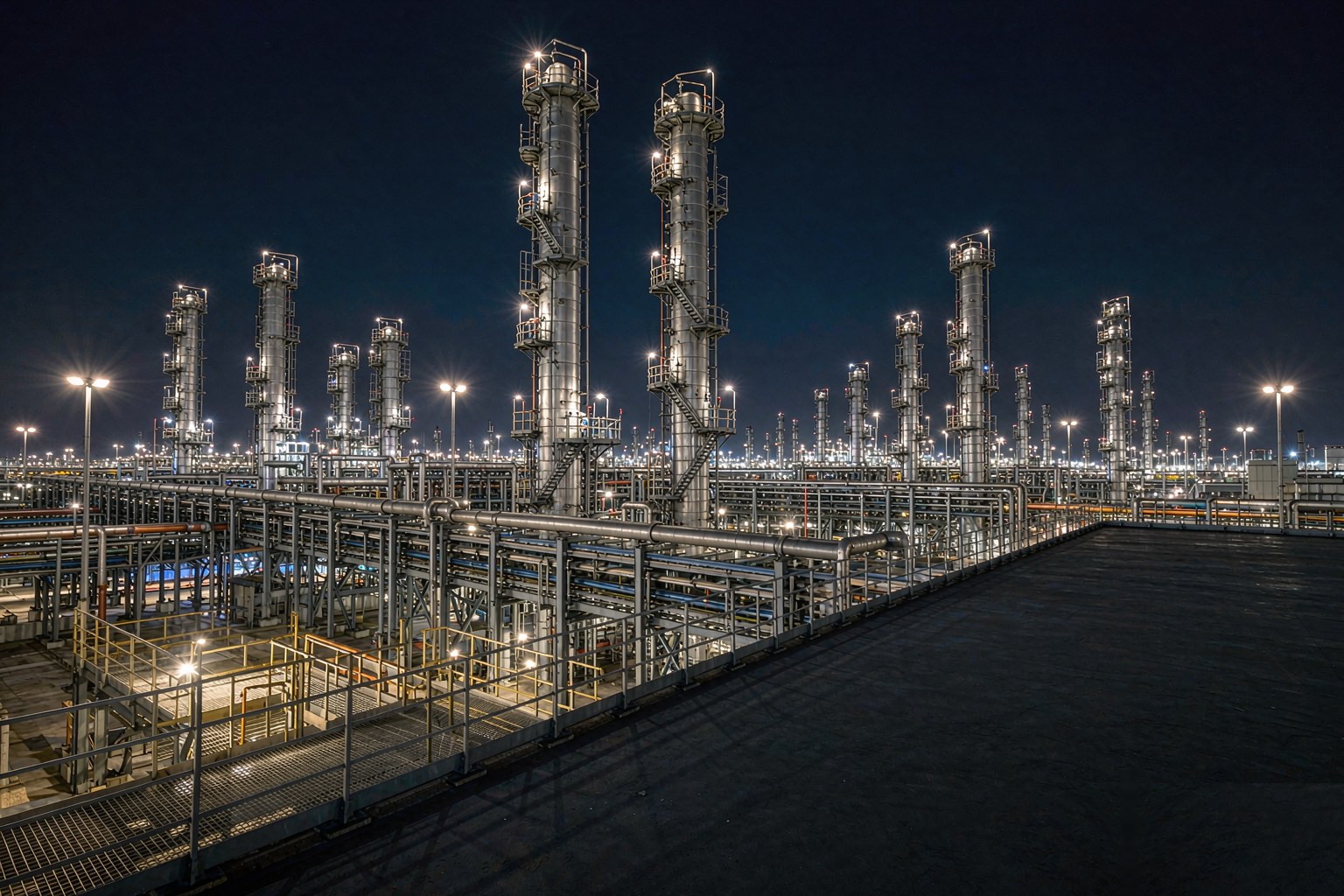
Where refinery and terminal lighting demand sits
Hazardous-area luminaires in a refinery are bought by process area, not by product family, and each area stretches a different part of the specification. Five area types account for most of the fixture count.
| Area type | Typical location | What drives the lighting spec |
|---|---|---|
| Process units | Pipe racks, pump rows, exchangers, fired heaters, compressor houses | Dense structure and deep shadow, mixed Zone 1 / Zone 2, hydrogen and other IIC service in hydroprocessing; high mast and rack-mounted runs |
| Tank farms and storage | Tank roofs, bunded areas, perimeter roads, gauging and sampling points | Long, thin perimeters and access ways where uniform line light beats spot lighting; salt spray on coastal tank farms; Zone 1 at roofs and vents |
| Loading and dispatch terminals | Road and rail loading gantries, manifolds, metering skids | Ex db duty at the loading point, glare control toward the operator and the vehicle, and a layout that changes with every product line |
| Marine interfaces | Jetties, berths, loading arms, sea-water intake and outfall | Continuous runs over water with a marine atmosphere on top; corrosion class competes with the zone as the binding constraint |
| Utilities and offsites | Substations, flare areas, cooling towers, waste-water and sulphur units | Wide ambient swing between day and night, remote positions with infrequent access, and occasional sour or hydrogen service near the flare |
The practical consequence is that one project buys the same luminaire family across all five areas, and the specification that survives is the one written for the worst of them — the highest zone, the hottest ambient and the least accessible mounting position — not the one that reads best on a catalogue page.
Refinery selection runs on the area drawing
Selection follows the same IEC 60079 principles that apply anywhere, and in a refinery two of them do most of the work: the zone envelope, which is dense and irregular inside a process unit, and the certified ambient temperature range, which is the binding constraint on Gulf projects. Selecting on T-rating alone, without reading it against the certified Ta range, is the most common specification error on hot-ambient refineries.
| Selection axis | What it changes | Our data point |
|---|---|---|
| Zone | Dense process structure means Zone 1 pockets inside Zone 2 areas, often within metres of each other | Zone 1 duty met with Ex db (flameproof) construction; Zone 2 with Ex nR (restricted breathing). Our Ex db Zone 1 types are FL7 and HB21; our Ex nR Zone 2 types are FL8, GS and LU |
| Gas group | Most hydrocarbon streams are IIA / IIB; hydrogen and some chemical service reach IIC | Group is matched point by point to the area-classification drawing, not assumed from the process name |
| Temperature class (T-rating) | Must be read against the certified ambient, not a 40 °C default | T-class stated against the marked ambient for our Zone 1 and Zone 2 series; confirmed per project |
| Ambient temperature (Ta) | The binding constraint on Gulf and tropical refineries | Ta range verified on the certificate before selection; derating applied where the site exceeds it |
| Mounting and format | Decided by the structure, the throw distance and the access window | Format, bracket and pole or rail interface confirmed against the mounted position; replacement path agreed up front |
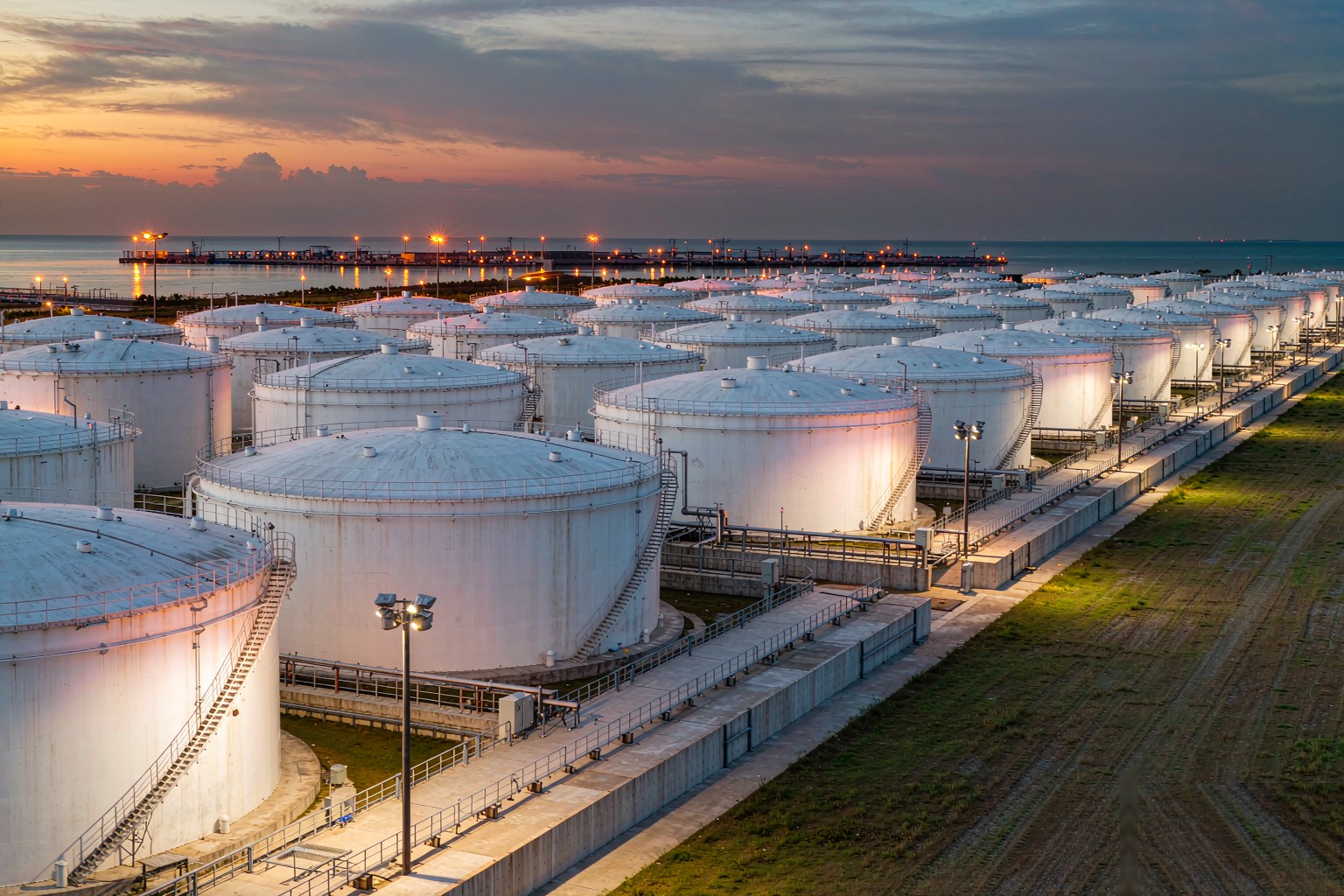
Matching format to duty
Once the zone, the gas group and the ambient range are fixed, the remaining choice is the physical format, and in a refinery the geometry of the area usually decides it. A rack that is walked twice a shift asks a different question from a tank roof that is visited once a year, and the mounting arrangement answers it.
- Long, thin, continuous planes. Pipe racks, pump rows, tank perimeters and access ways are continuous runs rather than discrete points. A linear format gives the required uniformity with fewer fittings and less glare than a row of floodlights, and the LU Series LED linear luminaire covers those runs for Zone 2 duty; the LO series serves the same duty where a pendant or Zone 1 position applies.
- Concentrated high points. Tank roofs, loading areas, rack extremities and open process areas need throw rather than line light, and a floodlight format carries the output. The FL8 Series explosion-proof floodlight is specified for that duty, and the FL7 Series where the point sits inside Zone 1.
- Canopy and shelter positions. Loading gantries, metering skids under canopy and shelter positions are served by a compact canopy format, matched to the zone and the mounting height at each point.
Formats and mounting at a glance
The table below maps the common refinery positions to the format that usually carries them. It is a starting point for a bill of materials — the zone, the gas group and the certified ambient at each mounting point decide the final marking.
| Position in the plant | Format that usually carries it | Zone coverage | Typical mounting |
|---|---|---|---|
| Pipe racks, pump rows, tank perimeters | Linear luminaire | Zone 2 (Ex nR); pendant types where Zone 1 applies | Rack rail, soffit or bracket |
| Tank roofs, loading points, rack extremities | Floodlight | Zone 2 (Ex nR); Ex db types for Zone 1 points | Pole, high mast or tank top |
| Loading gantries, metering skids | Canopy fitting | Matched to the point from the drawing | Canopy ceiling |
| Turnaround and maintenance positions | Portable or task light | Task-dependent, confirmed per unit | Local arrangement |
All formats ship with the IECEx and ATEX evidence set out below; the certificate that applies is the one listed against the specific type, not inferred from the series name.
What we provide
The manufacturer's side of the technical file is what we hold and what we hand over. Every number below is stated as issued, and the certificate for a given type is the one listed against that type.
| Document | Number | Issued by / covers |
|---|---|---|
| ATEX Type Examination Certificate | CSANe 25 ATEX 1229X | CSA Group (Netherlands notified body) — LO series |
| IECEx Certificate of Conformity | IECEx CSA 25.0093X | CSA Group — LO series |
| ATEX Quality Assurance Notification (QAN) | CSANe 26 ATEX M076 | CSA Group Netherlands — LO series |
| IECEx Quality Assessment Report (QAR) | GB/CSAE/QAR26.0002/00 | CSA Group (UK) — LO series |
| ATEX Type Examination Certificates | TÜV CY 26 ATEX 0207611 / 0207612 / 0207613 X | TÜV (Cyprus); correspond to the FL8, GS and LU series |
In practice we supply the IECEx test reports, the IECEx Certificates of Conformity, the IECEx QAR, the ATEX certificates and the quality assurance notification — the technical evidence a project needs in order to assess the equipment — together with installation manuals and the parameter set below.
What we need from you to quote
For a quote and lead time, please provide: the area-classification drawing (Zone 0/1/2 or 20/21/22, gas group, temperature class); the site ambient temperature range and the mounting height; the required illuminance and uniformity for each task; the mounting arrangement (pole, rack rail, tank top, canopy or bracket); the supply voltage and frequency; and the project node and required arrival time. With those we can match the protection concept, the certified ambient range and the format to the duty, and return a bill of materials rather than a single catalogue item.
Frequently asked questions
What ambient temperature rating do refinery projects in the Gulf require?
Refinery and terminal sites in the Gulf are routinely specified well above the 40 °C temperate default, and shaded process areas run hotter still. What matters is the Ta range the equipment is certified for, read together with the T-rating — a T6 rating at 40 °C may not hold at the site's real ambient. We confirm the certified Ta range per type before quoting and state where derating applies.
Which zones do refinery process units normally fall under?
Inside a dense process unit the classification is rarely uniform: pump rows, sample points and fired-heater areas can be Zone 1 while the surrounding structure is Zone 2, often within metres of each other. That split decides the protection concept — Ex db for the Zone 1 points and Ex nR for the Zone 2 areas, with Ex tb where dust classification applies. Final selection is always made against the project's own area-classification drawing.
How do you match a luminaire to a gas group in hydroprocessing?
Hydroprocessing and hydrocracking service can carry hydrogen and reach IIC, while most other hydrocarbon streams are IIA or IIB. For IIC duty the equipment's certification must cover IIC specifically, and a IIB rating cannot be extended by catalogue description. We match group by group off the area drawing and confirm the certificate against the type ordered.
What luminaire format suits tank farms and loading terminals?
Tank perimeters, access ways and loading gantry runs are long and thin, so a linear format gives the required uniformity with fewer fittings and less glare than a row of floodlights. Discrete high points such as tank roofs and the loading point itself need throw rather than line light, so a floodlight format is the right tool. Most terminal projects end up using both.
Do you supply emergency and exit versions for process units?
Yes — emergency and exit luminaires for hazardous areas are part of the range, and the same zone, ambient and gas-group logic applies. Where a project specifies a maintained emergency function or a defined escape-route illuminance for a process unit, the certification basis and the lead time are confirmed with the quotation. Where a unit needs a marking outside the standard range, the type and its certificate are confirmed against the drawing before the quotation is issued.
- About Us
- Products
- Explosion proof light
- Portable explosion proof lighting
- Explosion proof emergency light
- Explosion proof LED T8 tube
- Explosion proof Junction Box
- Explosion proof street light
- Service
- FAQ
- Docs download
Service hotline
Tel:+86 755 29846615
Work time:9:00-20:00
E-mail:sales02@seekingled.com
address:5F, Building 5, Guole Science and Technology Park, Lirong Road, Dalang Street, Longhua, Shenzhen, China