

LED Explosion Proof Lights: Wattage, Lumens and What Actually Matters
In the HID era, wattage was a reasonable proxy for brightness: a 400W metal halide was a 400W metal halide. With LED that link is broken — two explosion proof LED flood lights with the same 150W on the label can differ by 40% in the light they actually deliver on the ground. This guide sets out what to compare instead, with real replacement data from our own certified range, and the one comparison that matters more than any of the numbers: buying the right protection concept for your zone.
- Why wattage stopped meaning anything
- Lumens, lux and what to actually specify
- HID and fluorescent to LED: real replacement data
- What the explosion proof enclosure does to the light
- Heat: the real lifetime limit
- Temperature class is not a wattage question
- The comparison that matters more than lumens: FL7 vs FL8
- The LED lineup at a glance
- FAQ
Why Wattage Stopped Meaning Anything
Wattage measures electricity consumed, not light produced. The ratio between the two — efficacy, in lumens per watt — is now the variable that separates a good LED explosion proof light from a mediocre one. HID lamps delivered roughly 60–100 lumens per watt at the fixture level once you accounted for the ballast and the reflector. LED sources range from about 100 to over 160 lumens per watt, and the difference between the two ends of that range is a 60% swing in the lighting installation you end up with.
The practical consequence: a 150W LED flood light from one manufacturer can out-deliver a 200W LED flood light from another. Quoting "we need 200W flood lights" to a supplier therefore specifies the electricity bill, not the lighting result. The better specification is the maintained lux level you need over the task area — the supplier's job is to hit it with the fewest watts that also survive the environment.
Lumens, Lux and What to Actually Specify
Three terms, three different things, and datasheets often blur them:
| Term | What it measures | What to do with it |
|---|---|---|
| Lumens (lm) | Total light output of the luminaire | Compare products; but only if measured at the luminaire, not the LED chip |
| Efficacy (lm/W) | Lumens delivered per watt consumed | The honest efficiency number — ask for it at luminaire level |
| Lux (lx) | Lumens arriving on each square metre of the task area | The number your lighting calculation actually needs (e.g. 150–200 lx on a pump deck) |
When comparing two explosion proof LED lights, the question that gets a real answer from a real manufacturer is: "what is the delivered luminaire output and the efficacy of this model, and what mounting height and spacing achieves my target lux?" The answer should come with IES or LDT photometric files so your own engineer can verify it rather than trust it.
HID and Fluorescent to LED: Real Replacement Data
These are the replacement ratios we publish for our own certified range — the wattage of LED that replaces the legacy lamp at equivalent or better installed light:
| Legacy lamp | LED replacement | Model | Notes |
|---|---|---|---|
| 400W metal halide flood light | 200W LED | FL7 flood | 50% energy saving, certified for Zone 1 and 2 |
| 250W HID flood light | 150W LED | FL8 flood | Zone 2 and 22; 40% less energy |
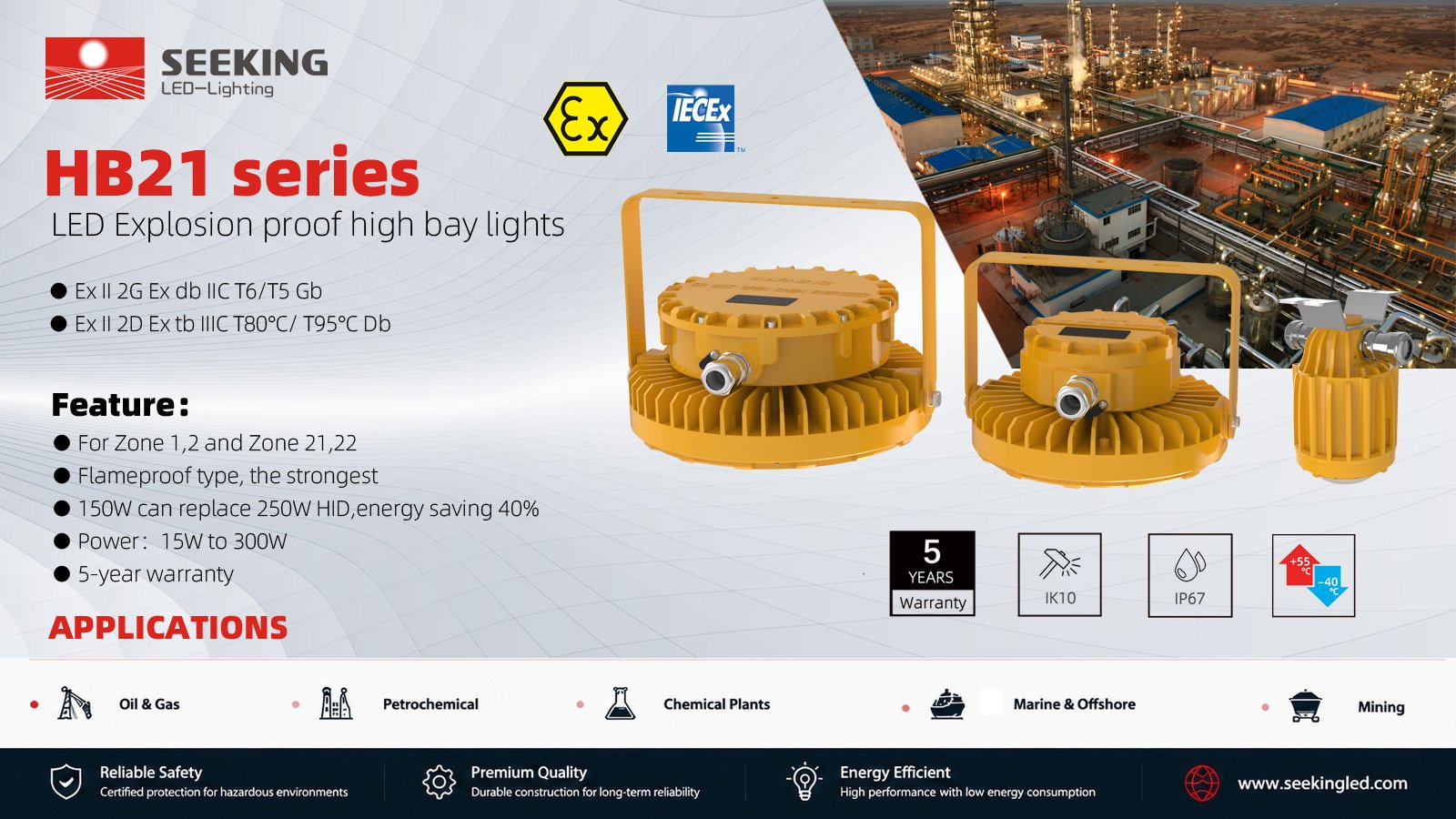
| 250W HID high bay | 150W LED (22,000 lm) | HB21 high bay | About 147 lm/W at the luminaire, Zone 1 rated |
| 2 × 18W fluorescent tubes | 20W LED | Bay 51 linear | One-for-one conversion on legacy linear fittings |
| 18W fluorescent tube | 9W LED tube | BT8 T8 tube | 50% saving, drops into G13 sockets |
Two observations worth taking away. First, the saving is consistently 40–50% — that is the realistic band for like-for-like LED replacement, and anyone promising 70%+ on a like-for-like swap is usually also cutting the delivered light. Second, the replacement ratios above only hold because the LED fittings deliver their light through a designed optic; a bare "wattage match" onto a random fitting will not reproduce it.
What the Explosion Proof Enclosure Does to the Light
An explosion proof enclosure is not optically neutral. In a flameproof (Ex db) fitting, the light leaves through a thick, certified front lens, and every internal surface absorbs something before it gets there. That is why the number that matters is the luminaire-level output, measured with the enclosure on — not the LED module's rating on the chip datasheet, which can be 20–30% higher than what exits the fitting.
This is also why the fixture design matters as much as the LED: reflector geometry, lens material and the spacing between the light source and the lens decide how much of the generated light reaches the ground. When a datasheet quotes efficacy, check whether it is declared for the luminaire. If the document does not say, ask — the difference is not small.
Heat: The Real Lifetime Limit
LEDs do not usually fail suddenly; they fade. Lifetime is expressed as L-values — L80B20 means the light holds at least 80% of its initial output for the stated hours, with 20% of the batch allowed to fall below. Our high bay, flood and linear families are rated L80B20 above 100,000 hours at 25 °C (the BT8 tube, 50,000 hours).
The number that governs whether you see that lifetime is the temperature the fitting actually experiences. Our range is rated for ambient temperatures of -20 °C to +55 °C. For installations in the Gulf, site ambient near the luminaire can approach that ceiling on a rooftop or above a process unit — so thermal path design (the housing acting as a heat sink, not a sealed box) is what keeps the electronics inside their limits. In a flameproof enclosure, where the electronics sit inside a sealed, thick-walled housing, the thermal engineering is harder than in an open industrial fitting, which is exactly where cheap designs cut corners.
Temperature Class Is Not a Wattage Question
A common and dangerous assumption: "more watts means hotter, so a T6 rating must be a low-wattage light." Not so. The temperature class (T1 to T6, with T6 the strictest at 85 °C maximum surface temperature) is certified for the complete design — housing, heat sinking, driver, LED load. The same housing family can carry T6 at one wattage and T5 at a higher one; that is why our flood light markings read T6/T5 across the power range, not a single letter.
The practical rule: never derive the temperature class from the wattage. Read it from the Ex marking of the specific model and power step you are buying, and match it to the auto-ignition temperature of the gases present in your area. Our guide to reading and verifying Ex certification covers how the marking encodes this.
The Comparison That Matters More Than Lumens: FL7 vs FL8
Here is the trap that wastes more money than any efficiency difference: buying a Zone 2 light for a Zone 1 area. Our two flood light families use the same LED technology, but they exist because the zones are different:
| FL7 flood | FL8 flood | |
|---|---|---|
| Certified zones | Zone 1, 2 (gas) and 21, 22 (dust) | Zone 2 (gas) and 22 (dust) |
| Ex marking | II 2G Ex db IIB T6/T5 Gb | II 3G Ex nR IIC T5/T6 Gc |
| Protection concept | Flameproof — contains an internal explosion | Restricted breathing — sealed so gas cannot enter |
| Power range | 60W – 400W | 50W – 300W |
| Dust marking | II 2D Ex tb IIIC T80/T95 °C Db | II 3D Ex tc IIIC T80/T95 °C Dc |
| Where it belongs | Process areas where gas can be present in normal operation | Areas where gas is present only abnormally — tank perimeters, pumping stations, workshops |
Notice something that surprises many buyers: the Zone 2 fitting is rated IIC while the Zone 1 fitting is IIB. Gas group and zone are independent axes — the restricted-breathing concept happens to be certified for the more severe gas group. That does not make the FL8 usable in Zone 1: the zone is determined by the protection concept (Gb vs Gc), not by the gas group. A lighting calculation can fix a lux shortfall; only reclassification or the right fitting can fix a zone violation.
The LED Lineup at a Glance
| Model | Type | Zones | Ex marking | Power range |
|---|---|---|---|---|
| HB21 | High bay | 1, 2 / 21, 22 | Ex db IIC T6/T5 Gb | 15W – 300W |
| FL7 | Flood / street | 1, 2 / 21, 22 | Ex db IIB T6/T5 Gb | 60W – 400W (flood) |
| Bay 51 | Linear / pendant | 1, 2 / 21, 22 | Ex db eb mb IIC T6/T5 Gb | 18W – 60W |
| LO | Linear / pendant | 1, 2 / 21, 22 | Ex db IIB T6 Gb | 20W – 80W |
| FL8 | Flood / street / portable | 2 / 22 | Ex nR IIC T5/T6 Gc | 50W – 300W |
| LU | Linear | 2 / 22 | Ex nR IIC T6 Gc | 40W – 150W |
| GS | Canopy (gas station) | 2 / 22 | Ex nR IIC T5/T6 Gc | 100W – 200W |
| BT8 | T8 tube (G13) | 1, 2 | Ex d e IIB T6 Gb | 9W – 28W |
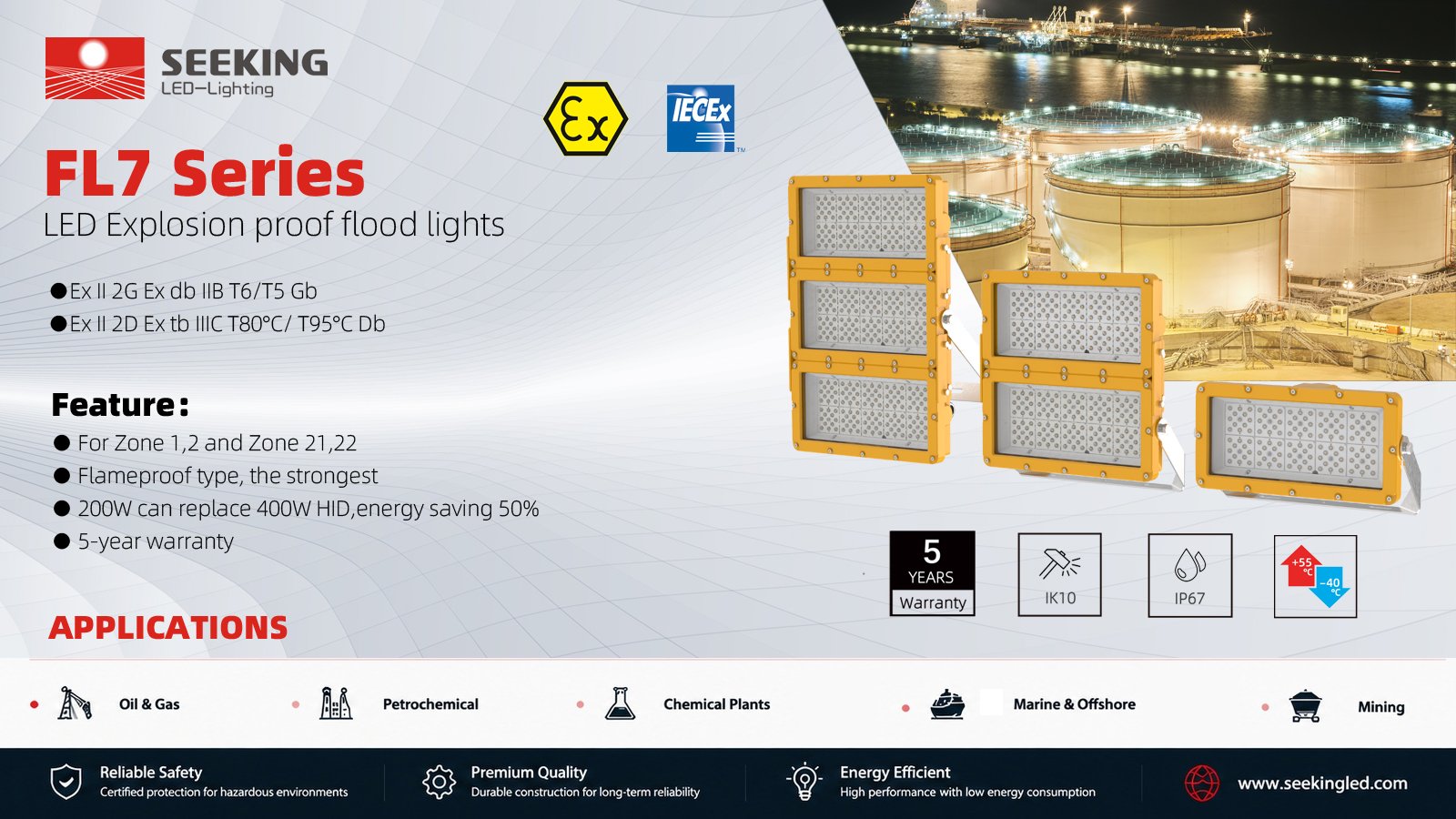
Across the range the environment ratings are consistent: IP67 and IK10 (the BT8 tube is IP33 with IK10), C4 corrosion protection per ISO 12944 for coastal and chemical atmospheres, and 100–277 V input. Where a project needs a different CCT, 3000K and 4000K are available across the families as options.
FAQ
How many lumens does a 150W explosion proof LED light produce?
It depends on the design, which is exactly why the wattage is not a specification. For reference, our HB21 high bay at 150W delivers 22,000 lumens — about 147 lm/W at the luminaire. Compare products on delivered luminaire lumens and efficacy, not on input power.
What wattage LED replaces a 400W metal halide flood light?
In our range, the 200W FL7 flood light replaces a 400W HID floodlight at equivalent installed light — a 50% energy saving, with the fitting certified for Zone 1, 2 and 21, 22. For a 250W HID, the equivalent is the 150W FL8 in Zone 2 areas.
Is a higher-efficacy LED always better in a hazardous area?
Higher efficacy is good, but never at the cost of the certified parameters. A fitting with a slightly lower efficacy but the correct temperature class, gas group, IP67 sealing and C4 corrosion protection is the better purchase. Efficiency differences of 10–15% matter less than a wrongly certified fitting.
Can I use a Zone 2 LED explosion proof light in Zone 1?
No. Zone 2 equipment carries the Gc protection level, which is not permitted in Zone 1. If your area classification says Zone 1, you need equipment marked with the Gb level (such as our Ex db families). Our Zone 1 vs Zone 2 guide explains the boundary and the cost difference.
Do explosion proof LED lights need maintenance?
Far less than HID — no lamp changes, no ballast replacements. What remains is periodic cleaning of the front lens (dust film can cost a surprising amount of delivered light), inspection of cable glands, and checking that the nameplate and installation remain unmodified. The L80B20 rating above 100,000 hours describes the LED's output retention, not a service-free guarantee for the whole installation.
What ambient temperature range do your LED explosion proof lights cover?
-20 °C to +55 °C across the range. Outside that window — cold stores, desert rooftops — tell us before ordering so we can confirm the right configuration rather than assume the standard rating applies.
Have the lux target but not the fitting?
Send us the area type, the mounting height and the target lux. We will come back with the model, the wattage step and the photometric file — and tell you honestly if the answer is a lower wattage than you asked for.
Email: sales02@seekingled.com
Tel: +86 755 2984 6615
WhatsApp: +8613418600102
- About Us
- Products
- Explosion proof light
- Portable explosion proof lighting
- Explosion proof emergency light
- Explosion proof LED T8 tube
- Explosion proof Junction Box
- Explosion proof street light
- Service
- FAQ
- Docs download
Service hotline
Tel:+86 755 29846615
Work time:9:00-20:00
E-mail:sales02@seekingled.com
address:5F, Building 5, Guole Science and Technology Park, Lirong Road, Dalang Street, Longhua, Shenzhen, China