

Explosion Proof Light Fixtures: The Complete Type Guide
Search for an explosion proof light fixture and you get product pages before you get an explanation. But "fixture" is not one product — it is a family of enclosures engineered around different tasks: washing a tank farm with a floodlight, lighting a workbench with a linear fitting, marking an escape route with a certified exit sign. Picking the wrong type is a more expensive mistake than picking the wrong brand, because a fixture that is the wrong shape for the task gets replaced at the buyer's cost. This guide walks through every fixture type used in hazardous areas, what each is for, and which zone each can legally serve.
The Fixture Types, One by One
Flood lights
The workhorse for wide, outdoor or high-mounted areas: tank farms, loading bays, perimeter lighting, rig floors. Flood lights are defined by beam angle and power more than by shape — a narrow beam reaches across a storage area, a wide one covers a work apron. Our FL7 covers Zone 1 (flameproof Ex db, 60–400W); the FL8 covers Zone 2 (restricted breathing Ex nR, 50–300W) at a lower cost.
High bay lights
Mounted high (typically above 6 m) over production halls, warehouses in classified areas and process buildings. The design question is delivering controlled light from a great height without glare, in a housing that survives dust and washdown. Our HB21 is a flameproof high bay (Ex db IIC — the most severe gas group) spanning 15–300W, with the 150W step delivering 22,000 lumens.
Linear and pendant lights
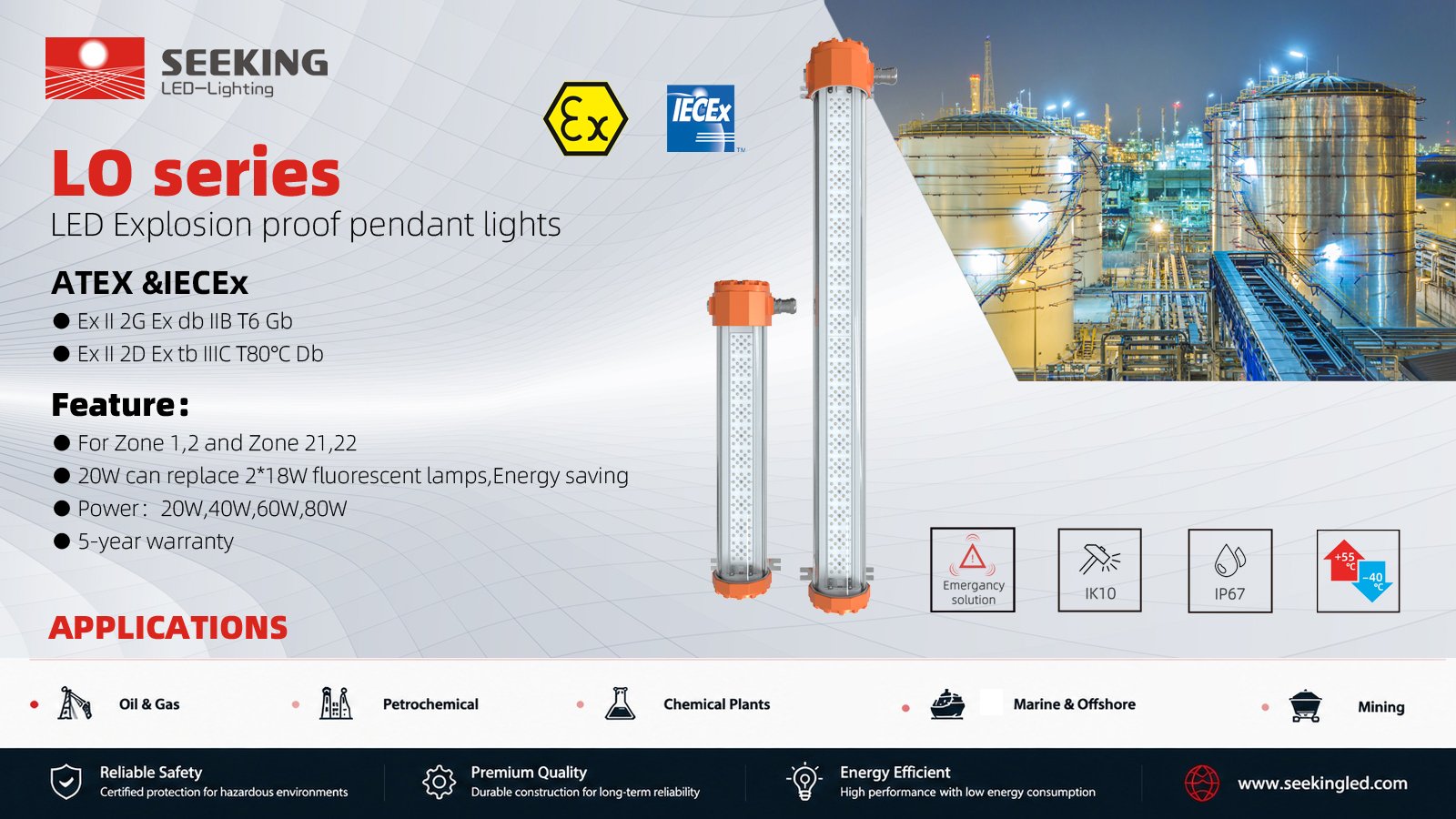
The everyday fittings of a plant: along walkways, above pumps, over workbenches, in workshops. Linear fixtures replace fluorescent battens one-for-one and carry the highest day-to-day count in most plants. Our LO series (Ex db IIB, 20–80W) is the flameproof option; the Bay 51 series (Ex db eb mb IIC) adds a triple-protection design with an optional 3-hour emergency supply; the LU series (Ex nR, 40–150W) is the Zone 2 workhorse.
Street and area lights
Roads inside refineries and petrochemical complexes, tanker access routes, plant perimeters. The optical requirement differs from a flood light — a shaped road beam rather than a broad wash — which is why a street light is a distinct fixture type and not a flood light on a pole bracket. Both our FL7 (Zone 1) and FL8 (Zone 2) families have street variants.
Canopy lights
Recessed into fuel-dispenser canopies at petrol stations — a special case with its own constraints: limited depth, upward light control, and the Zone 2/22 classification created by the fuel vapour itself. Our GS series is designed for exactly this mounting, 100–200W with power-switchable steps to reduce the SKU count per site.
Portable work lights
Maintenance jobs, tank cleaning, shutdown work — lighting that moves. A portable Ex fixture is certified with its handling in mind (impact resistance, supply flexibility). Our FL8 portable (Zone 2/22) accepts battery supply on DC 24V; the HB21 portable covers Zone 1 work with a flameproof housing.
Emergency and exit lights
Escape routes inside classified areas need the same certified construction as the working lights, plus a battery. The BAJ52 is a flameproof emergency luminaire (2 × 3W / 2 × 4W, about 3 hours of backup); the BAYD82 is a certified illuminated exit sign with a visible distance beyond 25 m. Both are fittings buyers discover late in a project — worth ordering with the main batch.
T8 tubes
The retrofit path: a certified tube that drops into existing G13 sockets, converting legacy fluorescent installations without replacing the whole fitting. Our BT8 (Ex d e, Zone 1 and 2) does this at half the energy — 9W replaces an 18W fluorescent tube.
Master Table: Type, Task, Zone, Model
| Fixture type | Typical locations | Zones covered | Our series | Ex marking | Power |
|---|---|---|---|---|---|
| Flood light | Tank farms, loading bays, perimeters | 1, 2 / 21, 22 | FL7 | Ex db IIB T6/T5 Gb | 60–400W |
| Flood light | Tank perimeters, workshops, pumping stations | 2 / 22 | FL8 | Ex nR IIC T5/T6 Gc | 50–300W |
| High bay | Process halls, classified warehouses | 1, 2 / 21, 22 | HB21 | Ex db IIC T6/T5 Gb | 15–300W |
| Linear / pendant | Walkways, pump rows, workbenches | 1, 2 / 21, 22 | LO | Ex db IIB T6 Gb | 20–80W |
| Linear / pendant | Workshops, offshore modules | 1, 2 / 21, 22 | Bay 51 | Ex db eb mb IIC T6/T5 Gb | 18–60W |
| Linear | Zones 2/22 long runs | 2 / 22 | LU | Ex nR IIC T6 Gc | 40–150W |
| Street / area | Plant roads, tanker routes | 1, 2 / 21, 22 | FL7 street | Ex db IIB T6/T5 Gb | 60–100W |
| Street / area | Plant roads in Zone 2 | 2 / 22 | FL8 street | Ex nR IIC T5/T6 Gc | 50–200W |
| Canopy | Fuel-dispenser canopies | 2 / 22 | GS | Ex nR IIC T5/T6 Gc | 100–200W |
| Portable | Maintenance, shutdown work | 1, 2 / 21, 22 | HB21 portable | Ex db IIC T6 Gb | 15–40W |
| Portable | Zone 2 maintenance work | 2 / 22 | FL8 portable | Ex nR IIC T6 Gc | 50–100W |
| Emergency | Escape routes in classified areas | 1, 2 / 21, 22 | BAJ52 | Ex db IIB T6 Gb | 2×3W / 2×4W |
| Exit sign | Exits, stairways, corridors | 1, 2 / 21, 22 | BAYD82 | Ex db IIB T6 Gb | 6W |
| T8 tube | Retrofit into G13 sockets | 1, 2 | BT8 | Ex d e IIB T6 Gb | 9–28W |
Environment ratings are consistent across the range, so they can be specified once for a whole project:
| Rating | Value | Applies to |
|---|---|---|
| Ingress protection | IP67 | All families except the BT8 tube (IP33) |
| Impact resistance | IK10 (20 J) | All families |
| Corrosion protection | C4 (ISO 12944) | All families |
| Ambient temperature | -20 °C to +55 °C | All luminaires (BHD51 box: -60 to +60 °C) |
| Supply voltage | AC 100–277 V, 50/60 Hz | All families (portables also DC 24 V) |
| Colour temperature | 5700K ±250K standard | 3000K / 4000K optional across the range |
Protection Concepts Behind the Types
The fixture type answers "where does the light go". The Ex marking answers a different question — "what can this fitting survive". Two axes matter and they are independent:
| Axis | Options in our range | What it decides |
|---|---|---|
| Protection concept | Ex db (flameproof) vs Ex nR (restricted breathing) | Zone: db fits Zone 1 and 2; nR fits Zone 2 only |
| Gas group | IIB vs IIC | Which gases: IIC covers hydrogen and acetylene; IIB covers most hydrocarbons like propane |
| Temperature class | T5 / T6 | The hottest surface the fitting can reach vs the auto-ignition temperature of the gas |
| Dust protection | Ex tb (Db) vs Ex tc (Dc) | Zone 21 vs Zone 22 dust areas |
A frequent surprise: our Zone 2 families (FL8, LU, GS) are rated IIC while the Zone 1 FL7 flood is IIB. The gas group does not imply the zone — the protection level (Gb vs Gc) does. When comparing fixtures between suppliers, align the markings character by character rather than trusting a "Zone 2 rated" label.
Fixtures and the Wiring System Around Them
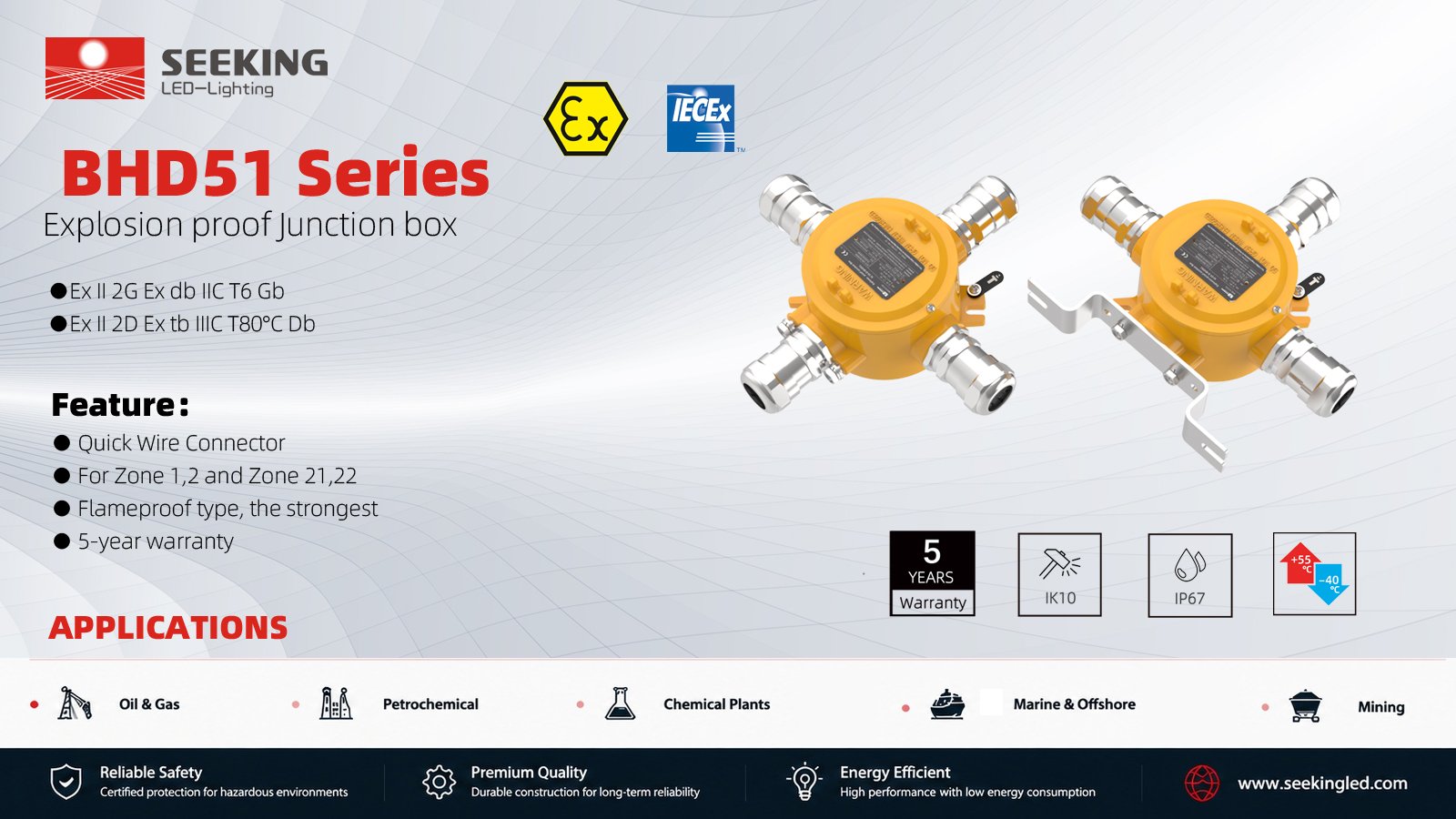
Luminaires are only part of an Ex installation. The wiring between them lives in certified enclosures too — our BHD51 flameproof junction box (Ex db IIC, up to 800 V and 32 A) exists because in Zone 1 even a wiring joint must be contained. When planning a project, count the junction boxes at the same time as the fixtures: they are the fittings most often discovered missing on site.
How to Read a Fixture Nameplate
Every certified fixture carries a nameplate that is its legal identity. Before accepting a shipment, check four things on it:
- Ex marking — identical to the certificate, character for character;
- Certificate number — present and verifiable in the issuing body's register;
- Manufacturer — the entity holding the certificate;
- Ambient and temperature class — matching the environment you are installing into.
Our guide to reading and verifying ATEX certification decodes the marking format in detail, including what the "X" suffix on a certificate number changes.
Choosing Between Two Certified Fixtures
When two fixtures are both certified for your zone, the decision usually comes down to three things, in this order:
- The photometry. Delivered lumens and the beam shape for your mounting height — request IES/LDT files and run the calculation.
- The mechanical fit. Mounting interface, cable entries (our fittings ship with an M20 or M25 nickel-plated brass gland and a matching plug), weight, and whether maintenance access exists at that location.
- The commercial terms that survive the project. Lead time, spares availability for years, and the documentation set. A fixture is a 10–15 year commitment; the cheapest quote rarely survives that arithmetic.
FAQ
What is the difference between an explosion proof light and an explosion proof light fixture?
In practice, none — "fixture" and "luminaire" describe the same complete certified unit: housing, light source, driver and terminals as one certified assembly. The term matters mainly in documentation, where a certificate covers the complete fixture, not the LED module or driver separately.
Which fixture type do I need for a Zone 1 area?
One marked with the Gb protection level — in our range that means the Ex db flameproof families: FL7 (flood and street), HB21 (high bay), LO and Bay 51 (linear), BAJ52 (emergency) or the HB21 portable. A Zone 2 fitting (Gc, such as FL8 or LU) is not permitted in Zone 1.
Can a high bay replace a flood light at the same wattage?
Not reliably. They are optically different: a high bay throws controlled light downward from above, a flood light washes a vertical or horizontal plane from a distance. Swapping them usually means re-running the lighting calculation — the wattage being equal does not make the installation equivalent.
Do I need a certified junction box if the light fittings are certified?
Yes, wherever wiring joints or circuit splits occur inside the classified area. The certification of the luminaire does not extend to the connection box feeding it. In Zone 1 the junction box must be at least Ex db (or Ex e if your area classification and local practice allow) — our BHD51 is the flameproof option.
Are LED explosion proof fixtures available with emergency backup?
Selectively. The Bay 51 linear offers an optional built-in 3-hour emergency supply at 5W, and the BAJ52 and BAYD82 are dedicated emergency and exit fittings with backup built in. Most flood and high bay families accept an external emergency power kit instead — worth deciding before ordering, not after.
What is the most commonly mis-ordered explosion proof fixture?
The Zone 2 flood light ordered for a Zone 1 area — usually because the quote arrived before the area classification did. The second most common is the junction box forgotten until installation week. Both are avoided by running the pre-order checklist before the purchase order, not after.
Not sure which fixture type fits your area?
Send us the area description — zone, gas group, dimensions and mounting — and we will answer with the fixture type, the model and the photometric file, including the fittings (junction boxes, glands) the installation will actually need.
Email: sales02@seekingled.com
Tel: +86 755 2984 6615
WhatsApp: +8613418600102
- About Us
- Products
- Explosion proof light
- Portable explosion proof lighting
- Explosion proof emergency light
- Explosion proof LED T8 tube
- Explosion proof Junction Box
- Explosion proof street light
- Service
- FAQ
- Docs download
Service hotline
Tel:+86 755 29846615
Work time:9:00-20:00
E-mail:sales02@seekingled.com
address:5F, Building 5, Guole Science and Technology Park, Lirong Road, Dalang Street, Longhua, Shenzhen, China