

Spark Proof vs Explosion Proof: What "Spark Proof" Really Means
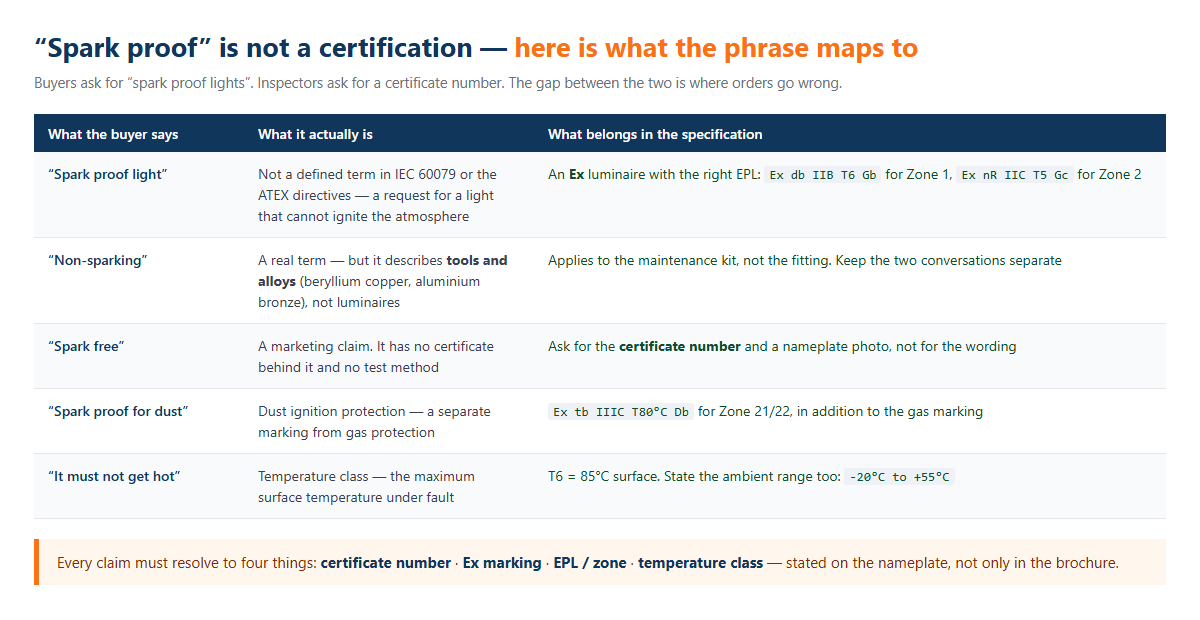
Almost every week an enquiry lands in our inbox asking for “spark proof lights”. We understand what the buyer means — a light that cannot set the atmosphere on fire — but the phrase is not a term from IEC 60079 or the ATEX directives. It appears on no certificate, in no Ex marking, in no inspector's checklist. What it stands in for is a set of precise choices: a protection concept, an equipment protection level, a gas or dust group, and a temperature class. This guide separates the real meaning of “spark proof” from the informal one, and shows how to phrase the requirement so a certifier will recognise it and an inspector will accept it.
Where “spark proof” is real — and where it is not
The word spark sits in two completely different conversations, and mixing them up is how bad specifications get written. In one, “non-sparking” describes tools and alloys: wrenches, shovels and scrapers made from beryllium copper or aluminium bronze, specified because a steel tool striking rusty steel can produce a mechanically generated spark. In the other, “spark proof lighting” is a buyer's shorthand for a luminaire that will not ignite a flammable atmosphere — and that requirement is written in a different language entirely: the Ex marking and its certificate. Table 1 puts the terms side by side; only the rows backed by a standard belong in a purchase order.
| Term | Where it belongs | What it actually means |
|---|---|---|
| “Spark proof light” | Informal request — not in IEC 60079 or ATEX | Shorthand for an Ex luminaire. No certificate, marking or test method carries this phrase |
| Non-sparking tools | Real — maintenance practice | Tools of Cu–Be, Al–bronze or similar alloys that will not produce friction or impact sparks against steel |
| Explosion proof | Market umbrella term | Covers several protection concepts (Ex d, Ex e, Ex nR…). “Flameproof” (Ex d) is the defined standard term for an enclosure that contains an internal explosion |
| “Spark free” | Brochure wording | A claim with no standard behind it. Always respond by asking for the certificate number |
| Spark-free / non-sparking area | Facility rule | An operator's zone rule that all equipment and tools inside must be ignition-source assessed — which brings you straight back to Ex certification |
A spark is one ignition source among many
It helps to see why the phrase does not survive contact with the standards. EN 1127-1, the ignition-risk standard behind the ATEX directives, lists thirteen ignition sources — from hot surfaces and mechanically generated sparks to static electricity, optical radiation and adiabatic compression. A luminaire has to be engineered against the ones that apply to it, and a “spark proof” label would only ever cover one of them.
For a light fitting, the sources that matter most are the five in Table 2 — and each is answered by a different engineering decision that ends up visible in the Ex marking.
| Ignition source | How a certified fitting deals with it | Where it shows up in the marking |
|---|---|---|
| Hot surfaces | Thermal design keeps the enclosure surface below the ignition temperature of the gas, under fault conditions | Temperature class: T6 (85 °C) or T5 (100 °C), stated with the ambient range |
| Sparks and arcs inside the enclosure | An Ex d flameproof enclosure withstands an internal ignition and cools escaping gases in its flameproof joints; Ex e design eliminates them | Ex db, Ex eb |
| Ignition inside a normally sealed enclosure | Restricted-breathing construction is sealed so tightly that flammable gas cannot enter in sufficient quantity | Ex nR |
| Static electricity | Earthing provisions and anti-static materials per IEC 60079-0; plastic parts limited in size or made dissipative | Not visible — but covered by the certificate's type examination |
| Mechanically generated sparks (impact, abrasion) | Light alloys kept off impact surfaces or protected; flamepath joints specified so housings are not rubbed against steel | Assessed in the type examination; relevant when the housing is aluminium |
The last row is where “spark proof” thinking is genuinely useful: an aluminium housing dragged across rusty steel is a recognised spark risk. Certified luminaires handle it at design level, as part of the type examination. Specifying an uncertified fitting and asking the electrician to be careful is not.
The four protection concepts behind the request
When a buyer says “spark proof”, one of four protection concepts is almost always the real requirement — and the zone decides which: Zone 1 needs an EPL of Gb, Zone 2 accepts Gc, and a dust area needs the separate Ex t marking on top of the gas marking.
| Concept | How it works | EPL / zone | Typical luminaires in our range |
|---|---|---|---|
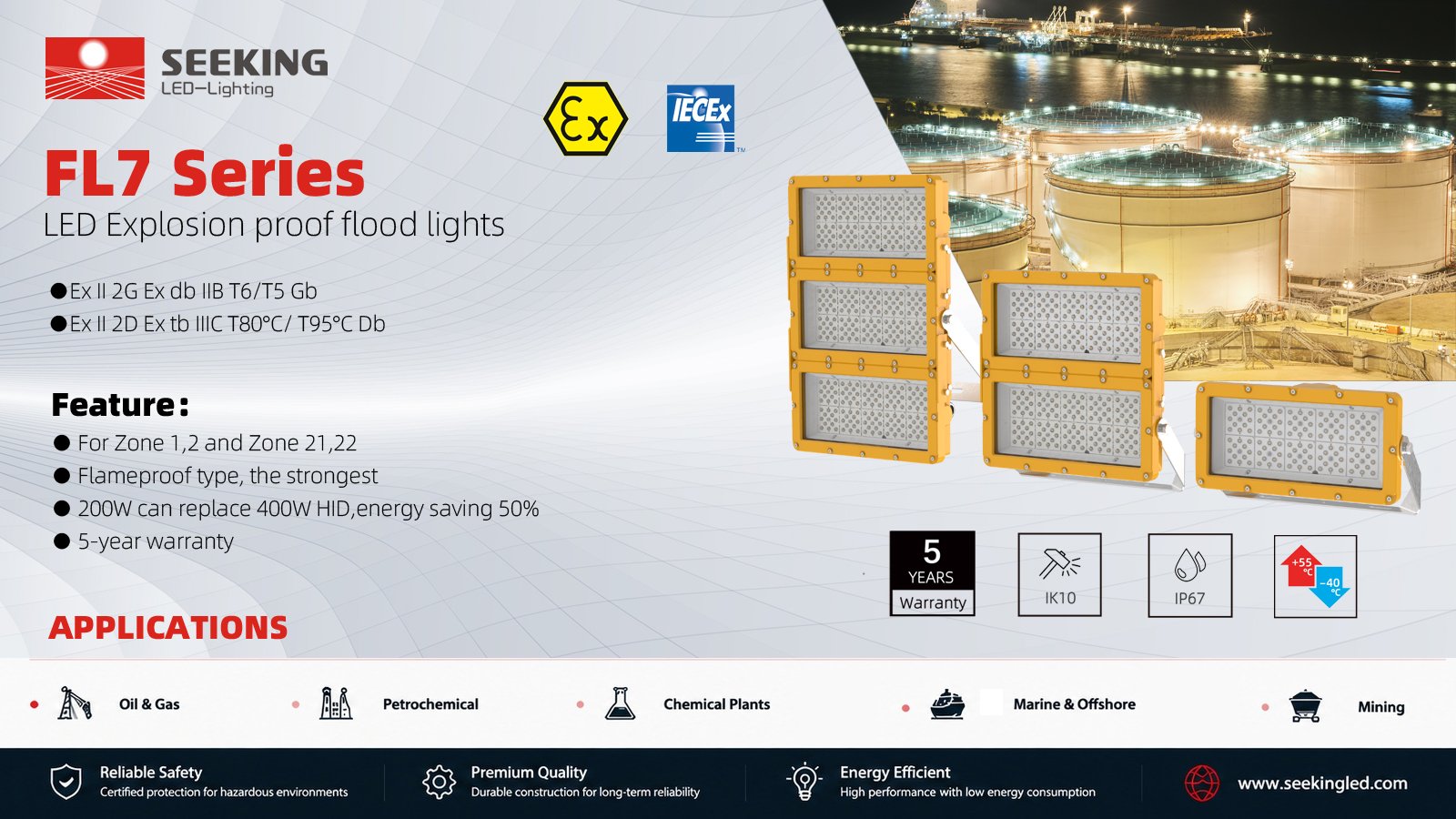
| Ex d flameproof | The enclosure withstands an internal explosion and prevents its propagation through precisely machined flameproof joints | Gb — Zone 1 and 2 | FL7 Ex db IIB T6/T5 Gb flood lights; HB21 Ex db IIC T6/T5 Gb high bays (IIC covers hydrogen) |
| Ex e increased safety | Design removes sparks and arcs: oversized terminals, controlled creepage and clearance, robust mechanical strength | Gb — Zone 1 and 2 | Usually combined inside one marking, e.g. Bay 51 pendants: Ex db eb mb IIC T6/T5 Gb |
| Ex nR restricted breathing | The enclosure is sealed so that flammable gas cannot enter in ignitable quantity in normal operation | Gc — Zone 2 | LU Ex nR IIC T6 Gc linear lights; GS canopy lights for forecourts |
| Ex t dust protection | Enclosure excludes combustible dust and limits surface temperature; IP6X-type sealing is part of the marking (Ex tb / tc) | Db / Dc — Zone 21 / 22 | Zone 1 fittings carry the dust line, e.g. Ex tb IIIC T80 °C Db; the Zone 2 range carries Ex tc IIIC T80 °C Dc |
Translating the phrase into a purchase order
Most disputes about “spark proof” equipment end the moment both sides agree to write the requirement in certificate language. Table 4 is the translation we use in replies to enquiries — copy the right row straight into the RFQ.
| If the requirement says… | Write instead | Evidence to demand from the supplier |
|---|---|---|
| “Spark proof lights for the pump area” (Zone 1) | Ex luminaire, EPL Gb minimum, gas group IIB or IIC, T6: e.g. Ex db IIB T6 Gb | ATEX and IECEx certificate numbers; for Ex d, the manufacturer's QAN (production quality assurance) |
| “Spark free lighting for the tank farm” (Zone 2) | EPL Gc: e.g. Ex nR IIC T6/T5 Gc — a real certificate example is TÜV CY 26 ATEX 0207611 X | Certificate copy with the model number on it, plus a nameplate photo |
| “Spark proof for the dust collection area” (Zone 21/22) | Dust marking in its own right: Ex tb IIIC T80 °C Db | The dust line of the certificate, and the IP rating as marked |
| “Non-sparking lighting” | Clarify first: the fitting needs an Ex marking; the tools are a separate alloy specification | — |
One habit worth building: ask every supplier to print the certificate number with the model number on it and photograph the nameplate of the actual unit. A certificate that cannot be tied to the quoted model is not evidence, and it will not survive an inspection.
Four traps that turn the order into a problem
1. Treating an IP rating as ignition protection. IP65 stops dust and water. It says nothing about hot surfaces, sparks or enclosures that must contain an explosion. A fitting can be IP67 and uncertified, and it is the certificate that counts in a hazardous area, not the gasket.
2. Accepting “spark free” as a specification. If a quotation uses the phrase, reply with one question: what is the certificate number, and what Ex marking is on the nameplate? Suppliers who answer fluently are safe to work with; suppliers who answer with more adjectives are not.
3. Assuming non-sparking tools make any fitting acceptable. A Cu–Be wrench does not downgrade the zone. Where a certified luminaire is required, the requirement is on the equipment, and the permit-to-work covers the tools — the two controls never substitute for each other.
4. Buying on price alone for a Zone 1 area. Ex d fittings carry flameproof joints that need correct closing and periodic inspection (IEC 60079-17). The cheapest quote is usually the one that has not costed that maintenance — or the one whose certificates will not check out. Our buyer's guide covers the verification flow.
FAQ
Is “spark proof” the same as explosion proof?
No. “Explosion proof” is the market umbrella term; in IEC and ATEX language a fitting carries a defined protection concept (Ex d, Ex e, Ex nR, Ex i), plus an equipment protection level and a temperature class. “Spark proof” appears in none of the standards. Treat it as shorthand, then ask which zone and gas group the area is.
Can I use a normal IP65 LED light in a Zone 2 area if it is described as spark free?
No. Zone 2 requires Ex equipment with an EPL of Gc at minimum — for example Ex nR IIC T6 Gc — and a certificate from a recognised body. IP65 addresses ingress only. Our Zone 1 vs Zone 2 guide explains how the boundary changes the equipment class.
We already use non-sparking tools. Is that enough for the lighting?
No. Non-sparking tools reduce ignition risk during mechanical work; they do not make an uncertified luminaire legal in a hazardous area. The fitting itself must carry the Ex marking for the zone.
What wording on the certificate proves a fitting is safe for my area?
Four items: the Ex marking (protection concept + group + temperature class), the equipment protection level (Gb, Gc, Db, Dc), the ambient range, and a certificate number traceable to the issuing body. For Ex d equipment, also ask for the QAN, which proves the manufacturer's production quality system.
Is Ex d always the better choice over Ex nR for Zone 2?
Not necessarily. Ex d is required in Zone 1; in a genuine Zone 2 area a restricted-breathing fitting (Ex nR) is fully compliant, lighter, cheaper and avoids flamepath maintenance entirely. Over-specifying wastes budget; under-specifying creates a compliance failure. Decide from the area classification drawing, not from habit. Our protection concepts comparison walks through the trade-offs.
Send us the phrase — we will translate it
Send the requirement exactly as given, plus the zone and gas group if you have them, and we will reply with the correct Ex marking, the compliant models from our ATEX & IECEx certified range, and the certificate numbers attached.
Email: sales02@seekingled.com
Tel: +86 755 2984 6615
WhatsApp: +8613418600102
- About Us
- Products
- Explosion proof light
- Portable explosion proof lighting
- Explosion proof emergency light
- Explosion proof LED T8 tube
- Explosion proof Junction Box
- Explosion proof street light
- Service
- FAQ
- Docs download
Service hotline
Tel:+86 755 29846615
Work time:9:00-20:00
E-mail:sales02@seekingled.com
address:5F, Building 5, Guole Science and Technology Park, Lirong Road, Dalang Street, Longhua, Shenzhen, China